








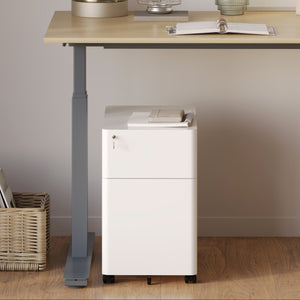






















Filing Cabinet Choices for Cleaner Workstation Planning
Cleaner workstation planning starts with filing storage that matches the desk, document volume, security needs, and daily workflow. Explore how cab...
Learn more

Visit quiz page to see how we makes it easy to create an inspiring workplace


Workspaces today are built around constant device interaction. Power is no longer something accessed occasionally but something relied on throughout the day. Laptops, monitors, phones, tablets, lighting, and accessories all demand dependable access that does not interrupt focus or compromise desk layout.
In-desk power outlets emerged as a response to these realities. Instead of forcing cables across floors or under desks, desk-integrated power places electricity exactly where work happens. This supports cleaner layouts, safer cable routing, and desks that function as complete systems rather than furniture paired with loose accessories.
Power located at desk height removes friction from everyday tasks. Devices can be connected and disconnected without bending or repositioning furniture. Charging becomes intentional rather than reactive. Over time, these small efficiencies shape how organized, comfortable, and productive a workspace feels.
An in-desk power outlet refers to any power solution designed to live on or within the desk itself. Some are installed through the desktop with precise cutouts. Others mount to the desk edge or underside without permanent modification. The defining characteristic is accessibility, organized power where work actually takes place.
Not all desk power systems are built the same. Structural differences influence installation, flexibility, and long-term suitability.
Integrated systems are installed directly into the desktop surface, creating a flush or semi-flush appearance. These solutions are typically chosen for desks intended to remain in one configuration. When installed correctly, they feel like a natural part of the furniture rather than an add-on.
This category works best when desk material, thickness, and layout are known in advance, as installation is permanent.
Surface-mounted solutions attach to the desk without cutting into the surface. They are secured using clamps or brackets and can be repositioned or removed entirely. These systems suit evolving workspaces, temporary offices, or situations where modifying the desk is not ideal.
A practical example is a clamp-mounted desk power outlet, which provides accessible power while preserving the desk surface and allowing future layout changes.
Desk power units are available in several formats. Flush-mounted designs emphasize clean surfaces. Pop-up units conceal outlets when not in use, offering protection from spills. Flip-top designs balance accessibility and coverage. The best choice depends on how visible power should be and how the desk is used daily.
Beyond physical design, the type of ports determines how effectively a desk power system supports modern devices.
Traditional AC outlets remain essential for monitors, desktop computers, and lighting. These outlets handle higher loads than USB ports and form the backbone of most desk power setups.
USB-A and USB-C ports allow phones, tablets, and accessories to charge without external adapters. These ports reduce clutter and improve convenience, especially for devices that are frequently picked up and set down.
Wireless charging surfaces add convenience for compatible devices but are best treated as secondary features. Wired connections remain more reliable for consistent, daily use.
Accessible power must also be dependable and safe. Understanding core electrical principles helps set realistic expectations.
Each desk power system is designed to support a defined total electrical load. This accounts for all connected devices operating at once. Most office equipment falls within safe ranges, but awareness helps prevent overuse.
Certified desk power solutions meet established electrical safety standards. These certifications indicate that components are suitable for everyday use in office environments and help protect both users and devices.
Plug-in systems connect to existing outlets and are common in residential and light commercial spaces. Hardwired systems integrate directly into a building’s electrical infrastructure and are typically used in fixed commercial installations. The right choice depends on how permanent the workspace is intended to be.
The desk itself determines which power solutions are appropriate.
Solid wood, veneer, laminate, and composite desktops behave differently when modified. Thickness affects whether integrated systems can be installed securely. Thinner desktops may be better suited for surface-mounted options.
Integrated desk power relies on accurate cutouts. Poorly sized openings can weaken the desk or prevent proper seating of the power unit. Careful planning preserves both function and structure.
Height-adjustable desks introduce movement that static desks do not. Power systems must accommodate vertical travel without stressing cables. Selecting compatible height-adjustable desks early helps avoid retrofitting challenges later.
Power access without cable control often leads to clutter and strain. Effective desk setups treat cable management as a core requirement.
Unmanaged cables can snag, tangle, and pull against connectors. Over time, this affects reliability and safety. Organized routing protects cables and maintains a clean workspace.
Many devices rely on bulky adapters that need a secure place beneath the desk. A dedicated under-desk cable management tray provides structure for securing adapters and excess cords while keeping the area clear.
Adjustable desks require cables to move smoothly as the desk changes height. A vertical cable management spine guides cables in a controlled path, maintaining slack and preventing strain throughout the full range of motion.
Power placement should support natural movement rather than interrupt it.
Frequently used outlets should fall within easy reach without awkward bending or stretching. Thoughtful placement reduces physical strain during long workdays.
Laptop-based workflows often involve multiple connections competing for limited desk space. Pairing desk power with an adjustable laptop stand elevates the screen, frees surface area, and supports a more balanced posture.
Desk power should feel cohesive with the workspace rather than visually disruptive.
Power units are available in finishes designed to complement common desk materials. Matching tones and textures helps maintain a unified look.
Some environments benefit from visible power access for convenience, while others prioritize minimalism. Selecting the right design aligns functionality with the intended workspace aesthetic.
Multi-user settings introduce considerations beyond individual desks.
Conference tables and collaborative desks require evenly spaced power access to avoid crowding and cable overlap. Thoughtful planning supports smoother collaboration.
Seeing desk power integrated into complete environments provides clarity beyond specifications alone. Experiencing layouts through a workspace furniture showroom experience helps inform decisions about scale, placement, and interaction.
Certain missteps consistently undermine desk power performance.
Choosing a power system without accounting for desk construction can lead to poor fit or compromised durability.
Adding power without planning cable routing often creates new problems. Cable management should be planned alongside power selection.
Workspaces evolve. Selecting adaptable power solutions helps accommodate future devices without redesigning the entire setup.
Some environments benefit from power solutions designed as part of the desk itself.
Professionals who rely on multiple devices throughout the day often prefer power access that feels permanent and intentional. Integrated systems reduce daily setup friction and support consistent workflows.
A dedicated in-desk power module is designed specifically for desktop integration, balancing accessibility, form, and durability while supporting clean, organized work surfaces.
A well-designed desk power setup balances accessibility, safety, ergonomics, and adaptability. By considering desk structure, power configuration, cable management, and placement together, power becomes a natural extension of the workspace rather than a separate concern.
Thoughtful planning ensures that in-desk power outlets support how people work today while remaining flexible enough for future needs.


You have unlocked free shipping!
You're saving $29 and unlocked free shipping!
Leave a comment