








Can a Bistro Table Replace a Desk in a Minimalist Workspace?
A bistro table can work beautifully in a minimalist workspace when the setup is laptop-first, visually restrained, and designed for flexibili...
Learn more
Visit quiz page to see how we makes it easy to create an inspiring workplace


A small room does not automatically require a small desk. What usually causes frustration is choosing a desk width based on how tight the space looks, then trying to force a dual monitor plus laptop setup onto a surface that never had enough working span in the first place. At Urbanica, we design workstations to feel calm and functional, and the most reliable way to get there is to measure what you work with every day and then match the desk to that reality.
Monitor size is marketed by diagonal, but your desk cares about left-to-right width. Two screens that are “only 27 inches” can still consume most of a 48-inch desk once you account for bezels and the space between panels.
A practical habit: measure the monitor’s edge-to-edge width with a tape measure, or look up the width in the product specs, then add a small buffer for the gap between screens. That gap matters because you rarely run two monitors perfectly flush without losing comfortable tilt.
Monitor stands often use wide bases that steal the exact area you need for the keyboard, mouse, notebook, and phone. Monitor arms typically reclaim surface area because the clamp sits at the rear edge, and the “legs” disappear. The trade-off is clamp clearance and edge thickness compatibility, plus the need for stable mounting.
An open laptop is not just its chassis width. The open-angle posture creates an “occupied zone” because you need airflow, room for your hands, and clearance for cables. In tight setups, this is why the laptop often works better on a stand or docked closed, rather than living flat on the desk all day.
Even in a small room, a desk has to support neutral shoulders. When the keyboard is squeezed between monitor stands and the mouse has no lateral range, you start compensating through wrist angle and shoulder lift. That is a comfort problem, but it is also a productivity problem because micro-adjustments never stop.
A simple rule of thumb: plan for a keyboard zone plus a consistent mouse lane that does not force the mouse to operate in a tiny pocket.
Many setups technically fit but fail in daily use. You want enough front working span to type with forearms supported and still have a place for a quick note, a coffee, or a phone without stacking items on top of each other.
Use this as a starting point, then adjust based on whether you run the laptop open, the monitors on arms, or one screen in portrait.
Quick measurement steps
Measure both monitor widths edge-to-edge.
Add a small gap between monitors for tilt and cable clearance.
Decide where the laptop lives: open on desk, on a stand, or docked closed.
Add buffer on both sides so your keyboard and mouse do not feel trapped.
If you prefer an even faster approach, mock it on the wall with painter’s tape or on the floor with cardboard. The goal is not precision to the millimeter. The goal is to prevent a desk from becoming a bottleneck.
Most small-room workstations fall into two “safe” widths: a compact width that requires discipline and a comfort width that supports daily work without constant compromises.
A 48-inch desk can support two monitors and a laptop, but the layout choice matters. The most reliable compact approach is to reclaim surface area with monitor arms and to reduce laptop sprawl with a stand or docking.
The mouse lane becomes narrow
Notebook space disappears
Speakers fight for corners
Monitor stands consume the center zone
If you need two larger monitors side-by-side plus an open laptop on the surface, 48 inches often becomes a daily friction point.
A 60-inch desk is often the difference between “I can make this work” and “this feels like a workstation.” The extra width supports a centered dual-monitor viewing line plus a laptop station that does not invade the keyboard zone.
When we talk about small rooms, width is only part of the story. A 60-inch desk can still fit a compact footprint if the room has a longer wall and you plan circulation intentionally.
Depth determines viewing distance. If depth is too shallow, you end up placing monitors right at the edge, which forces your eyes and neck to work harder. Depth also affects whether a monitor arm clamp can sit properly without colliding with wall trim or cable raceways.
A deeper desk can make a smaller width feel more usable because it gives you space to set monitors back and keep the front edge clear for hands and tools.
Your layout is your strongest lever. The same room and desk width can feel cramped or effortless based on how you position the screens and what role the laptop plays.
Side-by-side is intuitive and great for tasks that rely on horizontal scanning, such as comparing documents, referencing dashboards, or keeping communication visible while working. It is also the most width-hungry arrangement.
If you choose side-by-side in a small room, prioritize keeping the primary viewing line centered. When the midpoint between screens drifts away from your body’s center, your neck rotates more than you realize.
Portrait orientation is a powerful small-room tactic because it reduces total left-to-right span without reducing the amount of information you can keep visible. It works especially well for reading, writing, code, chat threads, and long documents.
A practical placement: keep the landscape monitor centered as the primary display, then place the portrait monitor on the side that matches your dominant “reference” behavior. If you constantly glance right for reference, put portrait on the right and keep the left side cleaner for mouse movement.
Stacking saves width, but it raises the importance of height and tilt. The top monitor should tilt slightly downward so your neck stays neutral. In small rooms, stacking can be the difference between a 48-inch desk feeling usable versus feeling like a puzzle.
Stacking is also a good option when your desk cannot get wider, but your workflow demands two full-size displays.
If the laptop is open as a third screen, plan for it as a station rather than as “something that sits wherever it fits.” A stand can push the laptop upward and backward, opening space for your hands. Docked closed-laptop mode can free significant width instantly, but it requires a keyboard and mouse you like.
The key is to choose one role for the laptop and build around it. Floating between modes tends to create clutter because you keep both layouts half-ready.
The easiest way to make a desk feel wider is not always to buy a wider desk. It is often to stop wasting the inches you already have.
Monitor bases are typically centered, and that is where your keyboard wants to be. They also block the most flexible area for notebooks and devices. If your setup feels tight, look at what occupies the front middle of the desk. That is usually the bottleneck.
Arms can reclaim usable surface, but only if they are placed well. The clamp should not force monitors too far forward, and the screens should not drift out of alignment after adjustments. Arms also benefit from thoughtful cable routing so the back edge does not become a tangle that pushes the desk away from the wall.
In a small room, cables become visual clutter quickly. A simple principle we use: route cables toward a single exit path, then manage slack so you can still adjust screens. Avoid letting cables cross your working area. The desk should feel like a surface, not a cable tray.
The room feels smaller when circulation is blocked, even if the desk technically fits.
Wall length at baseboard height, not just at shoulder height
Door swing and closet clearance
Chair pull-back distance for sitting down and standing up
Outlet and cord paths that do not cross walkways
A small room workstation should allow you to enter, sit, and leave without turning sideways. If circulation is tight, consider pushing the desk fully against the wall and managing cables so the back edge can sit flush. The desk can be wider than you think if it does not protrude into the walking path.
Corners can help when the room has awkward wall lengths, but they can also reduce usable width if the desk’s corners become dead zones. Flat-wall placement often wins for dual monitors because you can keep a clean centerline and manage glare more predictably.
Desk width gets the attention, but surface design often decides whether the setup feels easy.
A comfortable front edge helps long work sessions. At the same time, monitor arms need a suitable rear edge for clamping. If you plan to use arms, confirm you have a clean rear edge and enough clearance between the back of the desk and the wall.
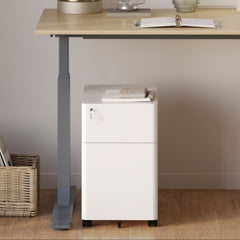
Drawers, panels, and crossbars can block your legs or force your chair farther back, which changes your reach to the keyboard and mouse. In small rooms, that shift can make the entire setup feel cramped. If storage is required, it should support the workflow, not compromise posture.
A sit-stand desk can work beautifully in small rooms, but it benefits from careful planning because movement changes cable needs and stability requirements.
Two monitors increase leverage. If screens are on arms, small vibrations become more noticeable during height changes. Stability comes from a solid frame, good placement, and keeping weight balanced so the desk does not feel top-heavy.
Leave enough slack for the full range of motion, and avoid routing cables so tightly that they pull when you stand. A quick test: raise the desk to standing height and gently move each screen. If cables tug, reroute before it becomes a daily annoyance.
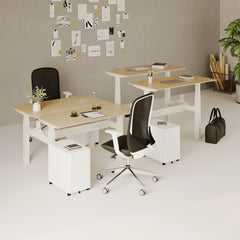
If you want a sit-stand surface that supports dual monitors and a laptop without overfilling the room, look for size options that align with the widths discussed above. Our Standing Desk in 48" x 30" and 60" x 30" sizes is built around those practical footprints, making it easier to match the desk to the layout you plan to run.
The goal is not perfection. The goal is a repeatable layout that keeps your centerline, your mouse lane, and your daily tools consistent.
Best when you use monitor arms or a narrow-stand approach, and when the laptop is docked or elevated.
Center the primary monitor directly in front of your chair
Place the second monitor in portrait to reduce width
Keep the laptop on a stand to reclaim front-edge space
Reserve one corner for small essentials only, not a pile
If you want a fixed-height desk footprint in this range, our Office Desk in 48" x 24" x 30" and 60" x 30" x 30" sizes gives you a compact option and a step-up width without changing the overall design language.
This is where dual 27-inch monitors become more comfortable and the laptop can live as a side station without disrupting the main viewing line.
Keep both monitors centered as a pair
Position the laptop to the side as a secondary station
Maintain a clear front zone for keyboard and mouse
Use depth to set screens back for better viewing distance
| Desk width class | Typical dual-monitor layout fit | Laptop placement that works | What to prioritize | Common compromise |
|---|---|---|---|---|
| 48-inch class | Two smaller monitors, or one portrait plus one landscape | Docked closed or elevated on a stand | Clear mouse lane and centerline | Less notebook and speaker space |
| 60-inch class | Two mid-size monitors side-by-side, or portrait mix | Side station or elevated | Comfortable spacing and cable routing | Requires thoughtful placement in very tight rooms |
| Wider on a long wall | Dual monitors plus accessories with breathing room | Side station or docked | Keeping circulation clear | Room planning matters more than desk itself |
At Urbanica, we see the same pattern repeatedly: people pick desks by aesthetics first, then try to force their equipment into the remaining space. A better approach is to pick by footprint and layout, then choose the style that fits your room.
Our desks and tables collection makes it easier to compare footprints and forms in one place, especially when you are deciding between compact widths and more comfortable work surfaces.
If two people share a room, a paired desk can reduce clutter because cables and equipment can be planned as a system instead of two separate stations. Our Two-Person Standing Desk with a 59" x 47" work surface is designed for that shared footprint, helping two users maintain dedicated work zones without duplicating furniture.
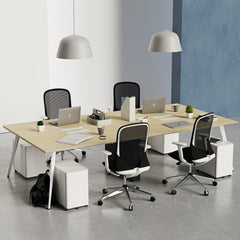
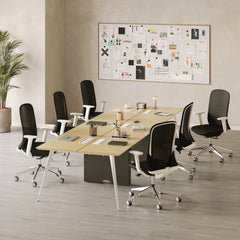
For environments where four users need a defined workstation layout, a multi-user surface can keep pathways clean while supporting consistent positioning. Our Quad Workstation Desk with 95" x 48" x 30" and 118" x 60" x 30" options is built around that structured setup, which can be useful when space planning needs predictable station boundaries.
A desk can be the right width and still feel wrong if the chair cannot tuck in, swivel comfortably, or match the desk height.
In small rooms, chair arms often collide with desk edges or force the chair to sit farther back. That changes your reach and makes the desk feel smaller. A chair that tucks cleanly under the desk keeps circulation open and preserves your working posture.
Hard floors, rugs, and tight clearance can make chair movement either smooth or frustrating. The best option depends on your floor and how often you transition between sitting and standing. The important part is planning movement, not just seat comfort.
If the chair does not adjust into a range that supports neutral forearms, the setup becomes tiring even if the desk is perfectly sized. Our office chair selection includes ergonomic seating designed for daily work, which helps align the desk width decision with a posture-friendly sitting position.
Confidence comes from eliminating surprises, especially in tight spaces where a few inches can matter.
Use these checks before ordering any desk for a dual-monitor plus laptop setup:
1. Measure wall length where the desk will actually sit, including baseboards.
2. Map door swing and closet clearance so the desk does not block access.
3. Confirm chair pull-back distance so you can sit down and stand up easily.
4. Identify outlet locations and plan a cable path that stays off the walkway.
5. If possible, mock the desk width with tape so you can see circulation.
When you want help planning a small-room workstation, the most useful information often lives on location-specific pages that include guidance, FAQs, and support context. If you are looking for that kind of detail, our workspace planning FAQs and online support details page is a practical reference without requiring a showroom visit.
A desk width decision becomes easy when you treat it as part of a system: layout, depth, circulation, and posture. The most successful small-room setups share three traits.
Your primary screen should sit in front of your body’s center, not off to the side. If dual monitors are used equally, keep the seam between them aligned with your centerline. This reduces neck rotation and makes the desk feel more organized.
A cramped mouse lane is the most common reason a dual-monitor desk feels frustrating. When you plan width, make sure the mouse has a consistent zone that is not interrupted by stands, notebooks, or laptop edges.
If your room is tight, the most effective improvements are often layout-based: a monitor arm that clears surface space, an elevated laptop station that opens the front zone, and cable routing that reduces visual noise. When those are solved, choosing the right desk width becomes a straightforward match to your wall and circulation, not a guess based on how small the room looks.


You have unlocked free shipping!
You're saving $29 and unlocked free shipping!
Leave a comment