











What Makes a Desk Truly Modular for Hybrid Work

Hybrid work turns one desk into multiple work scenes across the same week
The hybrid rhythm creates fast context switches that furniture has to absorb
Hybrid work rarely follows a single pattern for long. Some days are laptop-only, built around quick tasks between meetings. Other days demand deep focus with a full monitor setup, proper posture, and a quieter environment. There are also crossover days when someone comes home from the office and needs a ready workspace without spending mental energy re-plugging, clearing, and re-arranging.
A desk becomes the place where these modes either flow or collide. When the surface is always fighting the workflow, friction shows up as clutter, constant repositioning, and a setup that never feels “done.” That is the moment many people assume they need a bigger desk or a nicer one. The real need is often modularity, meaning the desk can change with the week without requiring a reset from scratch.
To see the range of desk types and workstation formats that people typically evaluate when they start thinking in systems, the office desks and workstations collection is a helpful snapshot of how different layouts solve different hybrid scenarios.
Friction is the hybrid-work problem that shows up before discomfort
Ergonomics matter, but friction usually arrives first. Friction is the daily tax of hybrid work: cords that tangle, peripherals that have nowhere to live, a camera that is always too low, and a laptop that shifts the entire setup off-center. Hybrid work makes that tax feel heavier because you keep switching context.
A truly modular desk reduces friction in three ways:
-
It can accept new tools without becoming messy or unstable.
-
It can be reconfigured without turning into a weekend project.
-
It can scale from one person to shared use without forcing compromises.
These are not “premium features.” They are practical qualities that keep a workspace honest, calm, and repeatable as work patterns change.
Modular means reconfigurable and expandable without forcing a full restart
A modular desk is a system that can be recombined, not a surface you hope will work
The cleanest way to define modular is simple: a modular desk is built to accept change. That change might be a second monitor, a different room layout, a new job role, or a household shift where one desk needs to support two people.
A desk can look modern and still be non-modular if it only works in one configuration. Similarly, a desk can be adjustable and still be non-modular if it changes in one dimension while everything else becomes inconvenient. Modularity is not about novelty. It is about a system that stays coherent while it evolves.
The four non-negotiables that separate modular from merely flexible
Interchangeability makes upgrades feel normal
Interchangeability means components can be swapped without replacing the entire desk. That could include changing a top size, re-orienting a layout, or adjusting how the workspace is organized while keeping the core stable.
Expandability keeps the desk relevant as your work footprint grows
Expandability means the desk can gain surface area or support additional use without becoming awkward. Hybrid work often expands over time. People add a docking setup, improve their video call position, or need a dedicated area for notes and planning. A desk that cannot expand turns every improvement into a compromise.
Reconfigurability is about realistic change, not one-time assembly
Reconfigurability means layouts can shift as the week shifts. In practice, it should be possible to change how the desk is used without dismantling the setup or losing your cable routing and organization.
Serviceability protects long-term trust
Serviceability means parts can be replaced or refreshed. Hybrid work can be hard on furniture because the desk is used intensely and often. A modular approach supports longevity because the system is easier to maintain over time.
Modular vs adjustable vs convertible, and why the words get mixed up
-
Adjustable desks typically change one variable, often height. That can be valuable, but it does not guarantee easy reconfiguration.
-
Convertible desks can switch modes, but may require tradeoffs like reduced stability, limited mounting, or awkward cable solutions.
-
Modular desks support multiple configurations through a stable core and compatibility with growth.
For hybrid work, adjustability can be part of modularity, but it is not the definition of it.
The modular desk blueprint is built from layers that can evolve together
The structural layer decides what is possible later
The frame is the foundation for everything else. If a desk flexes, shifts, or feels uncertain under real use, add-ons become frustrating. A stable base makes modularity practical because it keeps the workspace predictable.
The worksurface layer supports zoning, not just “more space”
A surface is modular when it supports distinct zones that match real tasks. Hybrid work is a mix of deep focus, communication, and transitions. Zoning gives each mode a place to land.
The vertical layer protects posture and video presence
Hybrid work is camera-forward. When the vertical layout is ignored, people hunch, crane their neck, or place the laptop in ways that compromise both posture and professional presence. A modular approach plans for the vertical plane instead of forcing people to improvise with books and unstable stacks.
The infrastructure layer is cable paths and power access that survive reconfiguration
Cable management is often treated like a cosmetic detail. For modular hybrid work, it is infrastructure. A desk that hides cables but cannot move them when the setup changes is not modular. A truly modular system keeps cables tidy and adaptable.
Structural modularity starts with stability under real-world loads and movements
Side-load stability is the stress test hybrid setups fail quietly
Hybrid setups introduce side-loads more than people expect. Monitor arms, corner placement, frequent typing, and leaning in during calls create lateral forces. If a desk is not stable under these conditions, every upgrade creates more wobble, not more capability.
Stability is also psychological. When a desk feels solid, people are more likely to maintain a consistent posture and leave their setup in a ready state. When it feels unstable, people avoid placing important tools where they should be, or they constantly re-position items to reduce movement.
Repeatable alignment is a modular feature even when it is not marketed
Hybrid work rewards repeatability. When someone returns from a commute day, the best desk is the one that feels instantly familiar. Repeatable alignment means the keyboard, screen, and primary tools return to the same “good” positions with minimal thought.
Repeatability comes from thoughtful proportions and a layout that supports zones. It also comes from a stable frame and practical cable routing. If cables are too short, too exposed, or routed in a way that assumes one permanent layout, the desk resists change.
Relocation modularity matters more than people realize
Hybrid work often changes rooms. A guest room becomes an office. A living room layout shifts. A small team moves offices. A modular desk system should tolerate relocation without losing coherence.
Relocation modularity is not about promising that something is effortless or instant. It is about designing a system that can be moved and re-set without turning into a complete reinvention of the workspace.
Worksurface modularity means zoning the surface to match hybrid tasks
The three-zone desktop map that supports hybrid work patterns
A modular desk surface is less about maximum width and more about how the space is organized. A practical hybrid zoning approach looks like this:
Primary work zone for focused production
This is where the keyboard and pointing device live, aligned with the primary screen. It should support long sessions with minimal strain and a consistent position.
Reference zone for thinking and context
This zone holds notes, a tablet, reference materials, or a secondary screen. It keeps context available without crowding the primary work zone.
Transition zone for hybrid life
Hybrid work includes arrival and departure routines. A transition zone supports charging, docking, and the daily items that come and go. When this zone is missing, those items drift into the primary work area and create clutter.
Depth and reach decide whether the desk stays usable all day
Many people prioritize width, but depth often determines comfort. Too little depth forces screens too close, reduces room for a camera position that feels natural, and compresses the primary work zone. A modular mindset treats depth as a functional requirement because it preserves flexibility in how the surface is zoned.
When a fixed-format desk is still a modular starting point
Not every hybrid setup needs a complex system on day one. Many people start by stabilizing their core workspace and building habits that keep the desk consistent. A fixed-format desk can be a practical foundation if it provides a reliable surface for zoning and infrastructure planning.
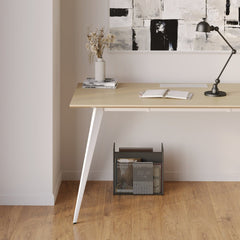
The Urbanica Office Desk fits naturally into this part of the conversation because it represents a straightforward desk format that can anchor a modular approach when the priorities are stability, repeatability, and a clean baseline setup.
Mode-switch modularity is sit and stand that stays consistent, not just height adjustment
Sit-stand modularity is measured by how cleanly the workflow resets
A standing desk can be helpful for hybrid work, but the real test is whether switching modes preserves the setup. If the transition requires moving cables, re-aiming a camera, or re-positioning the keyboard every time, the desk is forcing friction back into the day.
Mode-switch modularity means the desk supports two work modes while keeping the workspace coherent.
Repeatable ergonomics protect both comfort and professional presence
Hybrid work is often judged through a camera. A setup that places the camera too low can unintentionally change how someone is perceived. A modular system supports a stable camera height and screen position while allowing normal movement through the day.
Screen and input positions should not drift between modes
When a desk moves, the relationship between screen height, keyboard position, and posture should remain consistent. That is what makes switching realistic rather than aspirational.
Cable routing should tolerate motion without becoming messy
Cables should have a clear path that does not snag, pull, or sprawl when the desk changes height. This is a practical requirement for modularity because it keeps the setup reliable.
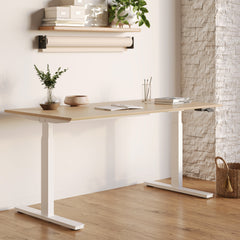
For teams and individuals who want sit and stand capability as a core component of their hybrid system, the Urbanica Standing Desk is the relevant reference point because it represents a dedicated standing desk format that is commonly used as the foundation for mode-switch workflows.
Micro-modularity for tight spaces and multi-use rooms
Hybrid work often happens in rooms that serve multiple purposes. In those environments, the best desk is not necessarily the largest. It is the one that can support a coherent workflow while fitting the space and allowing the room to function normally.
Compact desks can still be modular when they support zoning, stable placement, and practical cable and power habits. They also offer an upgrade path. Someone can start with a compact setup that fits their home and expand later if their work footprint grows.
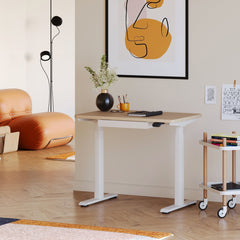
The Urbanica Mini Standing Desk is a meaningful example for this section because it aligns with small-space needs where the desk must support hybrid flexibility without taking over the room.
Shared hybrid work reveals whether modularity is real or only marketing language
Two-person configurations need defined zones and respectful separation
When two people share a workstation footprint, the challenge is not just space. It is ownership and repeatability. Shared setups fail when one person’s cables cross into the other’s area, when screens compete for attention, or when neither person can return to their preferred layout after stepping away.
A modular two-person setup works best when it supports:
-
Clear left and right work zones with predictable boundaries
-
Separate infrastructure logic, even if the desk shares a footprint
-
Layout consistency that avoids daily negotiation
The Two-Person Standing Desk belongs here because it directly corresponds to a shared workstation format designed for two users, making it the most semantically accurate internal reference for discussing dual-user hybrid work.
Team scaling turns modular desks into layout tools, not individual purchases
Hybrid teams often grow in waves. A new project adds people. A department reorganizes. A company shifts office attendance patterns. In these moments, furniture that can scale becomes a strategic advantage because it helps the space adapt without chaos.
Predictable workstation geometry makes collaboration and focus easier
When workstations follow a repeatable pattern, the office becomes easier to navigate. People can quickly orient themselves, set up devices, and maintain tidy cable paths. Predictability is part of modularity because it makes expansion coherent.
Mixed-mode offices need both focus and collaboration within the same footprint
Hybrid offices often need quiet, heads-down capacity and group collaboration capacity. A modular approach makes it easier to create clusters that support teamwork while still respecting individual work zones.
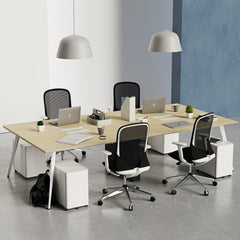
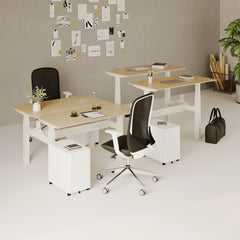
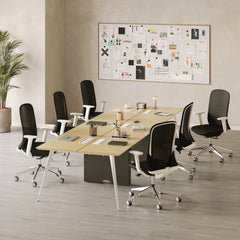
The Quad Workstation Desk is the appropriate reference for team scaling because it corresponds to a four-person workstation format and aligns directly with the idea of clustering workstations for shared use.
Infrastructure modularity is power access and cable paths that keep working after change
Modular cable management prioritizes movement, not hiding
Many people treat cable management as a final step. In a modular hybrid setup, cable strategy is a design input from the beginning. The goal is not to create a perfect photo-ready desk. The goal is to create a desk that remains tidy and functional when devices change position, when a laptop is removed for commuting, and when a second screen is added.
A safe, realistic infrastructure mindset focuses on:
-
Keeping cables routed in a way that tolerates reconfiguration
-
Reducing reliance on temporary fixes that fail under daily use
-
Ensuring that power access is convenient enough to support consistent habits
Power needs shift as hybrid work grows from laptop-only to multi-device
Hybrid work often starts simple and becomes more complex. A laptop becomes a laptop plus a monitor. Then it becomes a monitor plus a dock plus chargers plus a webcam or headset. The desk does not need to predict every future device, but it does need to support growth without turning into a tangled mess.
Infrastructure modularity is not a promise of a perfect setup for every scenario. It is a commitment to a system that stays dependable as needs evolve.
Hybrid routines that modular infrastructure supports without drama
A desk system proves itself in small moments.
The Monday reset after commute days
When a person returns home, they should be able to reconnect their laptop, restore their preferred layout, and get into focus mode quickly. A modular system supports that by keeping cables in predictable paths and leaving the desk organized enough that the reset feels natural.
Video-call readiness without clearing the desk
Hybrid work includes unplanned calls. A desk that supports a stable camera position, adequate screen distance, and an uncluttered primary zone keeps video calls from becoming a scramble.
A modularity scorecard helps choose desks for hybrid work without overpromising
Modularity scorecard table for real hybrid decision-making
The goal of this scorecard is not to label one desk type as universally best. Hybrid work is varied. The scorecard is designed to help someone decide what kind of desk system matches their real behavior and environment.
| Hybrid-Work Criterion | Fixed Desk | Standing Desk | Modular Desk System |
|---|---|---|---|
| Layout consistency across the week | Often strong if setup is stable | Strong if transitions are repeatable | Strong when components support repeatable reconfiguration |
| Reconfiguration effort when needs change | Can become limiting as tools increase | Can become complex if cables and layout drift | Designed to evolve without a full restart |
| Stability under real use and side-loads | Varies by build and setup | Varies by frame and usage habits | Prioritized to support add-ons and changes |
| Cable and power adaptability | Depends on planning and available routes | Must tolerate motion to stay tidy | Treated as infrastructure that survives change |
| Fit for shared or scaled setups | Limited without major changes | Useful for individuals, complex for shared | Built to scale across users and clusters |
| Longevity through serviceable components | Can be durable but less adaptable | Durable when maintained, depends on system | Designed to replace or update parts over time |
The 10-minute modular fit test for hybrid work
1. Map your weekly pattern: home days, office days, and mixed days.
2. List devices you use now and what you are likely to add.
3. Define your non-negotiable zones: focus, calls, planning, and transitions.
4. Identify the one layout change you will actually do weekly.
5. Decide whether stability under side-loads matters for your setup.
6. Choose a cable path that still works if a laptop leaves and returns daily.
7. Confirm how you will keep video-call positioning consistent.
8. Decide what should be replaceable: surface, accessories, or layout components.
9. Measure the room constraints that affect relocation and reorientation.
10. Choose a realistic growth path: improve the core first, then expand.
Workspace planning support matters when modular desks become a team or space decision
Modular workspaces often start as one desk and become a layout conversation
When someone begins improving a hybrid setup, it often looks like a single purchase. Once the setup evolves, it becomes a space plan. That shift is normal. Hybrid work forces people to consider traffic flow, power access, and how to keep a space tidy when it is used intensely.
From a brand perspective, this is where we see the difference between furniture that looks good on day one and furniture that keeps working when the team changes, the room changes, or the workflow changes. A modular mindset treats the desk as part of a system that has to remain stable under real use.
Signals that it is time to think in systems instead of single pieces
-
The workspace is being reconfigured often, not seasonally.
-
A second person uses the same space regularly.
-
Devices are multiplying and the setup is becoming fragile.
-
The office is shifting attendance patterns and needs flexible layouts.
When these signals show up, guidance and practical support become more valuable than hype. The goal is a workspace that works honestly, not one that promises unrealistic outcomes.
For those who want practical next steps around product exploration, delivery considerations, and support context, workspace delivery and showroom support details is the relevant page to consult.
Future-proof modularity is a phased approach that keeps hybrid work coherent
Phase-based modularity keeps the workspace calm while it grows
A modular desk for hybrid work does not need to be complex to be effective. It needs to be intentional.
Phase 1: Stabilize the core and define zones
Start with a stable surface and clear zones that match real tasks. This phase is about reducing friction and building repeatable habits.
Phase 2: Build infrastructure that survives change
Focus on cable paths and power access that tolerate commuting routines and device upgrades. This phase is about keeping the workspace dependable.
Phase 3: Expand into shared or scaled formats when the need is real
When a household begins sharing work time, or when a team needs workstation clusters, modularity becomes the strategy that protects the space from constant disruption. Expansion should be done when it is clearly required, not because a desk promises a perfect future.
The two-year test for a desk that claims to be modular
A desk is truly modular for hybrid work when it still feels coherent after life changes. That might mean a new role that changes your tools, a move to a new room, or a shift from solo work to shared use.
The most reliable signal is simple: the desk should adapt without forcing you to discard what you already built. Modularity is the ability to evolve the workspace honestly, step by step, while keeping it stable, organized, and ready for the way hybrid work actually happens.
Related Articles
-
 Desk Setup With Laptop and 2 Monitors Needs Better Height
-
 Desk Width Requirements for Dual Monitor Setups That Still Fit Small Rooms
-
 How Deep Should a Desk Be for 2 Monitors to Prevent Neck and Eye Strain
-
 Flexible Living: Why Modular Furniture Is Changing Modern Homes
-
 Where the Right Desk Design Makes Work Flow
-
 Computer desk for dual monitors that supports monitor arms without wobble


