










Better Guest Seating Ideas Around a Round Meeting Table
Better guest seating around a round meeting table starts with more than adding chairs. The right layout supports comfort, conversation, sight...
Learn more
Visit quiz page to see how we makes it easy to create an inspiring workplace


A dual-monitor setup looks perfectly calm—until you raise your desk. Standing height changes the physics. The higher the worksurface goes, the more leverage small forces have: a light bump, vigorous typing, even the spring tension in a monitor arm. Two displays amplify the effect because you’ve doubled the mass above the desk and often extended that mass farther forward (especially with arms). The result is familiar: screens that sway, drift out of alignment, or slowly migrate off-center until you’re constantly nudging them back.
Stability starts with the desk’s base and how it behaves when extended. A desk can feel rock-solid seated and still wobble when raised because the legs become a longer “column.” If the feet are short, the frame has flex, or the fasteners aren’t designed to resist torsion, the entire structure can twist slightly. That tiny twist becomes obvious when your screens sit on a long arm like a flag on a pole.
A practical way to think about this is center of mass. Two monitors mounted on arms shift weight forward and upward. The farther forward that weight sits, the more it “pulls” on the top when the desk moves. That pulling force doesn’t just create bounce; it also encourages the arms to creep, making the seam between your monitors stop lining up with your body. If you want screens that stay stable and centered, start with a base built for standing-height rigidity and a top that won’t flex under clamp pressure. An electric standing desk is typically the easiest path to dialed-in height and repeatable positioning, but the real win is choosing a model that remains stiff when fully extended.
Before anything else, do a standing-height stress test: raise the desk to your standing working height, place your hands near where a keyboard would sit, and lightly shift your weight as if you’re typing quickly. Watch the surface and imagine two monitors mounted at the back edge. If the desk oscillates for more than a brief moment, your arms and displays will exaggerate it. A stable dual-monitor setup doesn’t depend on one magic accessory; it depends on a solid platform that won’t transmit every movement into the screens.
“Centered” means more than aesthetically centered on the desk. It means centered on you. When dual monitors are off by even an inch or two, you end up micro-turning your head all day. That’s subtle enough to ignore in the moment, but by late afternoon it shows up as neck stiffness, shoulder tension, and that sense that you can’t quite settle into a comfortable posture.
The simplest rule: put the seam between the two monitors on your body’s midline—directly in front of your nose and sternum—unless one screen is clearly dominant (for example, design work on one display, chat/email on the other). For a truly balanced workflow, the seam-as-centerline approach keeps both screens equally reachable with small eye movements rather than neck rotation.
From there, lock in three variables:
Eye-line height: the top third of the screens should sit near eye level for most people. If you wear progressive lenses or look down more comfortably, lower the monitors slightly to reduce chin lift.
Distance: a common sweet spot is roughly an arm’s length. Too close, and you increase head movement; too far, and you lean forward and lose the “stacked spine” posture that sit-stand desks are meant to support.
Tilt and angle: angling each screen slightly inward helps your eyes track naturally across the two displays. If the monitors are flat and wide, you end up turning your head rather than scanning with your eyes.
If your monitors are different sizes, treat the primary screen as the anchor. Center that display on your midline and place the secondary screen slightly off to the side, angled more aggressively inward. The goal is to reduce neck rotation and keep the main viewing zone centered even if the desk itself shifts.
A big part of “visual lock” is matching heights precisely. If one monitor is even a few millimeters higher, your eyes will constantly re-accommodate across the seam, and you’ll feel like the screens never quite line up. Use the monitor arm adjustments to get the top edges level, then re-check after a day of work—arms can settle as tension equalizes.
When people shop desks for dual monitors, they often prioritize width: “I need a long desk.” Depth is usually the real deciding factor for stability and comfort. With two monitors, you want enough depth to keep screens at a healthy viewing distance while still leaving room for your keyboard, mouse, and forearms without crowding the front edge.
Here are the three measurements that decide whether your setup stays stable:
1. Depth (front to back): deeper tops let you position the monitors farther back without forcing your keyboard to the edge. That reduces reach and helps keep the monitors closer to the desk’s center of support.
2. Rear overhang or mounting zone: monitor arm clamps need clearance behind the desktop. If the back edge is tight to a wall or has a thick rear lip, you’ll fight for clamp space and end up mounting the arms in suboptimal positions.
3. Top thickness and rigidity: a flexible top can amplify bounce even if the base is excellent. Clamp pressure can also cause a thin top to deform slightly over time, which nudges arms out of alignment.
If you’re still deciding on a surface, browsing a curated desk collection for home offices helps you compare sizes and top styles that play nicely with clamp-mounted arms.
A fixed-height desk can handle dual monitors well when the frame is rigid and the setup stays seated most of the day. A modern office desk can be a clean, stable option if you prefer simplicity or already have a separate standing solution. The key is still the same: the top must resist flex, and the rear edge must allow secure arm mounting without awkward clamping angles.
Monitor arms are the best and worst thing for a dual-monitor setup. They free desk space, improve ergonomics, and make centering easier—yet they introduce leverage that can magnify wobble and encourage drift. The trick is choosing an arm strategy that balances flexibility with rigidity.
A single dual-monitor arm can make centering the seam easier because both monitors share one mounting point. If the arm is sturdy, you get a cleaner “unit” that moves together. The downside is load concentration: one clamp bears all the force. If the desktop flexes or the clamp isn’t perfectly tightened, both screens can bounce more.
Two single arms distribute the load across two clamp points. This often reduces bounce and makes micro-adjustments easier. The tradeoff is alignment: you must carefully set both arms so the monitors meet evenly at the seam and maintain that alignment over time.
Pole-mounted arms tend to be more rigid once set because they rely on mechanical joints and fixed positions. Gas-spring arms are fantastic for quick adjustments but can introduce subtle “float,” especially with heavier screens. If you frequently change positions between seated and standing, gas-spring can still work well—just prioritize models known for strong joints and stable VESA plates.
Drift usually happens because the monitors aren’t balanced around the centerline. If one monitor sits slightly farther forward, it changes the torque on the arm joint, and gravity slowly wins. To prevent that, set both monitors so the VESA plates are equidistant from your desk’s centerline and the screens’ front faces sit on the same plane.
A simple alignment method:
Mark the desk’s centerline with a small piece of painter’s tape.
Mount the arms so their posts/clamps are symmetrically placed around that line.
Set both monitors to the same height, then angle each inward equally.
Sit (and stand) in your working posture and adjust until the seam is directly in front of you.
One caution: overtightening a clamp or joint can backfire on thinner tops. It may compress the surface slightly, creating a subtle tilt that you’ll keep correcting. Tighten firmly, then stop—stability comes from correct positioning and a rigid desk/top, not maximum brute force.
Cable management isn’t just about hiding wires. It’s a stability tool. Poor routing creates constant tension: a cable that’s too short, snagging, or hanging can pull on a monitor corner and gradually rotate it. That’s one of the most common reasons a carefully centered dual setup becomes “mysteriously” off-center a week later.
The order matters: strain relief first, then hiding. Strain relief means your cables have slack where the monitor moves, and that slack is supported so it doesn’t tug the display or arm joints.
For sit-stand desks, think in terms of two slack zones:
Floating slack near the monitor/arm joints: enough to allow full range of motion without pulling.
Anchored slack below the desk: secured so it doesn’t sway, snag, or drag when the desk rises.
A clean way to do this is a two-layer system. Start with an under-desk cable management tray to catch power bricks, bundles, and the horizontal run across the underside of the desk. Then add a vertical channel from desk to floor so the cable bundle rises and falls neatly with the desk. A dedicated Spine cable management solution keeps that vertical run controlled so it doesn’t swing or pull at the top when you adjust desk height.
Once your cables are routed, do a “full travel” test: raise the desk to max height and lower it to seated height while watching the monitors. If you see either display shift, you likely have cable tension at the arm joint. Add slack at the monitor end and secure the anchored slack below so it moves smoothly without yanking.
A stable, centered dual-monitor setup should still work when real life shows up: a laptop docked for work, a tablet for notes, a webcam, a microphone arm, or a small light for calls. The core principle stays the same: protect the centerline and reduce forces that cause wobble.
If you keep a laptop open, it often steals the center spot and pushes dual monitors off to one side. That’s when neck strain creeps in. The better approach is to keep the dual monitors centered and treat the laptop as a tertiary screen off to the side—raised if possible—so your primary viewing zone stays aligned with your posture.
With dual monitors, people often place the webcam on one screen edge, and then their gaze looks “off” on calls. If you’re on camera often, place the webcam near the seam (or on the primary monitor closest to the seam) so your eye line stays near the camera and your setup remains centered.
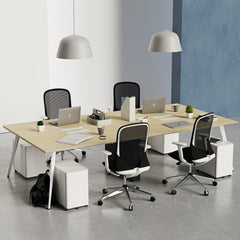
In shared offices, stability is also about repeatability. People bump desks, adjust chairs, shift monitors, and cables get moved. A workstation designed for multiple users benefits from rigid frames and defined zones so each person’s monitors stay centered relative to their seat. For team pods and shared benching, a purpose-built quad workstation helps maintain consistent spacing and consistent alignment across multiple setups.
1. Raise the desk to standing height and test for oscillation with light typing motions.
2. Mark the desk centerline; align the seam between monitors to that line.
3. Set both monitors to the same height; level the top edges precisely.
4. Position screens at a comfortable distance (roughly arm’s length) and angle inward evenly.
5. Choose arm strategy (single dual vs. two singles) based on desk rigidity and monitor weight.
6. Route cables with slack at the arm joints and anchored slack below the desktop.
7. Run the desk through full height travel and confirm cables don’t tug the screens.
8. Re-check alignment after 24–48 hours; retighten only what needs it.
| Factor | What you feel | Why it happens | Fastest fix that preserves centering |
|---|---|---|---|
| Desk base flex at standing height | Whole setup sways | Tall legs amplify torsion | Choose a more rigid frame; reduce arm leverage by moving monitors slightly back |
| Thin or flexible desktop | “Springy” bounce near monitors | Clamp pressure + top flex | Use a stiffer top; distribute load with two clamp points |
| Gas-spring arm with heavy screens | Slow sag or micro-bounce | Tension near limits | Re-tension correctly; consider a more rigid arm type |
| Cables pulling during height changes | Screens rotate or drift | Strain relief missing | Add slack at monitor end; secure vertical cable run |
| Asymmetric mounting | Seam shifts off center | Uneven torque on joints | Reposition arms symmetrically around centerline |
Specs and photos rarely show the thing that matters most: how a dual-monitor setup behaves at standing height with real inputs—typing, leaning, and daily adjustments. If you can test in person, you can prevent the most common regret: buying a desk that looks great but never feels stable once fully set up.
A 60-second test that reveals a lot:
Raise the desk to your standing working height.
Put your hands near keyboard position and simulate brisk typing.
Lightly tap the desktop near where a monitor arm clamp would sit.
Watch how quickly the movement dissipates.
You’re looking for a desk that damps motion quickly rather than oscillating. Then check practical mounting realities: is there enough rear space to clamp an arm cleanly? Is the top thickness friendly to secure mounting without deformation? Can you keep the seam centered without putting the arms at awkward, overextended angles?
If you’re in Southern California, visiting an office furniture Los Angeles showroom makes this evaluation straightforward. Bring your monitor sizes/weights and your approximate arm type so you can replicate the real clamp position and cable travel.
Even a perfect build can drift if you never revisit it. Monitor arms settle, desk fasteners experience tiny shifts, and cable bundles gradually change shape as you add or remove devices. The goal isn’t constant tweaking; it’s a quick routine that preserves the stable-and-centered feel with minimal effort.
A practical monthly tune-up takes five minutes:
Check that the desk is level (especially if it sits on carpet or a soft mat).
Confirm arm clamps are secure and haven’t rotated.
Verify VESA screws are snug.
Move the desk through full height travel while watching for cable tension.
Reconfirm the seam alignment to your centerline and level the top edges if needed.
If you still feel bounce after everything is properly tightened, treat it as a system problem, not a monitor problem. Often the most effective upgrade isn’t a heavier arm; it’s a stiffer top or a desk with better standing-height rigidity. For broader sizing and layout options when upgrading, compare surfaces in the desk collection for home offices and choose a footprint that supports centered mounting without overextending the arms.
The real sign you’ve nailed it is how the setup feels day-to-day. Your hands can move quickly without the displays wobbling. Your eyes can scan across the seam without re-adjusting. Your posture stays neutral because the screens remain where you set them—stable, centered, and effortless to work from.


You have unlocked free shipping!
You're saving $29 and unlocked free shipping!
Leave a comment