





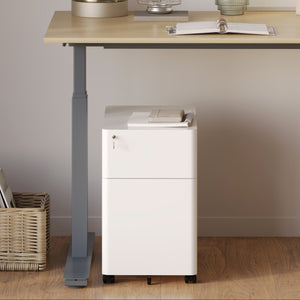






















Filing Cabinet Choices for Cleaner Workstation Planning
Cleaner workstation planning starts with filing storage that matches the desk, document volume, security needs, and daily workflow. Explore how cab...
Learn more
Visit quiz page to see how we makes it easy to create an inspiring workplace


When armrests are adjusted well, the upper body can stay quiet. Shoulders settle, the neck stops doing extra work, and your arms feel supported without needing to brace. When armrests are off by even a small amount, the body compensates in predictable ways, and those compensations often show up as neck tightness, upper trap fatigue, or a sense that you cannot stay comfortable at your desk.
Armrests set too high encourage the shoulders to lift so your forearms can make contact. That subtle lift can become a constant shrug during typing or mousing. Over time, the muscles along the neck and the top of the shoulders stay “on” even when you feel like you are sitting normally.
Armrests set too low remove meaningful support. Your elbows hang, your shoulders feel pulled downward, and the upper traps often work harder to stabilize the arms while you reach for the keyboard and mouse. The result can feel like tired shoulders first, then a stiff neck later.
If the desk is too high for your chair settings, or if armrests collide with the desk edge and force you to sit forward, your arms reach and your shoulder blades drift forward. The head tends to follow. That forward head position increases the load on the neck and makes it harder to relax the shoulders.
The goal is not a perfect posture pose. The goal is a repeatable neutral position where your shoulders do not need to lift, your elbows feel supported, and your hands can do their work without twisting the wrists.
Elbows: Aim for an elbow position that feels heavy and supported. You should be able to let your arms rest without needing to hold them up.
Shoulders: Shoulders should stay down and wide. If your shoulders visibly rise when your forearms touch the pads, the armrests are too high or the desk interaction is forcing you upward.
Wrists and hands: Your wrists should not be forced into extension by armrests that push your hands upward. If the armrests lift your forearms but your keyboard stays low, wrists often bend back to meet the keys.
Armrests work best when you rest on them rather than press into them. You want support without bracing. A practical check is to notice whether your forearms feel lightly supported while your shoulders remain relaxed. If you feel yourself pushing down to “hold” your position, the setup is encouraging tension.
Elbows feel heavy
Shoulders feel light
Neck feels long and free to turn
That combination is a strong signal you are supporting the arms without recruiting the neck.
Armrests are not the first dial to turn. When seat height, back support, and desk interaction are wrong, armrests become a constant chase. A chair first sequence makes adjustments stick.
Start by planting your feet. If your feet are unstable or your knees feel unusually high or low, the rest of the setup becomes harder to maintain. Once your feet feel grounded, your pelvis has a stable base and your upper body can relax.
A simple check: sit back into the chair, place both feet flat, and notice if you feel balanced without sliding forward. If you feel like you are perching, adjust seat height until the base feels stable. This matters because seat height directly changes elbow height relative to the desk.
When your upper back is supported, your shoulder blades do not have to “float” while you work. That reduces the urge to shrug and reduces forward shoulder drift. Adjust your back support so you feel contact behind the mid back, not just the lower back. If you feel like your chest collapses or your shoulders roll forward, improve that contact first before touching armrests.
Armrest setup works best as a quick loop rather than a one time decision. You adjust, test, and lock, then repeat once more.
1. Adjust one control
2. Test with typing for 10 to 15 seconds
3. Test with mousing for 10 to 15 seconds
4. Lock or leave the setting, then move to the next control
Light typing with elbows close to your sides
Mousing with the mouse hand moving across its full usable area
Different armrest controls solve different problems. If you know what a control is supposed to fix, you can adjust with purpose.
Set height so your elbows feel supported while shoulders remain relaxed. The easiest way to find it is to let your arms hang for a moment, then bring your forearms onto the pads without lifting your shoulders. If the shoulders rise, lower the armrests. If the elbows still feel unsupported, raise them slightly.
A useful check is the shoulder drop test: inhale gently, exhale, and allow your shoulders to drop. If the armrests block that drop, they are too high.
Width is about where your elbows live. If pads are too wide, elbows drift outward, shoulders abduct, and upper traps often engage to stabilize. If pads are too narrow, elbows may get squeezed inward and wrists can angle awkwardly toward the keyboard.
A helpful target is “elbows near your sides without pinching.” You should feel space at the armpits, not tension.
Depth decides where your forearm meets the pad. Too far forward can push your shoulders forward. Too far back can leave your forearm unsupported and can pressure the elbow area.
Aim for support under the forearm that does not block your ability to sit close enough to the desk. If the armrests stop you from getting close, your neck often pays the price because you reach.
Rotation can help align your forearms with your keyboard or mouse path. It is most helpful when you notice your wrists turning inward or outward to “find” the keys or mouse.
Typing often benefits from a neutral forearm path straight forward. Mousing sometimes benefits from a slightly outward pad angle if it keeps the mouse arm from reaching. The key is that rotation should reduce twisting, not create it.
If one shoulder feels twisted or pulled forward when you rest on the pad, rotate back toward neutral or reduce reliance on that pad during that task.
Armrests do not exist in isolation. They either complement the desk height or fight it. That relationship determines whether you can keep shoulders down.
If the desk height and armrest height allow comfortable clearance, sliding armrests under the desk can support closer positioning. That can reduce reaching and reduce neck load. However, clearance must be real. If pads bump the desk edge, you will unconsciously elevate your shoulders or sit forward.
To explore how different work surface designs interact with chair positioning, we often reference the range of profiles in the Urbanica desk collection. The goal is not a specific model, it is understanding how edge thickness, apron clearance, and worktop height affect whether armrests can coexist with the desk.
If armrests collide with the desk, they often create forced shoulder elevation. In that case, it can be more comfortable to lower the armrests slightly and keep them just short of the desk edge, so your chair can still come close enough for a neutral reach.
If a desk is significantly higher than your supported elbow position, armrests might lift your arms, but then your shoulders lift too. That is the wrong trade. In those situations, you can prioritize a stable chair position and reduce armrest dependence during typing, while finding ways to bring your input devices to a more comfortable height when possible.
How you use your hands changes what “ideal” feels like. Armrests can support the forearms differently depending on the task.
For typing, the best armrest setup typically supports part of the forearm while letting the shoulders remain free. You want to avoid locking in. If you feel like your arm pads are holding you in a rigid position, lower the height slightly or reduce forearm pressure so you can move.
A balanced approach is to let the pads carry some weight while your hands do fine motor work. That balance often keeps neck muscles quieter over longer sessions.
The mouse side is where many people develop asymmetry. The mouse arm often reaches farther, and the shoulder quietly creeps upward. Counteract that by checking mouse side armrest height first, then matching the non mouse side.
A simple habit is to reset your shoulders each time you switch tasks: exhale, let both shoulders drop, then return your forearms to the pads without shrugging.
Armrests can reduce the load of holding your arms up, but they cannot compensate for a screen that is too low. If you are looking down for long stretches, the neck works harder regardless of arm support. In laptop first setups, you will usually get the best neck outcome by addressing screen height and distance, then tuning armrests to keep shoulders relaxed while you interact with the keyboard or trackpad.
Not all chairs offer the same armrest architecture. Some have integrated arms, some have multi direction adjustments, and some prioritize clean design. Setup strategy changes depending on what the chair can actually do.
Adjustable armrests allow you to fit the chair to your body and desk. Integrated armrests require you to fit the workstation around the chair or use lighter arm contact so you do not force the shoulders.
The comfort goal stays the same: supported elbows, relaxed shoulders, and a neck that can move freely.
When customers ask us where to start with a modern chair setup, we often point them to the specific product configuration so they can match what they see to the controls they have at home. The Muse Chair product page is useful for that purpose because it grounds the setup conversation in the actual chair design.
If your armrests are adjustable, start with height so the shoulders can drop, then use width to keep elbows near your sides. If your desk interaction forces you to sit forward, do not “solve” that by raising armrests. Instead, aim for shoulder relaxation first, then adjust your positioning so reaching is reduced.
Chairs with 4D armrests can be tuned with more precision, which is valuable when you switch between typing and mousing. The Onyx Chair product details show that multi direction armrest capability, so it is a fitting reference when you are learning how height, width, depth, and angle interact.
A practical sequence on 4D armrests:
Set height for relaxed shoulders
Set width to keep elbows from flaring outward
Set depth so forearms are supported without pushing shoulders forward
Use angle only if it reduces wrist or shoulder twisting for your main tasks
Consistency is where comfort becomes reliable. The Novo Chair product details provide a helpful reference for the chair’s ergonomic intent and adjustability, which supports a repeatable setup approach.
A useful habit is to treat your best settings as a baseline rather than a perfect endpoint. If you notice shoulder elevation, lower height slightly. If elbows drift outward, narrow width slightly. Small adjustments tend to be more sustainable than big swings.
Integrated armrests can feel great when they fit your proportions, and frustrating when they do not. The Seashell Chair product details are a helpful reference because they clarify the chair’s design direction and what type of arm support it provides.
With integrated arms, focus on positioning and gentle contact. If the arms are higher than your neutral elbow height, avoid pressing down to force fit. Instead, lighten forearm contact during typing and rely on stable chair positioning and device placement to reduce reaching.
This routine is designed for real workdays. It is fast, it uses simple body cues, and it works whether you have basic or highly adjustable armrests.
1. Sit fully back so your spine is supported
2. Plant your feet so your base is stable
3. Exhale and let your shoulders drop naturally
4. Set armrest height so forearms rest without lifting shoulders
5. Set armrest width so elbows stay near your sides without squeezing
6. Set armrest depth so forearms are supported without pushing shoulders forward
7. If available, fine tune angle to reduce wrist or shoulder twisting
8. Type lightly for 10 to 15 seconds, notice shoulder and neck effort
9. Mouse through your full range, notice shoulder hiking or reaching
10. Lock settings, then repeat steps 4 to 6 once more in smaller increments
| What you feel during work | Most likely setup cause | First adjustment to try | What to avoid |
|---|---|---|---|
| Neck tightness after 20 to 40 minutes | Shoulders subtly lifted or reaching forward | Lower armrest height slightly, then reduce reaching by sitting closer | Raising armrests to “meet” a high desk |
| Upper trap fatigue on one side | Mouse side shoulder creeping up | Match both armrest heights, then check mouse placement | Leaning on one armrest harder |
| Forearm pressure or tingling | Too much pressure on the pad edge or depth too far back | Adjust depth so support is under the forearm, soften contact | Pressing down to stabilize |
| Shoulder pinching in front | Pads too far forward or too wide | Reduce depth or width to keep elbows closer | Rotating pads outward excessively |
Armrests can either support neutral movement or reinforce strain patterns. These mistakes are common even with good chairs.
If you push into armrests to slide forward or to reach, the shoulders often roll forward and the head follows. Instead, bring your body closer to your work so your arms do not need to “pull” you into position.
When armrests become a brace, the neck often tightens even if shoulders look level. The fix is usually softer contact and a small height change so you can rest without pressing.
A thicker keyboard, a different mouse, or a new desk height can shift your elbow relationship. A quick recalibration keeps settings honest and prevents slow drift into tension.
Comfort is personal, but the principles stay consistent. Fit tuning helps you apply the principles to your proportions and habits.
If you have a narrow frame, too wide pads can pull your arms outward and increase neck effort. If you have broader shoulders, too narrow pads can crowd your elbows and angle your wrists. The right width feels like your elbows are guided, not forced.
Longer forearms often do best with slightly more support under the forearm without crowding the desk edge. Shorter forearms often need pads slightly back so the elbow is not pressured. In both cases, avoid support that pushes your shoulders forward.
In a reclined position, forearm pressure can increase because your weight shifts and the pads become a stronger contact point. If reclining makes your shoulders roll forward, reduce armrest height slightly and keep the pads positioned so your elbows stay closer to your sides.
Recline changes how your torso weight distributes. If armrests carry too much of that change, the neck and shoulders can tighten. The solution is not more pressure, it is better balance between back support and gentle arm support.
When customers shop for a chair, we focus less on buzzwords and more on whether the chair can be adjusted to support their real tasks. Armrest adjustability matters most when you work long sessions, switch tasks often, or share a workstation.
Look for stability in the arm supports, a range of height adjustment, and controls that are straightforward to operate. Chairs that hold their settings well make it easier to maintain comfort across a week of work.
For a category level comparison of styles and intended use, the Urbanica office chair collection helps readers see the range of chair types without forcing a single definition of “best.”
Use the table below as a practical way to think about armrest requirements based on how you work.
| Work style | Armrest characteristics that tend to help | Setup focus |
|---|---|---|
| Long typing sessions | Reliable height adjustment, comfortable pad contact | Keep shoulders down, avoid bracing |
| Mixed typing and mousing | Multi direction adjustments, easy micro changes | Prevent mouse side shoulder creep |
| Shared or flexible workstations | Quick adjust controls, repeatable baseline settings | Recalibrate fast when conditions change |
Comfort is not a one time setup. It is a system you can return to, even when days vary.
We recommend building a “home position” you can reset to quickly. A small visual reference, like a photo of your armrest height relative to the seat or a simple note of your preferred settings, can reduce the temptation to keep tweaking randomly.
Re check after changes like switching desks, changing keyboard height, working longer sessions than usual, or changing how you sit. None of this requires perfection, it just requires awareness.
If you need guidance on ordering, delivery, and general support details while planning a workspace, our delivery and ordering guidance page is designed to answer the common practical questions that come up when customers are building out their office setup.


You have unlocked free shipping!
You're saving $29 and unlocked free shipping!
Leave a comment