



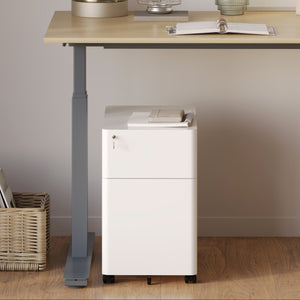






















Filing Cabinet Choices for Cleaner Workstation Planning
Cleaner workstation planning starts with filing storage that matches the desk, document volume, security needs, and daily workflow. Explore how cab...
Learn more
Visit quiz page to see how we makes it easy to create an inspiring workplace


Remote work makes it easy to forget the body is part of the job. Hours pass, tasks stack up, and posture quietly adapts to whatever is easiest in the moment. The real decision is not “sitting versus standing.” The decision is whether your setup supports a comfortable baseline and makes it simple to change positions without disrupting your work.
Two forces drive most remote-work discomfort.
First is poor fit. When the chair and desk do not match your body, you compensate with your shoulders, wrists, neck, or lower back. That compensation can be subtle. You might not notice it until late afternoon, when typing feels heavier and your shoulders feel tense for no clear reason.
Second is long static holds. Even a well-fitted setup becomes uncomfortable when you stay frozen in one posture for too long. Comfort improves when the workday includes small, regular changes in joint angles and muscle load. Those changes can happen through micro-breaks, shifting positions in your chair, or adding short standing bouts. The goal is a rhythm you can keep, not a perfect posture you can “maintain.”
From our perspective as an office furniture brand, comfort is not an upgrade that appears when you buy a new desk type. Comfort is a system. The system starts with seated fit because sitting is still where many people spend the majority of their remote day, even with adjustable options. A thoughtful chair and a compatible work surface create a neutral foundation, then standing becomes a useful tool rather than a desperate escape.
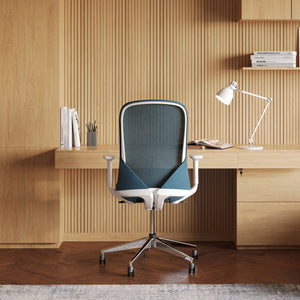
A practical starting point is exploring chairs that suit different bodies and sitting styles. The right chair is the piece that supports you for the hours when you are focused and stationary, which is why many people begin by browsing the office chairs collection and narrowing options based on fit, adjustability, and how the seat and back feel during real typing posture.
A good decision guide starts with how you actually work and how your body responds, not with trends. The simplest way to decide is to run a short self-audit that checks three things: task patterns, body signals, and environmental constraints.
The most comfortable position is often the one that matches your dominant task type.
If your day is keyboard-heavy and uninterrupted, you need stable forearm support and consistent screen positioning. Sitting tends to be easier for long, focused typing because it reduces demand on calves and feet. Standing can still help, but it usually works best in short bursts between deep work blocks.
If your day is meeting-heavy, standing can fit naturally. Many people find it easier to stay engaged while standing during calls, especially when they are not constantly using the keyboard. Standing can become a low-friction default for meetings, then sitting returns for writing, editing, or spreadsheet-heavy work.
If your day is mixed with admin bursts, quick reviews, and short tasks, you may benefit most from frequent, small position changes. In those cases, the best setup is the one that makes switching easy without forcing you to reorganize your tools each time.
Your body often tells you whether standing will help or whether seated fit needs attention first.
Signals that point to improving seated fit first include wrist discomfort, shoulder tension, or a feeling that you are reaching forward to type. Those are often signs of desk height or keyboard position issues. If you stand without fixing them, the same arm and shoulder mechanics can follow you into standing posture.
Signals that suggest short standing bouts may help include stiffness after sitting, a restless feeling in hips or legs, or a tendency to slump as the day goes on. Standing does not need to be long to be useful. A few minutes can reset posture and attention when done with good screen and keyboard placement.
If you have medical concerns or pain patterns that persist, treat this guide as general ergonomics guidance rather than personal medical advice. A clinician can help you assess what postures are appropriate for your specific situation.
Even the best ergonomic plan fails if the room makes it hard to follow.
Floor type matters. Hard floors may feel tiring if you stand for long periods, while thick carpet can make chairs roll poorly and change how you position yourself. Noise and shared spaces matter too. If you are in a shared home, you may need a setup that keeps video framing consistent and prevents constant mic or camera adjustments.
Space constraints can also decide the desk category. If you cannot pull a chair back comfortably, you will perch. If you cannot stand without bumping into a wall or shelf, standing will not happen consistently. Your setup needs enough clearance to make good posture the easiest posture.
Many people assume that a standing desk is the shortcut to comfort. In practice, a well-designed seated setup solves a large percentage of remote-work discomfort because it addresses the most common pain points: shoulders creeping upward, wrists bending, and the head drifting forward toward the screen.
Your desk should allow elbows to rest close to your body with forearms roughly parallel to the floor while typing. If the desk is too high, shoulders elevate and tension builds. If the desk is too low, you hunch or drop your wrists into an awkward angle.
A simple check is the elbow test. Sit with your shoulders relaxed, upper arms near your sides, and hands on the keyboard. If you feel like you are shrugging to reach the keys, the surface is likely too high for your chair height. If your wrists bend upward to type, the keyboard is likely too high relative to your elbow height.
When the desk height cannot change, the chair height becomes the main adjustment. If raising the chair helps your elbows but leaves your feet dangling, a footrest can restore lower-body support. The goal is not perfection. The goal is removing obvious strain so your body is not fighting the setup.
Neck discomfort is often a screen problem, not a sitting problem. Laptop screens sit low, which encourages the head and neck to tilt downward. Over time, that posture can create a feeling of tightness at the base of the neck and fatigue in the upper back.
A practical screen check is where your eyes land. When you look at your screen with your head in a neutral position, the top third of the display should be near your natural line of sight. That placement keeps you from constantly craning down. If you use a laptop as the primary screen, consider raising it and using an external keyboard and mouse so typing posture does not get worse.
Monitor distance matters too. If the screen is too far, you lean forward. If it is too close, you may crane your neck or squint. Aim for a distance that lets you read comfortably without reaching your head forward. Minor changes add up because you repeat them thousands of times each day.
Armrests can help when they support forearms lightly without pushing shoulders up. They can also cause problems if they collide with the desk edge and force you to sit too far back or too far forward.
If armrests hit the desk, people often compensate by widening elbows and reaching forward, which strains shoulders. A better approach is matching chair and desk heights so you can sit close enough to the surface while keeping elbows near the body. If armrests are adjustable, set them low enough to slide under the desk or high enough to support without lifting shoulders, depending on how your desk is built.
For many remote workers, a fixed desk is a simple, stable base that works well for consistent routines. A sit-first surface is especially helpful when you do focused typing, writing, or design work where wobble or frequent adjustments create distraction.
A dedicated workstation like the Office Desk can serve as that stable baseline for seated comfort, helping keep screen placement, keyboard position, and daily workflow consistent without requiring constant tweaking.
Standing can be a powerful tool when it is used strategically. The goal is not to stand all day. The goal is to distribute load across different tissues over the course of the day. To do that, standing needs to feel stable, usable, and easy to return to.
Standing posture should still be neutral posture. That means shoulders relaxed, elbows near your sides, wrists straight, and the screen at a comfortable height. If the screen sits too low, the neck tilts down. If the keyboard sits too high, shoulders lift. If the surface wobbles, you tense to stabilize.
A standing desk is most useful when it supports both sitting and standing modes without forcing compromises. Many people underestimate how often they will switch back to sitting, which is why stability and usability across modes matters more than novelty.
Most people quit standing because they do too much too soon. Calves fatigue, feet ache, and the lower back feels compressed. Then standing becomes associated with discomfort and gets abandoned.
Standing works best as a series of short bouts that fit into your workflow. Consider standing for tasks that require less typing, such as calls, reviewing documents, or organizing notes. Then sit for deep writing or heavy mouse work. This approach protects comfort while still gaining the benefits of movement and posture change.
A useful mindset is to treat standing like a reset button. Two to five minutes can be enough to change how you feel. Longer blocks can be added gradually if they feel good, but there is no requirement to chase a certain total time.
Standing with locked knees can increase fatigue and discomfort. Instead, keep knees soft and allow small shifts in stance. Leaning on one hip may feel relaxing but can create asymmetry over time. If you notice this habit, try alternating stance or returning to neutral.
Another frequent issue is screen height. If your screen is low, your neck will tell you. Standing should not turn into looking down for hours. Bringing the display into a comfortable zone protects the upper body and makes standing more sustainable.
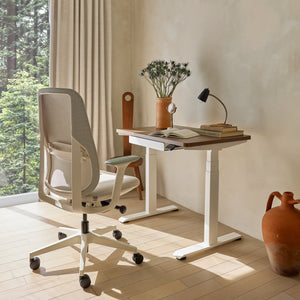
If you are considering a full adjustable workstation, a product like the Standing Desk represents a sit-stand approach that can support position changes during the day, provided the rest of the setup is aligned with your body and your tasks.
Not every home office has room for a large workstation. In many homes, the work zone is a corner, a bedroom wall, or a multi-purpose room. Comfort in these spaces depends on workflow fit just as much as posture fit.
A desk can technically fit in a room and still function poorly. If the chair cannot roll back, you perch. If the chair hits a bed frame or shelf, you twist. If standing requires moving the chair out of the way every time, standing becomes a hassle and stops happening.
Measure for real movement. You need space to pull the chair out and sit down smoothly. If you plan to stand, you need a stance area in front of the desk where you can stand without bumping furniture. Even small clearance improvements can reduce friction and make good habits easier.
Compact setups often rely on a laptop, which can crowd the work surface. Depth matters because it affects viewing distance. If the surface is shallow, your screen sits too close, and shoulders may round forward.
If you use a compact desk, consider how you will place the laptop, keyboard, and mouse. A cramped layout encourages awkward arm angles and constant reaching. The best compact setup keeps the primary tools within a comfortable reach zone while leaving enough space for notes or a drink without forcing your hands into the edge of the desk.
In tight spaces, a compact adjustable solution can help you vary posture without committing the room to a large desk footprint. The key is choosing something that supports your real working tasks, not just occasional standing.
A product like the Mini Standing Desk can suit a compact workspace when the goal is to add short standing periods without rebuilding the entire room, provided your screen and input devices can still be positioned comfortably.
Two desks can both be “desks” and still feel completely different during a long workday. Comfort often comes down to dimensions, surface feel, and stability.
The reach zone is the area where your hands naturally land without stretching shoulders forward. If the mouse is too far away, your shoulder reaches repeatedly. If the keyboard sits too close to the edge and your wrists rest on it, forearm pressure increases.
Width affects whether you can keep the mouse close without crowding. Depth affects whether you can place the screen at a comfortable distance. A surface that is too small encourages constant micro-adjustments and clutter, which increases stress and reduces posture quality.
The desk edge is where forearms often rest. A harsh edge can create pressure points over time. Surface finish also affects glare and the feel of your hands during long sessions. These are small details, but remote work is repetitive, and small details become significant when repeated daily.
Cleaning matters too. A surface that can be wiped easily supports a simple habit of resetting your space, which reduces clutter and makes position changes easier.
A desk that wobbles can trigger subtle tension. Your body stabilizes itself when the environment is unstable. That stabilization can show up as tighter shoulders, a firmer grip on the mouse, or a stiff posture during calls.
Stability also matters when you lean in slightly to review something on screen or when you adjust your posture. Even if wobble does not bother you immediately, it can reduce your desire to stand if the standing mode feels less solid.
To compare different formats and sizes, browsing the Desks collection can help you think in categories, such as broader work surfaces for multi-monitor setups versus cleaner, compact options for small rooms, without assuming that one size fits everyone.
The most sustainable approach for many remote workers is a hybrid strategy. Sitting becomes comfortable and efficient, then standing becomes a supportive change of pace rather than a requirement.
If your chair and desk pairing is uncomfortable, standing will feel like relief. The problem is that standing may become the only relief, which increases the risk of overdoing it. When seated fit is strong, you can choose standing based on energy and tasks rather than pain avoidance.
This is why chair quality, desk height alignment, and screen positioning matter even if you plan to stand regularly. The hybrid strategy works when both modes are usable.
The easiest switching pattern is task-based. Stand for calls, reading, and light review. Sit for writing, editing, heavy mouse work, and deep typing. This approach keeps the workflow consistent because your tools stay where they are.
Time-based switching can work too, but it needs to be gentle and flexible. Rigid timers can feel intrusive. A better approach is to use natural prompts, such as standing at the start of a meeting, sitting after a call ends, or switching positions when you finish a task batch.
The most reliable comfort gains come from small habits that do not require willpower.
Keep keyboard and mouse close so elbows stay near your sides. Keep the screen at a height that supports a neutral neck position. Keep the primary tools organized so you are not constantly reaching and twisting. These habits reduce strain whether you sit, stand, or alternate.
| Desk strategy | Best fit for | Comfort strengths | Watch-outs to manage |
|---|---|---|---|
| Fixed desk with well-fitted chair | Deep focus and heavy typing days | Stable posture reference points, consistent workflow | Needs strong chair and good screen height planning |
| Adjustable standing desk for sit-stand use | Mixed days with calls and varied tasks | Easy posture variety when set up correctly | Standing fatigue if switching is too aggressive |
| Compact adjustable setup in small spaces | Tight rooms and multipurpose areas | Adds standing without taking over the room | Surface space can feel tight if tools are not organized |
| Shared workstation for multiple users | Households or teams sharing a zone | Defined work zones, consistent layout for each user | Requires thoughtful organization and clear zones |
Remote work is often not solo. Many homes have shared spaces, shifting schedules, and two people trying to get productive in the same room. Comfort depends on reducing daily friction.
When different users share a workstation, height differences and tool preferences show up quickly. One person may type with a laptop, another may prefer a monitor. Camera height and framing may matter for video calls. If every session begins with a ten-minute reset, the workstation becomes stressful.
The solution is not always a standing desk. Sometimes it is a shared setup with clear zones and repeatable placement for key items.
Width planning matters most. Each user needs enough space for keyboard and mouse without elbow collisions. Depth matters if screens sit on the surface rather than on arms. Crowded depth forces screens too close or pushes keyboards to awkward positions.
A practical approach is to plan zones. Define where each person’s primary tools live, where cables route, and where shared items sit. The goal is to prevent constant rearranging.
If multiple people need to work in the same home or small office, a workstation layout can create structure that a single desk cannot. Defined spaces reduce visual clutter and give each person a consistent starting point.
For multi-user environments, a product such as the Quad Workstation Desk aligns with a shared-zone approach by providing a workstation format designed for multiple users, which can help maintain boundaries and consistency when schedules overlap.
Choosing between sit-first, sit-stand, or compact adjustability becomes easier when you connect the choice to your tasks, space, and switching behavior.
Prioritize seated fit and a stable surface. Ensure the chair and desk pairing supports relaxed shoulders and neutral wrists. Add standing in short bouts if it feels good, but do not force it to be the main mode.
Standing can integrate naturally. Use standing during calls and sit for writing and typing. This keeps standing tied to a specific workflow pattern instead of relying on motivation.
Compact adjustability can support position variety without committing the room to a large workstation. Focus on surface depth and tool organization so the compact setup still supports real work.
Adjustability or defined work zones become critical. A shared workstation format can reduce the daily reset burden and keep each user’s posture closer to neutral.
Desk height compatibility with your seated elbow height
Enough surface depth to keep the screen at a comfortable viewing distance
Enough surface width to keep the mouse close without shoulder reach
A screen plan that avoids looking down for hours, especially for laptop-first work
A switching plan you will actually use, such as standing during calls or between task batches
Cable and accessory placement that does not block movement or force awkward reaches
Furniture decisions are easier when the purchase aligns with how you will use the space day to day. That includes delivery considerations, assembly expectations, and how you plan to position the desk in your room.
Measure the space where the desk will live, including chair clearance and walking paths. Think through how your equipment will be positioned, including screens, keyboard, mouse, lighting, and any audio or camera gear. A desk that fits the room but does not fit the workflow can create discomfort and frustration.
When support information is available, it is useful to review practical ordering and service details so the decision feels grounded in reality, especially if you need guidance on selecting the right configuration for your space. For that purpose, the office furniture delivery and ordering details page can provide context on how the brand supports customers and what to expect during the process, without relying on unrealistic promises.
A comfortable setup is not one perfect snapshot. Remote work changes. Your schedule shifts. Your workload increases. You add a second monitor, a new microphone, or a different chair. The best decision is the one that stays usable as your work style evolves.
Comfort improves when small changes become consistent habits. A clearer desk makes posture easier. A screen at a better height reduces neck fatigue. Regular position changes reduce stiffness. None of these require extreme interventions. They require a setup that makes the right behavior easy.
When discomfort shows up, it is tempting to replace the desk first. A more effective sequence is to solve fit issues before changing desk categories. If your keyboard height is wrong or your screen is too low, a different desk type may not fix the root issue.
Start with the basics. Check elbow height and shoulder tension. Check screen height and viewing distance. Check whether you are reaching forward to type or mouse. Then choose the desk category that supports your real workflow pattern.
The best sit or stand choice is the one you will use consistently. A standing desk can be excellent if it supports stable work in both modes and if you have a realistic switching pattern. A fixed desk can be excellent if it supports long focus blocks and you build position variety in other ways. A compact adjustable option can be excellent if it fits your space and keeps your tools organized.
Remote work comfort is not a pledge to stand all day or a commitment to stay seated. It is a system that fits your body, your tasks, and your home. When that system is designed carefully, the sit or stand choice becomes simple because both options feel workable and honest.


You have unlocked free shipping!
You're saving $29 and unlocked free shipping!
Leave a comment