
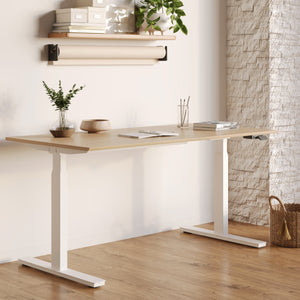
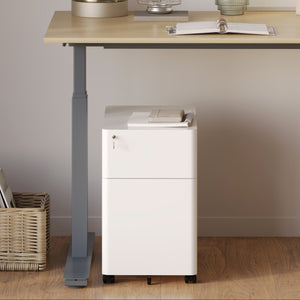















Dual monitor desk setup rules that keep your posture aligned all day

Posture alignment starts with a neutral head path, not a gear upgrade
Dual monitors can either make work feel effortless or quietly teach the body to compensate for hours. The difference is rarely about the screens themselves. It is about whether your setup supports a neutral head path, meaning your head stays stacked over your torso while your eyes and hands do the work.
Misalignment usually appears as one of three drifts:
-
Forward head posture, where the chin creeps toward the screens.
-
Rib flare, where the chest lifts and the lower ribs pop forward, often paired with shoulder tension.
-
Pelvic tuck or perch sitting, where you slide forward on the chair and lose back support.
These drifts can be subtle. They might show up as a tight upper trapezius late in the day, a stiff neck after focused tasks, or wrists that start to feel “floaty” because the arms are hovering instead of supported. A dual-monitor setup often amplifies those small compensations because you are asking your vision to cover more horizontal real estate.
A simple self-check reveals what your setup is teaching your body to do. Sit as you normally work. Without correcting anything, take a slow breath in, then out. Notice where you feel effort. If you feel effort at the base of the neck, you are likely craning forward or rotating slightly all day. If you feel effort in the low back or hip flexors, you might be perched and reaching. If you feel effort at the front of the shoulders, you may be pulling your arms inward to meet a keyboard that is off-center or too far away.
Comfort can be misleading because the body can adapt to poor mechanics in the short term. A “comfortable” posture that relies on continuous muscular effort is not sustainable. A posture-aligned workstation reduces the need for constant holding patterns. The goal is not perfect stillness. The goal is a setup that keeps you close to neutral so movement stays small, easy, and repeatable.
The centerline rule that prevents constant neck rotation and micro-leaning
The centerline rule is the foundation of a posture-aligned dual monitor desk. It simply means the work you do most often belongs directly in front of your body’s midline. If your core tasks are split between two screens equally, then the midpoint between them becomes your forward line. If one screen is clearly primary, that screen becomes the center.
Choosing a real primary screen or admitting you have two primaries
Most posture problems in dual monitor setups happen because the body is forced to choose a “primary” without your permission. If you handle email and chat on one side and deep work on the other, your neck and torso will still gravitate toward whichever task is most demanding. If you truly spend 70 percent or more of your focused time on one display, treat it as primary and center it. If your attention splits evenly, build your setup around an equal-use model instead.
Honest usage patterns matter. A screen that is “supposed to be secondary” but gets most of your attention becomes the true driver of posture. Your body will rotate toward it all day.
Two correct centering models and the posture tradeoffs of each
There are two centering models that protect posture when used correctly.
Primary-screen centering:
-
The primary monitor is centered on your midline.
-
The secondary monitor sits to the side, angled inward.
-
Your keyboard stays centered with the primary screen.
This model minimizes rotation during deep work. It is ideal for tasks that require long stretches of attention on one display.
Split centering:
-
The midpoint between the two monitors aligns with your midline.
-
Both screens are angled inward symmetrically.
-
Your keyboard stays centered to the midpoint.
This model reduces bias when you truly use both screens equally. It prevents one-sided neck loading that happens when people “live” on a screen placed off-center.
The 10-degree head-turn ceiling for all-day alignment
A practical rule is to keep your head turns under about 10 degrees for most routine viewing shifts. When angles exceed that, the movement tends to migrate from eyes to head, and then from head to torso. Over time, that becomes a pattern of slight rotation and forward lean.
To apply it, sit in your working position and look from one screen to the other. If you feel your head has to turn noticeably rather than your eyes simply tracking, your screens are likely too wide apart, too flat, or not angled inward enough. Toe the monitors in so the viewing surfaces form a gentle arc around you.
The bezel trap and why it creates a persistent neck bias
A common mistake is centering the gap between monitors even when one screen is clearly dominant. That places the true work slightly off-center. The body responds by rotating and leaning to “find” the content. This is the bezel trap. Even a small offset repeated thousands of times leads to cumulative strain.
If one monitor is primary, its content should be the thing your nose points toward during focus. That is your simplest indicator that your centerline is right.
Monitor height rules that keep the cervical spine stacked without shoulder tension
Height matters because vision and posture are linked. When screens are too low, the head drops and the upper back rounds. When screens are too high, the chin lifts and the neck compresses, often alongside shoulder elevation.
The top-third viewing target and why it works
A reliable starting point is to align your gaze so it lands around the upper third of the primary screen when you are sitting tall, relaxed, and not craning. This encourages a slight downward gaze, which is generally easier on the eyes and neck than an upward gaze.
This is a starting point, not a rigid rule. The goal is neutral neck positioning, meaning no chin jutting forward and no head tilting back. Your eyes should do more of the work than your neck.
Working with bifocals, progressives, and readers without chin lift
If you wear progressive lenses or bifocals, a standard “top-of-screen at eye level” approach can cause chin lift because you are trying to use the lower portion of the lens. A safer adjustment is to lower the screens slightly so the head can remain neutral while your gaze stays comfortable.
Instead of forcing posture to fit optics, tune screen height to maintain a neutral head position. Then adjust text size, scaling, and contrast so you can read without leaning.
When the height seems right but your neck still complains
If your screen height seems correct but your neck is still tight, check for two hidden conflicts:
-
The screen is at the right height, but too far away, causing you to protrude your head to read.
-
Your chair and desk heights are mismatched, causing shoulder elevation or a hunched upper back that changes your eye level.
The shrug test for hidden shoulder elevation
Place your hands on the desk where you work. Take a breath and notice whether your shoulders are lifted. If you feel the need to “drop” them, your desk height or arm support is likely off. Shoulder elevation invites neck tension even if the screens are positioned well.
Monitor arms versus risers versus stacking for stability and posture
Stability matters. If a monitor wobbles while you type, your body often stabilizes itself by tensing the shoulders and leaning forward. Arms can help by placing screens at the right height and depth, but only if they are sturdy enough for your monitor weight. Risers can work well if they give adequate height and allow the screens to sit at a comfortable distance.
Stacked monitors can reduce horizontal head turning for certain workflows, but they can also encourage chin lift if the top screen is too high. If stacking is used, the primary viewing area should still sit within a comfortable downward gaze.
The distance-and-depth rule that stops the slow creep toward the screens
Forward-head posture often comes from a simple scenario: content looks slightly small, you lean a little, then that becomes your new normal. Distance rules help stop the creep.
A practical starting point based on reach, then tuned for screen size
Start with a distance where you can comfortably read without leaning and where your elbows can remain relaxed near your sides. Many people find that roughly an arm’s reach is close, but screen size and resolution change what “comfortable” means. The better method is to set distance first for posture, then adjust text scaling so readability meets you where you are.
Fixing readability without leaning by using scaling and contrast
If you catch yourself leaning forward, do not immediately move your chair closer. Start with on-screen adjustments:
-
Increase text scaling slightly.
-
Adjust font sizes in frequently used apps.
-
Improve contrast and reduce glare.
-
Use clear cursor settings and UI scaling.
These changes reduce the temptation to inch forward during focus work.
Desk depth as an ergonomic variable for dual monitors
Desk depth influences posture more than most people expect. With dual monitors, shallow depth often forces screens too close or pushes the keyboard too far forward to make space. Both patterns drive leaning or reaching.
A deeper surface gives you room to position screens at a comfortable distance while keeping input devices close. If you are planning a surface specifically for multi-screen work, exploring the Urbanica office desks collection can help you compare different desk formats and footprints in a way that supports monitor depth planning.
Positioning dual monitors on limited depth without pulling the keyboard forward
When depth is limited, prioritize these moves:
-
Use monitor arms if possible to reclaim desk surface and pull screens slightly back.
-
Keep the keyboard and mouse in a neutral, close position, even if that means the screens sit a bit higher.
-
Angle screens inward so you do not need as much lateral space.
The keyboard should not be sacrificed to “fit” the screens. If the keyboard drifts forward, your shoulders follow.
Angle rules that keep your torso square while your eyes do the traveling
Angle rules are about turning your screens toward you so you can keep your torso facing forward. The more you have to rotate your body to see, the more likely you are to drift into asymmetry.
Building a visual arc with toe-in angles
A posture-aligned dual monitor setup forms a shallow arc around your seated position. Both monitors toe in so their faces point toward your eyes, not toward the center of the room. This keeps viewing shifts small and reduces the need for neck rotation.
A good check is to imagine a straight line from your eyes to the center of each screen. If those lines require a large head turn, your monitors need more inward angle or a closer grouping.
Equal-use monitors versus dominant-secondary setups
For equal-use setups, the monitors should be symmetrical in angle and distance. For dominant-secondary setups, the primary monitor stays more square to you and the secondary sits more angled on the side. The mistake is treating a dominant-secondary workflow like equal-use and centering the split. That tends to keep you slightly rotated during deep work.
Ultrawide plus secondary monitor considerations
An ultrawide can act like two monitors in one. If a secondary monitor is added, it should not expand your visual field so wide that you exceed your comfortable head-turn range. Often, keeping the ultrawide as primary and placing the secondary closer and more angled inward prevents excessive rotation.
Laptop-as-third-screen placement that avoids chin drop
If you use a laptop as a third screen, the biggest risk is chin drop because the laptop sits low. If the laptop is used for brief reference, keep it off to the side and angled, not directly in front as the primary. If it is used frequently, elevate it so the screen height aligns more closely with your monitors and use an external keyboard and mouse so the hands stay in neutral.
Desk height and input placement rules that protect shoulders, elbows, and wrists
Dual monitors make it easy to forget that hands drive posture. If the keyboard and mouse are not centered and supported, your shoulders and neck compensate.
The elbow window of 90 to 110 degrees without shrugging
A useful range is elbows bent roughly 90 to 110 degrees, with shoulders relaxed. If your elbows are much more open, you may be reaching. If much tighter, you might be cramped. The key is that you should not feel like you are holding your arms up.
If you cannot achieve this without lifting your shoulders, the desk is likely too high or the chair too low, or both.
Keyboard centering is non-negotiable even with dual monitors
The keyboard should align with your centerline, which is defined by your chosen centering model. If you center your primary screen but your keyboard sits centered between the screens, your body twists during typing. If you center between the screens but angle your keyboard toward one, your wrists and shoulders follow that twist.
Keep the keyboard straight. Let the screens angle, not your wrists.
Mouse zone mapping to avoid reach and twist
The mouse should live close to the keyboard, ideally within a short, relaxed reach. When the mouse sits too far out, people abduct the shoulder and rotate the torso slightly. That becomes a one-sided load pattern.
A practical mapping approach:
-
Place the mouse where your forearm can move with the elbow near your side.
-
Avoid placing it beyond the edge of the shoulder line.
-
If you use a large mousepad, ensure the usable area starts close to the keyboard.
Trackpad, mouse, and vertical mouse effects on forearm rotation
Different devices change wrist and forearm positioning. The safest choice is the one that lets you keep a neutral wrist, minimal grip tension, and relaxed shoulders. Some people prefer a vertical mouse to reduce forearm rotation, while others prefer a trackpad to keep the hand closer. Whatever you use, it should not force your shoulder to lift or your wrist to bend.
Stable surfaces reduce subtle bracing patterns
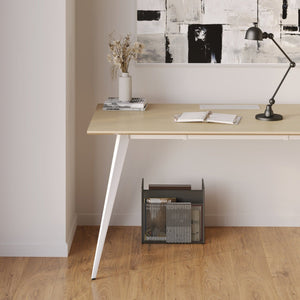
When the desk surface feels solid, the body does not brace as much. Wobble can trigger shoulder tension and leaning, especially during typing. If you are building a posture-first workstation, the Urbanica Office Desk is the kind of dedicated desk surface that helps keep monitor and input placement consistent day after day.
Chair-to-desk alignment rules that keep the pelvis stacked and the spine supported
A posture-aligned dual monitor setup starts at the pelvis. If the pelvis is not supported, the spine above it will compensate, even if monitors are perfectly placed.
Adjust seat height first, desk height second, with clear exceptions
In many setups, you adjust chair height so your feet rest comfortably and your thighs are supported without excessive pressure under the legs. Then you adjust desk height to match your elbow window.
If the desk height cannot change, you may need a footrest to keep feet supported while raising the chair to match the desk. The goal is to avoid hovering feet or perching forward.
Backrest tension and micro-recline for sustainable support
A small recline can reduce spinal loading and encourage a stacked posture, but only if you can still reach the keyboard without scooting forward. The best scenario is one where your back remains in contact with the chair while your hands rest comfortably at the desk.
If you notice that you drift forward during focus, it is often a sign that the keyboard is too far away or too high, not that you lack discipline.
Armrests that help versus armrests that force shoulder elevation
Armrests can reduce load if they support the forearms without pushing shoulders up. If armrests contact the desk edge and force the shoulders to lift, they are working against you. Adjust them lower or move them out of the way during heavy typing. The aim is relaxed shoulders and supported arms.
Foot position and leg-crossing patterns that rotate the pelvis
Leg crossing is often a compensation for an unsupported or awkward setup. It can rotate the pelvis and create asymmetry up through the spine. If you always cross the same leg, it can bias your torso and head positioning.
A simple improvement is to ensure feet have a stable place to land and that your chair height is not so high that your legs dangle. When the lower body is stable, the upper body can stay neutral.
Sit-stand transitions that keep alignment consistent across both working heights
Sit-stand can support comfort and variation, but only if your alignment stays consistent when you switch. Many people correct their sitting posture and then lose it completely when standing because the relationship between hands, eyes, and screens changes.
Standing mode is not taller sitting
When standing, your eyes, hands, and feet all shift. If you only raise the desk and do not re-check monitor height and distance, you can end up craning the neck or shrugging the shoulders. Keyboard and mouse height should rise with your elbows, and screens should remain in a comfortable downward gaze.
The two-height bookmark method for repeatable posture
Consistency removes guesswork. Set a sitting height where shoulders are relaxed and wrists are neutral. Then set a standing height where elbows and shoulders feel the same relative ease. Bookmark those two positions so you can return to them without re-solving the puzzle every day.
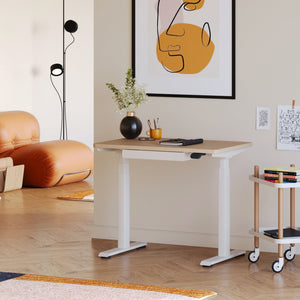
An adjustable surface such as the Urbanica Standing Desk supports this repeatability, which is a posture advantage because your setup does not drift when you shift between sitting and standing.
Anti-fatigue mats and footwear change your effective height
Standing posture is sensitive to small height changes. Shoes with thicker soles or an anti-fatigue mat can raise you slightly, which can make the monitors feel lower and prompt chin drop. The solution is not perfection. It is awareness. If you regularly use a mat, calibrate monitor height while standing on it.
Transition cadence that avoids posture reset fatigue
Switching positions too frequently without a consistent setup can create a pattern of constant adjustment and shoulder tension. A calmer approach is to switch at natural breaks, re-check key points quickly, and then settle in.
Cable routing rules that remove friction so posture does not compensate
Cable friction creates posture friction. If cables tug on devices, snag on knees, or create desk clutter, you end up twisting, reaching, and hovering arms. Good routing keeps your movement clean.
How cable drag silently changes posture
Cable drag can pull a mouse slightly, making you chase it with the shoulder. It can tug on a keyboard, causing you to re-center it incorrectly. It can create clutter that forces you to place devices in awkward spots. Over a full day, those small changes add up.
The clean vertical drop rule for a calm desktop
Aim for a simple cable path: from devices to the back of the desk, then down in a controlled channel. When the desktop stays visually calm, it is easier to keep screens centered and input devices aligned. A purpose-built accessory like the Spine Cable Management accessory helps organize cables in a defined vertical route, which supports a posture-aligned environment by reducing the need to constantly move things around.
Under-desk containment that preserves knee space and sit-stand movement
Under the desk, cables should stay clear of knees and feet. Loose power strips and hanging cords can create subconscious guarding, where you shift your legs and pelvis to avoid contact. That changes posture.
Using an under-desk routing approach such as the Under-Desk Cable Management accessory keeps cables contained so your lower body can stay stable, whether you are sitting, standing, or sliding your chair in and out.
The service loop rule for flexible, non-messy movement
Leave a small amount of slack where a device needs to move, such as a sit-stand desk or a monitor arm. That slack should be controlled, not dangling. A tidy service loop prevents tension on connectors while avoiding a cable nest.
Power bricks and heat awareness without overengineering
Keep bulky adapters positioned where they are not crushed by chair movement or feet. Avoid pinching cables under sharp edges. The goal is simple routing that stays consistent, not an elaborate system.
Desktop zoning that keeps everything inside the neutral reach bubble
A posture-aligned dual monitor setup is not only about screens. It is about where everything goes, so you do not repeatedly fold into flexion or twist.
The three-zone map for hands and eyes
Divide your desktop into three zones:
-
Primary zone: items used daily, kept close and centered.
-
Secondary zone: items used often but not constantly, kept within easy reach.
-
Tertiary zone: items used rarely, placed farther away.
Your keyboard and mouse belong in the primary zone. A notebook used for active work can sit slightly to the side but still within a small reach so you do not collapse forward.
Where notebooks, phones, and frequently grabbed items should live
If you take notes, place the notebook near the keyboard, not behind it. If the notebook sits behind the keyboard, you lean and lift your shoulders to write. Keep the phone out of the primary zone, especially if it triggers frequent downward head drops. A better place is a secondary zone that requires a deliberate reach and a deliberate glance.
Micro-break cues built into layout
Small cues can help prevent drift. A water bottle placed in the secondary zone can prompt a brief reach and posture reset. A sticky note near the monitor edge can remind you to unshrug and re-center. These cues work because they fit into your environment rather than relying on willpower.
The recovery corner for quick posture resets
Reserve a small corner of the desk for posture resets. This can be a spot where you place a massage ball, a resistance band, or simply a clear space that reminds you to roll the shoulders back and breathe.
Lighting and glare rules that prevent squinting, craning, and end-of-day hunching
Visual strain translates into posture strain. When glare hits a screen, people lean forward, tilt the head, or twist to escape reflections.
Window orientation and monitor placement for a no-glare triangle
A common strategy is to avoid placing monitors directly facing a bright window or with the window directly behind you. Side light is often easier to control. The goal is to position screens so reflections are minimized without needing to contort your posture.
Task lighting for two monitors without reflections
A task light can improve comfort if it illuminates your workspace without shining into the screens. Place it so it lights the desk surface rather than the display. Diffused light tends to create fewer harsh reflections.
Brightness, contrast, and end-of-day posture stability
Many people hunch late in the day because their eyes are tired. Instead of leaning closer, adjust brightness and contrast to match the ambient light. Keep text readable with scaling rather than physical creeping.
The squint test for quick glare diagnosis
If you catch yourself squinting, pause and look for a reflection or a brightness mismatch. Fixing glare often fixes posture without additional effort.
A posture-safe dual-monitor workflow that keeps the setup from drifting over time
Even a great setup can drift. Monitors slowly shift, keyboard positions migrate, and chair height changes. A posture-aligned system includes quick maintenance habits.
The 30-second alignment scan between meetings
Use a simple scan:
1. Head: chin neutral, no jutting.
2. Screens: centered to your model, angled inward.
3. Hands: keyboard centered, mouse close.
4. Hips: sitting back with support, feet stable.
This scan is fast and prevents a small drift from becoming a full-day pattern.
Preventing setup migration by locking the essentials
If you use a monitor arm, confirm that it holds position and does not sag. Use subtle visual markers, such as aligning the monitor base with a desk seam, so you can return it to center easily. Keep the keyboard in the same place. Consistency protects posture.
Adding a third device without breaking alignment
Adding speakers, a microphone arm, or a tablet can push screens outward. Before you add anything, preserve the centerline and keep the screens within your comfortable head-turn range. If the third device forces you to widen your setup, consider whether it belongs in a secondary zone rather than on the primary visual arc.
Weekly five-minute reset that restores centerline and distance
Once a week, re-check monitor distance, height, and angles. Wipe the desk, tidy cables, and re-center the keyboard. A clean reset makes it easier to stay aligned all week.
Shared workstations and team pods with alignment rules that scale across multiple bodies
Shared setups need faster calibration and more flexibility. The challenge is protecting posture without turning every desk session into a full ergonomic project.
Hot-desk quick calibration for instant posture safety
The fastest order of operations:
-
Adjust chair height for stable feet and supported thighs.
-
Pull the keyboard and mouse into the primary zone.
-
Center the primary screen or the midpoint, depending on the workflow.
-
Angle monitors inward.
-
Check that shoulders are relaxed.
Four-person workstation geometry that prevents twisted seating
In team layouts, people often angle their bodies toward “their” screen and end up working in rotation. A shared workstation benefits from clear screen ownership and symmetrical placement so each person can sit square to their own primary viewing area.
A multi-user surface like the Quad Workstation Desk reflects the kind of collaborative layout where consistent spacing and clear zones can help reduce twisting patterns across a group.
Space and routing considerations that keep shared posture clean
Shared workspaces create more cables, more devices, and more temptation to place things wherever there is room. Zoning becomes critical. Keep primary zones clear for each user. Route shared power and peripherals in controlled paths so the space under the desk stays unobstructed.
Buying and planning rules that make good posture the default instead of constant effort
A well-designed dual monitor workstation should make alignment easier, not require daily troubleshooting. Planning around posture starts with surface dimensions, stability, and support.
Minimum width and depth targets based on posture, not aesthetics
Dual monitors need space, but posture needs something more specific. You need room to keep screens at a comfortable distance while maintaining a centered keyboard. If a surface is too narrow, screens push outward and encourage rotation. If it is too shallow, screens creep forward or keyboards creep back, encouraging leaning.
Rather than choosing a desk first and “making it work,” planning around your layout reduces compensations. The most posture-friendly setups prioritize enough depth for screen distance and enough width for an inward-angled visual arc.
Stability and edge comfort as everyday posture factors
If the desk edge presses into forearms, people tend to hover their arms or shift forward. If the surface wobbles, the shoulders brace. These small effects matter because they repeat all day.
Validating delivery and support expectations before outfitting a workspace
From our brand perspective, clarity builds trust. When someone is setting up a workstation, they benefit from understanding what support and ordering details look like before they commit to a full office plan. That is why having a straightforward reference point like office furniture shipping and support details can be helpful during planning, especially when multiple desks or accessories need to arrive and function together without surprises.
A set-it-once calibration sequence for dual monitors that keeps posture aligned all day
Use this sequence to build the setup in a way that prevents one adjustment from breaking another.
1. Chair position: sit back with support, feet stable, thighs supported.
2. Desk height relative to elbows: shoulders relaxed, elbows in a comfortable bend.
3. Keyboard placement: centered to your chosen centerline model, straight alignment.
4. Mouse placement: close to keyboard, within relaxed reach.
5. Primary screen centering: primary screen or midpoint aligned to your midline.
6. Monitor height: comfortable gaze around the upper third of the primary screen, chin neutral.
7. Monitor distance: far enough to avoid leaning, close enough to read comfortably.
8. Monitor angles: toe in to form a visual arc, minimize head turns.
9. Lighting: reduce glare and brightness mismatch, prevent squinting.
10. Cable routing: eliminate drag and snags so posture does not compensate.
Dual-monitor setup table: configuration choices, posture risk signals, and the safest adjustments
| Dual-monitor configuration | Most common posture risk signal | Posture-aligned adjustment that usually fixes it |
|---|---|---|
| Primary plus secondary (side-by-side) | Head turns toward the “secondary” during deep work | Center the true primary, angle the secondary inward, keep keyboard centered to primary |
| Equal-use dual monitors (side-by-side) | One shoulder stays slightly forward all day | Center the midpoint, match monitor angles symmetrically, keep mouse close and centered relative to keyboard |
| Ultrawide plus secondary | Neck rotation to reach far edges of the visual field | Keep the secondary close and toed in, reduce total horizontal spread, use scaling to avoid leaning |
| Stacked monitors | Chin lift or neck extension when using the top display | Keep primary content lower, avoid placing frequent-use content too high, use a comfortable downward gaze |
| Laptop plus two monitors | Chin drop to laptop and frequent head bobbing | Move laptop to a secondary zone or elevate it, keep keyboard and mouse external and centered |
Posture-aligned dual monitor habits that keep the system working long after day one
A dual monitor setup stays posture-friendly when it stays consistent. A few habits protect that consistency.
Use the alignment scan as a reset, not a critique
The scan is a quick reset. It is not a judgment. If you notice you are leaning, that is a signal to adjust the environment, not to “sit up” harder.
Prevent drift by keeping a few non-negotiables
Non-negotiables that protect posture:
-
Keyboard centered to your centerline model.
-
Mouse close enough to avoid shoulder reach.
-
Screens angled inward so your torso stays square.
-
Cables routed so you do not fight your environment.
Upgrade without breaking alignment
If you add a new device, re-check the centerline, distance, and angles. Most posture breakdowns occur after an upgrade because the monitors get pushed outward or the keyboard moves off-center. Keeping the layout rules intact lets you expand without drifting into compensations.
Leave a comment