











Best Monitor Stand Ideas for Two-Screen Workstations Without Visual Clutter

Two-screen workstations solve one problem while often creating another. The extra display improves workflow, but the desk can quickly start to feel crowded, visually noisy, and heavier than it needs to be. That clutter is not always caused by a lack of square footage. In many cases, it comes from how the monitors are supported, how the sightlines are arranged, and how many objects compete for attention within the same field of view.
A clean dual-monitor setup does not require an empty desk or a showroom-like environment. It requires better structure. The right monitor stand idea reduces visual weight, gives each screen a clear role, and makes the workstation feel easier to use from the moment someone sits down. That is why the best setups often look calmer before a single decorative detail is added. Their foundation is doing most of the work.
For two-screen workstations, visual clutter usually comes from the same pattern: bulky bases, exposed cables, poor height alignment, badly placed lighting, and small accessories that pile up around the monitors. Fixing those issues changes the whole desk. The goal is not to make the setup look sterile. It is to create a workspace where the screens feel integrated, balanced, and intentional.
Why Dual-Monitor Desks Feel Cluttered So Quickly
Two screens double the visual footprint before accessories arrive
A single monitor usually occupies one central visual block. Two monitors create a wider and more demanding focal zone. Even before a keyboard tray, lamp, notebook, charger, or pen holder enters the picture, the desk already carries more hardware, more lines, and more surface interruption.
That extra footprint matters because the eye reads the monitor area first. If the screens appear bulky, uneven, or unstable, the entire workstation starts to feel crowded. This is true even on larger desks. Visual clutter is not measured only by how much fits on the surface. It is shaped by how much of the surface still feels visible and usable.
Factory bases often create more bulk than people expect
The default bases that come with monitors are practical, but they are rarely ideal for a clean two-screen layout. They occupy valuable desk space, interrupt the horizontal line of the setup, and can force awkward spacing between screens. Once both bases are placed side by side, the workstation often loses the open area that would otherwise make the desk feel calm.
That is why many of the strongest dual-screen arrangements begin by replacing those bases with a support solution that has a smaller footprint or lifts the monitors entirely off the surface.
Clutter usually comes from conflict, not quantity
A desk can hold several objects and still look composed. The issue starts when those objects compete with one another. Two screens angled differently, a lamp wedged between them, cables dropping behind the desk, and accessories parked directly below the monitor line all create visual friction. The eye has nowhere to rest.
A cleaner workstation is built around alignment, hierarchy, and restraint. Each piece should support the role of the screens instead of fighting for attention.
What a Monitor Stand Should Actually Do in a Two-Screen Setup
It should reduce visual weight, not just raise the screens
A good monitor stand idea is often described in ergonomic terms, but the visual effect matters just as much. Height correction is helpful, yet the larger benefit is usually structural. The stand should make the workstation feel lighter by reducing heavy bases, narrowing the contact points on the desk, or creating one continuous line beneath both displays.
This is where an adjustable monitor arm can make sense. It shifts the support system away from broad desktop bases and turns the monitors into suspended elements rather than fixed blocks sitting on the surface.
It should support alignment without forcing rigidity
Two-screen workstations do not always need perfect symmetry. Many people use one monitor as the primary display and the second as a secondary reference screen. A good support solution should make that hierarchy easy to maintain. The screens should look related, but not artificially locked into a position that ignores how the workstation is actually used.
It should help cable control happen naturally
A clean monitor setup is almost impossible when cables pool beneath the screens or spill off the rear edge of the desk. The best support ideas simplify cable routing from the beginning. That does not require complicated systems. It simply means choosing hardware that allows cables to follow a more predictable path instead of hanging into view.
Dual-Monitor Support Styles That Keep the Desk Looking Open
Wide risers create one grounded horizontal line
A wide monitor riser can work well when both screens are similar in size and used with roughly equal importance. This style gives the setup one shared visual base rather than two separate anchors. The result can feel calmer and more architectural, especially on desks with a clean rectangular shape.
An additional advantage is the open space underneath the riser. Keyboards, slim notebooks, and small daily-use items can be tucked below the screens instead of spreading across the surface. That reduces visible clutter without making the desk feel over-organized.
Independent risers allow more flexibility with mixed screens
Two separate risers are often the better choice when the monitors differ in size or role. One display may sit directly in front for primary work, while the second sits slightly off to the side for messaging, references, or secondary tools. Separate supports make this easier to tailor.
The risk is inconsistency. If the risers vary too much in height, finish, or form, the desk starts to look improvised. For that reason, independent supports work best when they still share a visual language.
Monitor arms create the cleanest surface profile
If the goal is maximum surface openness, monitor arms are often the strongest option. They remove wide monitor bases from the desk entirely and create more breathing room below the displays. This makes the whole setup easier to read at a glance. It also opens more room for keyboards, notebooks, or a simple cleared workspace in front of the screens.
Monitor arms also pair naturally with other workspace accessories that support organization without crowding the primary field of view. The key is to use accessories that serve the monitor area rather than multiply objects around it.
Hybrid setups can feel more natural than strict symmetry
Many productive dual-screen workstations are not mirror images. One screen may remain centered, while the secondary monitor sits slightly angled to the side. This arrangement often feels more honest and less visually heavy because it reflects real use patterns. When the support system makes that hierarchy clear, the desk feels more intentional.
How Desk Size and Shape Influence the Right Stand Choice
Shallow desks need low-depth solutions
Desk depth matters more than many people expect. On a shallow desk, bulky monitor bases consume precious front-to-back space and leave little room for comfortable keyboard placement. In that environment, arms or slimmer support systems usually perform better visually because they reduce how much of the desk surface is occupied by hardware.
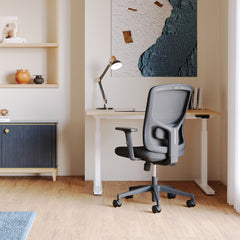
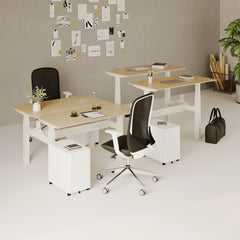
That is one reason clean two-screen setups often begin with the desk itself. Well-proportioned ergonomic office desks create a stronger foundation for dual monitors because they make spacing, alignment, and movement easier to manage.
Wide desks still need boundaries
A larger desk does not automatically solve visual clutter. In fact, wide surfaces can sometimes encourage objects to spread out with no clear zones. The monitor area benefits from a defined footprint. Once the screen zone expands too far, the setup can look fragmented rather than spacious.
Corner desks require more careful sightline planning
A corner desk can support two monitors well, but the angle of the workstation changes how the support system is perceived. A stand that works beautifully on a straight desk may look bulky in a corner if it pushes the screens too deep into the angle or forces accessories into awkward side pockets. In those cases, flexible supports and tighter monitor spacing tend to create a cleaner result.
Layout Rules That Make Two Monitors Feel Intentional
Align the top lines before anything else
When two monitors differ slightly in size or proportion, people often try to center them at the midpoint. Visually, that is not always the cleanest approach. Matching the top edges usually produces a neater and more controlled line. The desk immediately looks more deliberate because the monitors share a visual horizon.
Keep the monitor gap narrow but breathable
A wide gap between screens makes the workstation feel split in two. A gap that is too tight can feel cramped, especially with larger displays. The cleanest result usually comes from a narrow, intentional spacing that lets the screens read as a pair without merging into one oversized block.
Preserve negative space around the outer edges
One of the easiest ways to reduce visual clutter is to leave some desk surface visible around the monitor zone. When objects press too closely against the outer edges of the screens, the entire setup feels compressed. A little negative space helps the workstation look lighter and easier to navigate.
Use a clear hierarchy for primary and secondary tasks
If one monitor is clearly the main screen, let the layout reflect that. Keeping the primary monitor centered and the secondary monitor slightly offset often creates a cleaner composition than forcing both displays into equal visual weight. This is especially useful in workstations where one screen is used constantly and the other supports only specific tasks.
Lighting Can Support a Cleaner Setup or Disrupt It
The wrong lamp can add visual noise fast
Lighting is often treated as a separate styling decision, but on a two-screen desk it has direct visual consequences. A large base placed between the monitors, a visible tangle of lamp cords, or multiple small lights competing near the screens can undo the clarity created by a good stand.
Flexible task lighting works best when space is limited
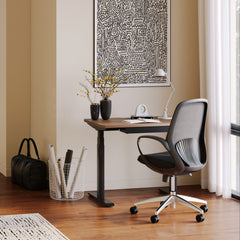
A compact, adaptable light source tends to suit dual-monitor layouts better than a bulky decorative lamp in the center of the desk. The Alumina LED lamp fits this type of role well because it can support focused lighting without demanding the same visual space as a larger desk fixture.
Softer accent lighting can warm up a technical setup
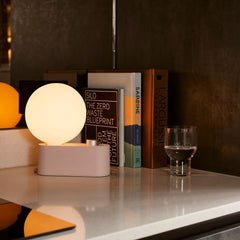
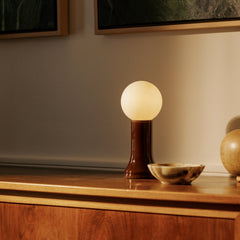
Not every workstation needs to lean fully utilitarian. Some desks benefit from a softer material presence, especially when two screens and darker hardware make the space feel overly technical. In those cases, a piece like the Shore recycled glass table lamp can introduce warmth and texture, provided it sits outside the main monitor zone and does not crowd the support structure.
Place lighting beside the monitor field, not inside it
The cleanest lighting placement is usually at the far side of the desk or slightly behind the main work area. This keeps the monitor zone visually dominant while allowing the light to contribute atmosphere or function without becoming another competing centerpiece.
The Chair, Desk, and Monitors Should Read as One System
A stand cannot fix a workstation that fights posture
A clean setup is not built by monitor support alone. If the chair height forces the user to look too far up or down, the screens will still feel wrong no matter how elegant the stand looks. The visual structure of the desk works best when posture, sightline, and screen placement align naturally.
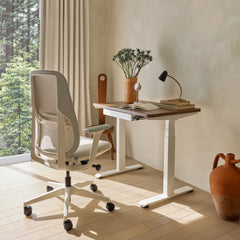
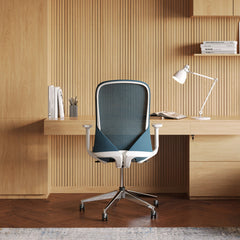
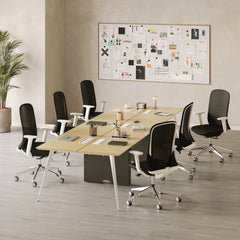
That is where ergonomic office chairs become relevant to the overall monitor strategy. A chair that supports a stable seated position makes it easier to place both monitors at a comfortable and visually balanced height.
The chair also affects visual weight
Large chairs with tall backs or heavy silhouettes can visually compete with the monitor setup, especially in smaller rooms. That does not mean a chair should disappear, but it should feel proportionate to the desk and screen arrangement. When the furniture pieces feel related in scale, the whole workstation becomes easier on the eye.
A Simple Framework for Choosing the Right Monitor Stand Direction
The best choice depends on desk depth, monitor size, and how the screens are used day to day. The table below offers a practical way to compare the most common support directions.
| Support direction | Best fit | Visual effect | Main watch-out |
|---|---|---|---|
| Wide shared riser | Matching monitors and symmetrical layouts | Strong unity beneath both screens | Less flexible positioning |
| Two separate risers | Mixed monitor sizes or distinct screen roles | Controlled asymmetry | Can look disconnected if mismatched |
| Dual monitor arm | Desks that need open surface area | Lightest overall appearance | Requires desk compatibility |
| Single arm plus secondary riser | One main screen and one support display | Clear hierarchy | Needs careful alignment |
| Low-profile stand near the wall | Shallow desks and minimal setups | Reduced visual depth | Limited repositioning range |
Styling Moves That Keep the Desk Minimal Without Feeling Empty
A visually calm workstation should still feel lived in and functional. The difference is that each visible object earns its place.
1. Keep only essential items inside the monitor zone.
2. Move chargers, hubs, and small tools below or behind the screen line.
3. Limit the number of finishes so the setup feels cohesive.
4. Use one intentional light source instead of several competing ones.
5. Let some of the desktop remain visible so the desk feels open.
These small decisions shape how the monitor stand performs visually. Even a strong support system can disappear into clutter if the surrounding area becomes overloaded.
Designing a Two-Screen Workstation That Stays Visually Quiet
The strongest dual-monitor setups are not necessarily the most complex. They are the ones where the support, furniture, and accessories share the same goal. The desk surface stays readable. The monitors feel aligned. The lighting supports the work instead of crowding it. The workstation looks calm because its structure is calm.
That is also why inspiration matters. Looking at broader modern workspace inspiration can help clarify how desks, seating, lighting, and monitor support work together as a whole rather than as isolated purchases. In a clean two-screen environment, every piece contributes to the same visual message: less friction, more focus, and a workstation that feels open without giving up practical function.
The best monitor stand ideas for two-screen workstations are the ones that remove excess weight, reinforce hierarchy, and protect the negative space that makes a desk feel usable. When that foundation is handled well, the rest of the setup becomes easier to shape, easier to maintain, and far less likely to drift into visual clutter.
Related Articles
-
 How Filing Cabinet Storage Supports Office Desk Must Haves
-
 Filing Cabinet Ideas for Better Office Furniture Accessories
-
 Best File Cabinet for Home Office Storage That Feels Easy
-
 Better Multiple Monitor Desk Setup Starts With One Stand
-
 Make Laptop and 2 Monitor Setup Work With Better Stands
-
 Why Dual Monitor Comfort Needs a Monitor and Laptop Stand


