



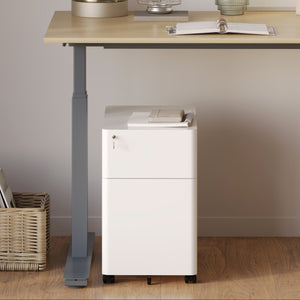






















Filing Cabinet Choices for Cleaner Workstation Planning
Cleaner workstation planning starts with filing storage that matches the desk, document volume, security needs, and daily workflow. Explore how cab...
Learn more
Visit quiz page to see how we makes it easy to create an inspiring workplace


A 6×8 home office sits at the threshold between possibility and limitation. It is large enough to support serious work, yet compact enough that poor layout decisions are immediately felt. In a space this size, desk placement is not a stylistic choice. It is a functional strategy that determines how comfortably you sit, how freely you move, and how long the room remains usable as your work evolves.
Effective desk layouts for a 6×8 room are grounded in spatial logic, realistic furniture proportions, and an honest understanding of how people actually work day to day. When these elements align, even a small office can feel composed, efficient, and surprisingly adaptable.
A 6×8 room provides 48 square feet on paper, but far less in practice. Once movement, seating, and posture changes are accounted for, the usable area shrinks quickly.
Measured space defines walls and corners. Functional space defines what your body needs. Chair slide-back distance, leg extension, and the ability to stand without obstruction all consume space that is rarely visible in floor plans. In a compact office, ignoring these zones leads to layouts that technically fit but feel restrictive after extended use.
Most office layout guidance assumes deeper rooms and wider circulation paths. In a 6×8 office, oversized desks and bulky furniture compress the room and disrupt flow. Successful layouts rely on proportion, restraint, and deliberate placement rather than maximizing surface area.
Before selecting furniture, the room itself must be assessed honestly. Fixed architectural elements define what layouts are realistic.
Door swing direction can remove an entire wall from consideration. Windows influence glare and depth perception. Outlets affect cable routing and desk placement. A layout that ignores these constraints often introduces friction into daily use.
What you see while seated matters in small rooms. Facing a close wall can feel confining, while a longer sightline across the room creates visual breathing room. Desk layouts that preserve depth tend to support focus and comfort more effectively.
Wall-aligned desks are among the most reliable solutions for 6×8 home offices. They keep the center of the room open and simplify circulation.
Desk depth is the most critical dimension. Excessively deep desks push seating too far into the room, reducing usable space. Desks with controlled depth and balanced width integrate more naturally into compact layouts.
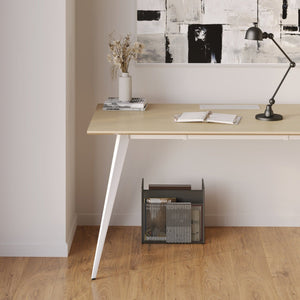
Collections of modern desks designed for home offices often emphasize clean profiles and practical proportions, which aligns well with the demands of smaller rooms.
Even with a wall-aligned desk, the chair must slide back far enough to allow standing comfortably. This clearance zone should remain unobstructed by storage or decorative elements to preserve ease of movement.
Corners are frequently underutilized in small offices, yet they can significantly improve layout efficiency when used correctly.
Placing a desk directly into a corner maximizes wall usage but can restrict legroom. Angling the desk slightly outward often improves comfort and creates a more open feel without increasing the footprint.
Corner placements naturally reduce exposure to doorways and hallways, which can lower distraction. They also tend to produce cleaner visual backgrounds and more controlled acoustics during calls.
Desk type influences not only posture, but also how flexible the room remains over time.
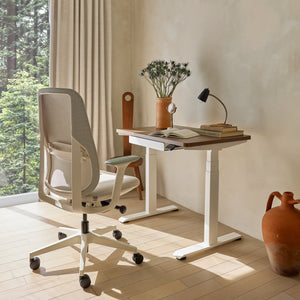
For writing, laptop-based tasks, and focused administrative work, fixed-height desks offer simplicity and visual calm. Their reduced mechanical complexity often results in a lighter presence within the room.
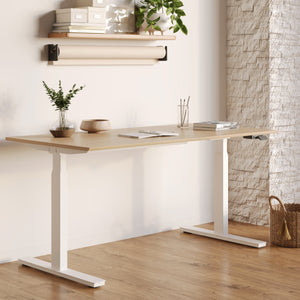
A height-adjustable standing desk can function well in a 6×8 room when surrounding clearances are respected. The key is selecting a design that balances movement with proportion, rather than dominating the space.
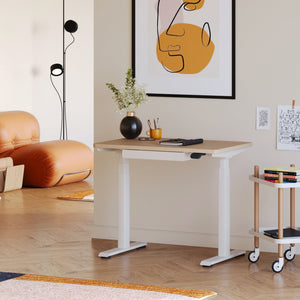
In particularly tight layouts, a compact standing desk for small offices introduces posture variation without overwhelming the room. These designs prioritize essential functionality while preserving circulation and openness.
In small offices, chair selection often determines whether a layout works at all.
Seat depth affects how far the chair extends into the room. Arm width influences lateral clearance. Recline range determines how much space is needed behind the chair. Each of these factors must be considered alongside desk placement.
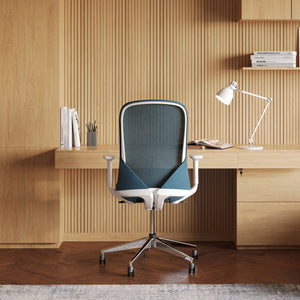
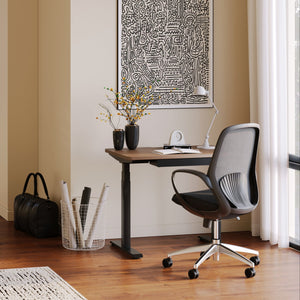
Effective support does not require oversized frames. Many ergonomic office seating options are designed to provide proper alignment while maintaining a relatively slim profile, which is essential in compact rooms.
The Novo ergonomic office chair emphasizes streamlined support and a lighter visual presence, making it well suited for layouts where openness is critical. The Onyx ergonomic office chair offers a more structured feel while still respecting spatial constraints, demonstrating how ergonomic seating can adapt to small offices without dominating them.
Translating spatial principles into real-world setups helps clarify what works in practice.
This layout relies on a narrower desk and minimal accessories. The chair tucks fully under the desk when not in use, preserving floor space. Storage is handled vertically or outside the immediate work zone.
Dual monitors require careful planning. Monitor arms reduce desk depth requirements and improve adjustability. The desk must remain stable while allowing sufficient clearance for posture changes.
When storage is necessary, vertical solutions outperform under-desk drawers. Keeping the area beneath the desk clear maintains legroom and reduces visual clutter.
| Layout Type | Desk Width Range | Seating Clearance Focus | Primary Use |
|---|---|---|---|
| Laptop-focused | Narrow to moderate | Rear clearance | Creative and writing tasks |
| Dual-monitor | Moderate | Balanced rear and side clearance | Remote professional work |
| Hybrid storage | Moderate | Under-desk openness | Mixed tasks with storage needs |
Lighting must be considered alongside desk placement to maintain comfort and clarity.
Placing the desk perpendicular to windows often minimizes glare while preserving brightness. This orientation also supports better depth perception in compact rooms.
Tall or bulky furniture placed too close to the desk can make the room feel compressed. Keeping the immediate work zone visually light helps the space feel calmer and more balanced.
Dimensions and photos do not always convey how furniture behaves in a small room. Experiencing pieces in person often reveals proportion issues that are not obvious online.
For many homeowners, exploring office furniture in person provides clarity around scale, finish, and how desks and chairs interact within real spatial boundaries. This perspective can prevent layout mistakes that only become apparent after installation.
A successful small office supports change rather than resisting it. Work habits evolve, and the room should adapt without constant reconfiguration.
Layouts that preserve open floor space, desks that support multiple workflows, and seating that accommodates posture variation all contribute to longevity. In a 6×8 home office, the most effective designs are not defined by how much furniture fits, but by how naturally the space supports daily work without friction or distraction.


You have unlocked free shipping!
You're saving $29 and unlocked free shipping!
Leave a comment