





Skip to content
For Teams
Spring Sale Ends Soon: Save 15% on WFH Bestsellers + Free Shipping on Orders $65+ | Use Code SPRING15
FAQ
need to know
Useful articles
Cable management for standing desk: simple guide for home offices

Cable management for standing desk: simple guide for home offices

Angled view of the Urbanica Under-Desk Cable Management Tray in gray – a sturdy steel organizer designed to keep cords and cables neatly managed under desks.

Sit-stand cable fundamentals that prevent snags, slack, and connector wear

A standing desk makes one thing unavoidable: movement. Every height change asks your cables to flex, slide, and settle again. In a home office, that movement is usually happening next to a wall outlet, a rolling chair, and a tangle of “temporary” chargers that became permanent. From our perspective at Urbanica, the cleanest setups are not the ones with the most accessories. They are the ones designed around a simple truth: cables need a controlled path through the full range of motion.

The travel range problem: what changes when the desktop lifts

When a desk rises, the distance between your devices and your outlet increases. When it lowers, extra length has to go somewhere. If that “somewhere” is the floor, you get dragging cords and chair snags. If it is a tight coil under tension, you get strain on connectors, especially at laptop and monitor ports.

Two measurements that stop most mistakes

  • Minimum height measurement: desk at its lowest, note how much cable length is actually needed without any coils touching the floor.

  • Maximum height measurement: desk at its highest, note how much additional length is needed so nothing pulls tight.

Those two checkpoints define how much slack you truly need, and where that slack should live.

Build a cable map before you mount anything

Cable management is easier when you decide on “lanes” first. For most home offices, three lanes cover everything:

  • Power lane: power strip cable, monitor power, laptop charger, task light power.

  • Data lane: USB-C, HDMI or DisplayPort, Ethernet, audio interfaces.

  • Peripheral lane: webcam, microphone, speakers, desk fan, small accessories.

Separating lanes is not about perfection. It is about serviceability. When power and data are bundled into one rope, a simple swap, like changing a monitor cable, forces you to unbundle everything.

Desk structure matters more than people think

A desk’s underside geometry determines where clips can stick, where a tray can sit, and where your “movement slack” can hide. If you are planning your setup around a specific desktop footprint and underside clearance, it helps to start with the exact desk you are working with, such as our Office Desk. (URBANICA)

The clean loop method for standing desks that keeps cables controlled at every height

In home offices, most cable mess comes from slack that has no job. The clean loop method gives slack a job: it becomes a single, intentional movement zone that flexes when the desk moves, while everything else stays anchored.

Step-by-step: how the clean loop works

1. Create a fixed zone under the desktop where cables are secured and protected.

2. Create one slack loop that can expand and contract as the desk moves.

3. Create one controlled drop from desk to wall or floor that stays out of the chair path.

Anchor points: what stays fixed vs what moves

  • Fixed: power strip, power bricks, dock, extra cable length.

  • Moving: the slack loop, plus only the cable segments that must move with the desktop.

If you treat the whole cable run as “moving,” the cables will drift. If you treat the whole run as “fixed,” something will pull tight. The method works because you deliberately separate the two.

The loop: a single slack zone beats random slack everywhere

The loop should sit where it is not visible and not in the way, typically under the back edge of the desktop, slightly offset to the side where your outlet is. It should be big enough to handle the full height change, but not so big that it droops into knees or the floor.

The drop: one path from desk to wall

Choose a single exit point for cables leaving the desk system. Multiple drops look messy and they invite snags. One drop is also easier to protect with a floor channel or tight wall-side routing.

Clean loop checklist for a first-time home office setup

  • Measure desk at minimum height and maximum height

  • Choose a single routing side based on your outlet location

  • Decide your fixed zone under the desktop

  • Separate power lane and data lane

  • Create one slack loop that flexes through the full travel range

  • Secure the drop so it stays out of the chair’s rolling lane

  • Run a slow raise and slow lower test, watching for tugging and dragging

Under-desk containment that hides power bricks and cable bulk without creating a mess you cannot service

If the top of the desk looks tidy but the underside is a nest, the setup will not stay clean. Home offices change constantly, and you need an underside layout that is easy to access when you add a device.

The “power core” concept: one containment zone for everything bulky

Power strips, adapters, and charging bricks are visually loud. They also create the most friction when you want to re-route. A power core is a single containment area where you keep:

  • power strip

  • power bricks

  • excess cable length

  • the point where cables split into power lane and data lane

The goal is not to bury everything forever. The goal is to keep bulk in one predictable place so you can troubleshoot without pulling cables across the floor.

Mounting strategies that work for renters and permanent setups

Different home offices require different levels of commitment. A practical approach is to choose mounting methods based on whether you need reversibility.

Screw mount, clamp, or adhesive: what to prioritize

  • Screw mount: most secure, best when you own the desk and want maximum stability.

  • Clamp mount: good for desks with suitable edges, easy to reposition.

  • Adhesive: best for renters or when you want minimal tools, but it requires a clean surface and realistic expectations about long-term hold.

A tray helps contain clutter while keeping it reachable

A dedicated under-desk organizer creates a natural “home” for power bricks and excess length so the underside stays readable. Our Under-Desk Cable Management accessory is built for concealing and organizing cords and cables under a desk to reduce clutter. (URBANICA)

Practical placement rule that improves comfort

Position the power core toward the rear underside, behind where your knees travel. That placement keeps leg space open and makes the desktop look cleaner from the seated view.

Vertical cable control from desktop to floor that prevents dangling cords

Once your cables are contained under the desk, the remaining challenge is the drop to the outlet. In a standing desk setup, that drop must be flexible. A rigid drop will pull tight at max height. A loose drop will tangle at min height.

When a vertical organizer is the best move

A vertical organizer becomes more valuable as you add peripherals:

  • dual monitors

  • laptop plus external dock

  • microphone or webcam

  • speakers or audio gear

The more cables you have leaving the desk system, the more important it is to keep them bundled in a single, protected path.

Placement rules that keep the drop invisible in daily use

  • Route the drop behind a desk leg whenever possible.

  • Exit the desk system from a rear corner rather than the center.

  • Keep the floor segment close to the wall so it is not in the walking lane.

Chair-safe routing: protect the rolling lane

Before you fix anything in place, roll your chair through the area where you naturally move. That path is your rolling lane. The cable drop should never cross it.

A spine-style drop keeps sit-stand motion controlled

A spine-style vertical organizer can guide cables from desk to floor while flexing with movement. Our Spine Cable Management accessory is designed to organize and conceal cables in a structured vertical path rather than leaving them hanging loose. (URBANICA)

Cable length, labeling, and bundling rules that keep a home office serviceable

The best cable management is not just hidden. It is understandable. When something stops charging or a monitor flickers, you should be able to trace the path without dismantling the whole system.

The too-long cable trap and what to do instead

Long cables are common in home offices because devices move and rooms vary. The problem is not the length. The problem is where the length ends up.

  • Avoid leaving coils on the floor where dust, pets, and chair wheels find them.

  • Avoid tight coils under tension that pull on connectors.

  • Prefer storing extra length inside the power core, in loose, gentle loops.

Protect connectors with bend-friendly routing

Sharp bends near a USB-C port or a monitor power brick are a quiet cause of failure. Give cables a gentle curve, especially where they leave the desktop and where they enter devices.

Labeling that is useful without looking like a server room

Label only where it solves a real problem:

  • the plug side at the power strip

  • the device side for look-alike cables, such as similar USB-C leads

A simple naming style works well in a home office:

  • “Monitor 1 power”

  • “Monitor 1 video”

  • “Dock power”

  • “Webcam”

Bundling do’s and don’ts for reliability

  • Bundle power with power, data with data.

  • Do not compress power bricks together in a tight stack.

  • Use gentle bundling so you can add or remove a cable without cutting everything apart.

Common home office cables and the cleanest routing choice

Cable type Typical devices Cleanest path in a standing desk setup Mistake to avoid
AC power cords monitors, chargers, task lights power lane into under-desk containment, then single drop letting cords hang below the desktop edge
USB-C laptop to dock, monitor to laptop data lane secured under desk, short run to device tight bends at the laptop port
HDMI or DisplayPort monitor video data lane with minimal slack, kept separate from power bundling with power into one thick rope
Ethernet router to dock data lane that stays fixed, with gentle slack loop routing across the floor in the walking lane
Audio cables speakers, mic interface peripheral lane, routed away from power bricks running directly over power adapters and transformers


Monitor, laptop, and dock layouts that reduce cable count at the source

A cleaner standing desk starts with fewer cables on top. The most effective strategy is to choose a single exit point for devices and keep the rest under the desk.

The single exit point goal for a working desktop

Aim for one visible cable group leaving the desktop area:

  • one power lead if needed

  • one primary data connection, often USB-C to a dock

  • minimal peripheral leads

When everything routes to a dock under the desk, the desktop becomes easier to keep tidy, and the clean loop has fewer moving parts.

Two-display standing desk routing without the spaghetti effect

Dual monitors often double cable mess because you get:

  • two power cords

  • two video cables

  • sometimes USB connections for monitor hubs

A practical approach is to route both monitors into the under-desk fixed zone first, then let only the essential movement slack live in the clean loop.

Keep video runs sensible

Video cables can be less forgiving than power when bent sharply or stretched. Keep them gently routed and avoid unnecessary length dangling outside the fixed zone.

Desktop edge control for daily charging that stays tidy

Even a perfectly routed underside can be ruined by a single charger draped across the work surface. Daily charging is a behavior problem as much as a hardware problem, so the system needs to support real habits.

The daily grab rule: chargers must be reachable, not wandering

Phone and accessory chargers work best when they have:

  • a consistent home at the same edge of the desk

  • a short visible run

  • hidden slack stored under the desk

Micro-routing that prevents visible clutter

Use small guides under the front edge to keep a charger from sliding across the surface. Route the cable down immediately into the underside zone so the desktop stays visually calm.

Define a clean boundary between desktop and under-desk zones

A good home office standing desk has a clear boundary:

  • top surface for work tools

  • underside for power, slack, and routing

That boundary keeps the setup stable as you add or remove devices.

Chair movement and floor safety that prevent snags in tight home offices

Home offices are often compact. That means your chair moves closer to cables, and the risk of snagging rises sharply. Cable management that ignores chair motion rarely survives a full week.

The rolling lane concept for snag-free floors

Your rolling lane is the path your chair takes most often. The rule is simple: do not place cables where the chair naturally rolls.

Floor routing that stays out of trouble

  • Keep any floor-level cable path along a wall line.

  • Avoid crossing open floor space, even if it looks tidy at first.

  • Leave enough slack near the wall so you can pull the desk out for cleaning without yanking connectors.

Chair choice affects cable outcomes more than people expect

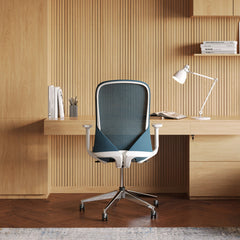
A chair that encourages constant scooting can unintentionally pull you into cable territory. If you are comparing seating options that match the way you work, start with the full Urbanica Chairs collection. (URBANICA)

Stable posture support and cleaner cable habits

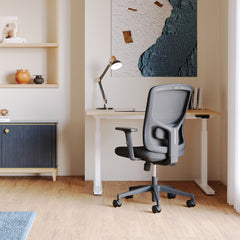
When seating promotes stable posture, people tend to reposition less aggressively, which helps keep floor routing intact. The Ergonomic Novo Chair is one option in our lineup to consider when planning a compact workspace where chair movement and cable paths overlap. (URBANICA)

Controlled mobility still needs protected routing

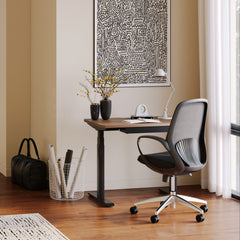
If you prefer a chair with a different feel, plan the floor and drop routing to account for rolling. The Ergonomic Onyx Chair is another chair model in our collection that you can reference while mapping chair clearance and cable drop placement. (URBANICA)

Outlet strategy and room layout that make cable management feel effortless

Cable management becomes “set and forget” when the room layout supports it. Even a great under-desk system will struggle if the outlet is far away or the desk floats in the middle of the room without a plan.

Choose the routing side before you mount anything

Pick a side for the drop based on:

  • where the outlet is

  • where your chair moves

  • where you enter and exit the workspace

Then build the entire system to feed that side. Consistency prevents the gradual creep where cables migrate across the underside.

Floating desk routing without creating a trip hazard

If your desk must sit away from the wall, the safest approach is still a single controlled drop, then a protected route to the outlet line. Keep that route tight and predictable, and avoid running cords diagonally across the floor.

When you want ordering and service details for a specific metro delivery area

For customers who want clarity on service contacts and ordering details tied to a major city delivery region, the delivery and ordering FAQ page provides that context. (URBANICA)

Upgrade-ready standing desk cable management that survives new gear and changing routines

Home offices evolve. A clean setup should not collapse the moment you add a microphone, swap a monitor, or move your printer. The most durable systems are designed for change.

Design for swaps: the one open lane rule

Always leave one unused path or clip route under the desk. That open lane is what keeps a simple upgrade from turning into a full teardown.

Standardize connection points so changes are local, not global

When possible, keep a consistent “hub area” in the fixed zone:

  • power core stays in one place

  • dock stays in one place

  • labeled connections stay grouped

Then when something changes, only one segment of the system changes.

A lightweight maintenance routine that prevents regression

Cable setups drift. Gravity, cleaning, and small device changes pull things out of place. A simple routine keeps it steady:

  • re-seat the slack loop so it stays off knees and off the floor

  • confirm the drop remains behind the leg and out of the rolling lane

  • check that power and data lanes are still separated and readable

Final quality check from every angle

A standing desk setup can look clean from the front but messy from the side. A quick angle check catches issues early:

  • Seated view: confirm nothing dangles into leg space

  • Standing view: confirm the drop is not visible and not pulling tight

  • Side view: confirm the underside looks intentional, not tangled

  • Floor view: confirm cables do not cross walking paths or chair paths

Previous article Mini Standing Desk Setup Tips That Prevent Wrist and Shoulder Strain

Leave a comment

* Required fields

Get 10% off your first order

Find the office furniture that’s designed to match your style, comfort, and needs perfectly. Subscribe

My Office

You have unlocked free shipping!

You're saving $29 and unlocked free shipping!


Your cart is empty.
Start Shopping

Contact Us