



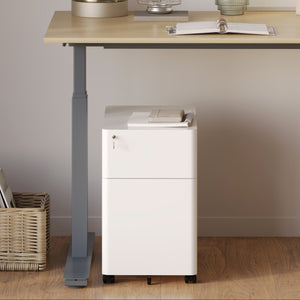






















Filing Cabinet Choices for Cleaner Workstation Planning
Cleaner workstation planning starts with filing storage that matches the desk, document volume, security needs, and daily workflow. Explore how cab...
Learn more
Visit quiz page to see how we makes it easy to create an inspiring workplace


Affordable is not the same as minimal. It means the chair gives you the ergonomic essentials that protect comfort and posture, plus the component quality that holds up to everyday use. The trick is separating features that matter from features that look impressive in a product photo.
A practical way to frame affordability is by workload, not hype. A chair that feels fine for quick emails can become distracting when the same seat supports deep work, calls, and long sessions. The goal is matching the chair’s adjustment range and build quality to how you actually sit.
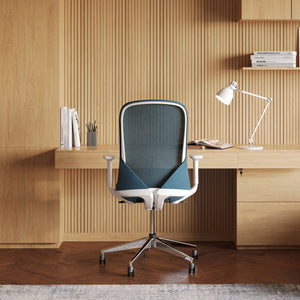
When shopping broadly, start by scanning a curated category for the main silhouettes and mechanisms, then narrow down. That avoids getting locked into one model before you know what you need. Urbanica’s office chair lineup is a useful starting point for comparing shapes, materials, and intended use at a glance.
A chair can look supportive while missing the fundamentals that keep you comfortable over time.
Limited adjustment range: If seat height, recline tension, or armrest height does not fit your body and desk, you compensate with your neck, shoulders, and hips.
Weak load-bearing parts: The base, casters, cylinder, and tilt mechanism do the heavy lifting. These are often where low-end chairs feel unstable, creak early, or loosen over time.
Thin product disclosure: If a listing lacks clear dimensions, materials, weight rating, or warranty information, it is harder to predict fit and longevity.
Durability is often about avoiding the stress points that break first. Focus on a stable base, smooth recline, usable adjustability, and materials that match your room conditions. Comfort is not only softness. Comfort is fit plus support plus movement that feels controlled.
Most comfort complaints that show up during longer sessions start at the seat. The seat determines how your legs rest, how your pelvis tilts, and how much pressure your tailbone and sit bones take.
A basic fit rule prevents a surprising amount of fatigue: feet flat, knees near a right angle, and hips not forced higher than knees. If the chair is too high, the front edge presses into the underside of the thighs and can reduce circulation. If it is too low, hips roll back and you end up slouching.
A practical test: sit back fully, place both feet flat, and check whether you can keep that position without reaching for the floor or perching on the edge.
Seat depth matters because it determines whether the front edge presses behind your knees. Too deep and you slide forward to create space, which reduces back support. Too shallow and your legs do not feel supported, which can increase pressure on the sit bones.
A fast guideline: sit back with your pelvis against the backrest and aim for about two fingers of space between the seat edge and the back of your knee. Bodies vary, so treat it as a starting point. If your chair includes seat depth adjustment, you gain flexibility across different sitting styles.
Seat width affects how naturally your hips settle. A seat that feels narrow can push the legs inward and create tension. A seat that feels overly wide can make armrests harder to use effectively.
Edge shape matters as much as width. A rounded or waterfall-style front edge reduces pressure under the thighs. You do not need technical language to evaluate it. If the seat edge feels sharp or you notice tingling in the legs during a longer sit, that is a signal to reassess.
Many chairs feel great for the first minutes because the foam is soft. Long-term comfort is about the foam holding its shape while spreading pressure. A seat that bottoms out concentrates pressure at the sit bones and tailbone.
Use a simple test in-store: sit for several minutes, shift slightly, then return to center. If the seat immediately feels compressed and thin in the middle, it may lose support sooner than you would like.
Sit back fully with your hips centered.
Place your hands under your thighs near the seat edge.
If you feel strong pressure at the edge, seat height or edge design may be mismatched.
Shift weight gently left and right. If you find one spot that always feels sharp, the cushion or shape may be concentrating pressure.
Back support is where comfort and durability overlap. A backrest that holds you in a healthy position reduces fatigue. A backrest and mechanism that wobble or loosen can create constant micro-adjustments, which become distracting over time.
Lumbar support works when it meets your lower back where your curve naturally sits. Some chairs use a fixed lumbar shape, while others allow lumbar height or depth adjustment.
A good evaluation is immediate: you should feel support, not a hard bump. If you feel pushed forward aggressively or if the support hits too high, it can encourage you to perch forward, which defeats the purpose.
Higher backs can feel comforting, especially during recline, but height alone does not guarantee comfort. The backrest should support the mid-back and allow your shoulders to move freely while typing.
If you feel your shoulders being pushed forward or you cannot comfortably pull your shoulder blades back, the backrest shape may not match your frame.
A recline that moves smoothly encourages posture variety, which helps comfort. The key is control. Recline tension should be easy to set so you can lean back without falling back, and sit upright without fighting the chair.
Tilt locks can be helpful, but they should feel secure. A chair that shifts unexpectedly when locked can feel unsettling and may indicate a lower-quality mechanism.
When you compare options, it helps to look at how a chair is presented. The Ergonomic Onyx Chair product page is a useful reference point for checking what a listing communicates about materials, configuration, and what is included. Use it as a template for what you want to see on any chair you consider, especially around measurements and functional details.
Armrests can either prevent fatigue or create it. They are most helpful when they support the forearms lightly so shoulders can relax and wrists can stay neutral.
If armrests are too high, shoulders lift and neck tension follows. If armrests are too low, you tend to hang your arms forward, which increases shoulder load.
A quick check: with hands on the keyboard, elbows should hover near your sides and shoulders should stay down. Armrests should meet your forearms, not push them up.
Arm pad comfort is about surface area and softness. A pad that is too narrow can create pressure points. A pad that is overly soft can compress quickly and feel hard underneath.
Look for pads that feel stable under light pressure and do not shift or twist easily. If the pads feel loose during normal use, they may become distracting later.
Desk fit is not only about aesthetics. The chair, desk height, and armrest height combine to determine wrist angle. When the desk is high relative to your chair, you lift shoulders or bend wrists upward. When it is low, you hunch.
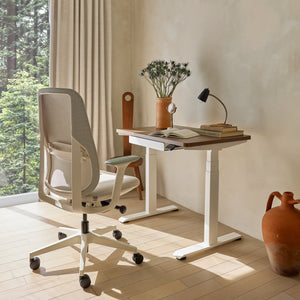
A simple alignment goal: keyboard height that allows forearms to be roughly parallel to the floor and wrists straight while typing. If you are evaluating both pieces together, the Urbanica Office Desk product listing can serve as a reference point for thinking through clearance, legroom, and how your chair will tuck in during work.
Even with a well-fitted chair, small changes help. Lower armrests slightly for typing focus, then raise them for reading or calls if that feels better. The point is flexibility, not one locked position.
Material decisions should match the room and the user. Breathability, cleaning reality, and wear patterns matter more than how a chair looks in a staged photo.
Mesh backs can feel cooler and allow airflow, which is helpful in warmer rooms or for longer sessions. Upholstered backs can feel softer and more structured, depending on the padding and frame.
The durability lens:
Mesh should feel evenly tensioned with no sagging zones.
The frame should not flex excessively when you lean back.
Upholstery should feel taut, with seams that look consistent.
Choose materials you can realistically maintain. Some households prefer quick wipe-down surfaces. Others prefer fabric that feels warmer and resists visible fingerprints. There is no universal best. The safe choice is the one you will actually clean.
Look closely at the edges and seams. Those are common wear points. If you see loose stitching or thin edge finishing, it may show wear sooner.
A chair can feel comfortable but still have structural play. Before deciding, sit and gently shift side to side. The chair should feel stable, not like it is twisting at the base or rocking unpredictably.
If the chair creaks under small movements, it may be the normal sound of parts settling, or it may indicate loose connections. The important question is whether the movement feels controlled.
Most “chair failures” are not dramatic. They are annoying. A caster that rolls poorly, a cylinder that feels unstable, a tilt mechanism that becomes noisy. Screening the component basics reduces the chance of those problems.
A five-star base is standard for stability. Focus on how it feels when you sit down, swivel, and recline. If the base feels light or tips under normal movement, it can undermine confidence even if the seat feels comfortable.
Casters should roll smoothly without forcing you to push off awkwardly. Flooring type matters:
Hard floors benefit from casters that roll without scratching and without sticking.
Rugs need enough rolling ability to avoid constant repositioning.
Carpet needs casters that do not sink and fight movement.
If you plan to use a chair mat, that can reduce wear and improve roll consistency, but it should not be required to make the chair functional.
You do not need to know cylinder classes to judge basic quality. Raise and lower the chair. The motion should be smooth and predictable, not jerky. At your preferred height, the chair should feel stable without slow sinking.
When you recline, the movement should feel consistent. If tension changes abruptly or the chair feels like it drops into recline, that can become tiring. A good mechanism supports movement without surprise.
Sit, swivel, and recline with your weight centered and then slightly off-center. Occasional noise is not automatically a problem, but repeated clicking or grinding sounds during normal motion are signals to slow down and inspect assembly quality and mechanism feel.
It is easy to over-focus on feature lists. The better approach is prioritizing what improves fit for most bodies while avoiding extras that add complexity without clear benefit.
Seat height range that fits your legs and desk.
Stable back support that encourages upright comfort.
Adjustable recline tension so you can move without losing control.
Solid base and casters that keep movement predictable.
These are not flashy features, but they are where comfort and durability live.
Adjustable lumbar positioning for better alignment if fixed lumbar hits the wrong spot.
Seat depth adjustment if you are between sizes or share the chair.
More refined recline tuning if you alternate between upright typing and relaxed reading.
If a feature creates more fiddling than comfort, it becomes noise. Examples include add-ons that feel delicate, controls that are difficult to reach, or features that only work well for a narrow set of body types. The safest path is choosing the most useful adjustments with the simplest, most durable implementation.
For a comparison point, the Ergonomic Novo Chair product page can help you see how a different chair lists its configuration and presentation. Use it to compare how each chair communicates core ergonomic elements and what is included, then decide which aligns with your needs.
A chair can be excellent and still be wrong for the job. The best affordable buying decision comes from matching the chair to the way the space is used.
For long desk sessions, the seat and back support combination matters most. You want a chair that keeps you stable while allowing small posture changes. Armrests help when they fit the desk and your typing posture, but they are secondary to seat and back fit.
If you work in shorter blocks, the chair still needs to be comfortable, but you can prioritize durable basics and a clean mechanism feel. A chair that feels solid and predictable often beats a chair with many features that feel fragile.
For households or offices where multiple people use the same chair, look for easy controls and forgiving fit. Overly specific shapes can feel uncomfortable for someone with a different body type. A chair that is simple to adjust and stable for most users tends to win.
Design can be part of comfort when it supports posture rather than fighting it. When evaluating a chair with a more design-led silhouette, treat it like any other and run the same fit tests. The Muse Chair product page provides a concrete example of how a specific chair is presented, which makes it easier to evaluate what is stated and what is not.
Even a great ergonomic chair cannot replace movement. Comfort improves when your body changes position throughout the day. That can mean recline changes, standing breaks, or simply switching seats for short tasks.
Static posture, even “good posture,” can create fatigue because the same tissues carry the load continuously. Small changes distribute pressure and encourage micro-movement, which can reduce stiffness.
A secondary chair makes sense when it supports shorter tasks that do not need full ergonomic dialing-in. Examples include:
Quick calls
Reading and review sessions
Laptop work that benefits from a slightly different posture
Creative sessions where you shift positions more often
Stability and comfort come first. The chair should feel steady, easy to get in and out of, and comfortable for shorter sessions without encouraging a deep slouch.
If you are comparing an accent-style seat for shorter use, the Seashell Chair product page offers a specific reference for assessing design, dimensions, and intended use. The same honesty rule applies. If it is meant for shorter sits, it should be treated as a supporting chair, not a substitute for a full ergonomic task chair.
Buying an office chair should feel straightforward and transparent. A chair is a daily-use product, so trust signals matter.
Use a timed sit, not a quick perch. The goal is to let your body notice pressure and alignment.
1. Sit back fully and set height so feet are flat.
2. Type posture test, shoulders relaxed, wrists neutral.
3. Recline slightly, then return upright. Check if the chair feels controlled.
4. Shift weight gently side to side. Check for wobble.
5. Stand up and sit down again. Notice whether the chair feels consistent, not loose.
A warranty does not guarantee perfection, but it can signal how the brand thinks about longevity and support. Look for clarity around what is covered and how service is handled. The more precise the terms, the easier it is to set realistic expectations.
A well-designed chair should assemble without forcing parts into place. If assembly requires awkward force, it can create stress on connections that leads to squeaks later. Clear instructions and sensible packaging reduce that risk.
For buyers who value straightforward logistics, the delivery and showroom support information page helps set expectations around service and fulfillment details. The safest shopping experience is one where shipping, support, and policies are visible before checkout.
This checklist is designed to be used quickly while still being strict enough to protect comfort and longevity. It avoids guesswork, avoids hype, and focuses on what you can verify by sitting, inspecting, and reading basic product information.
Feet flat test: Can you sit with both feet flat and thighs supported without pressure behind the knees?
Seat depth test: Is there a small gap behind the knees when you sit all the way back?
Edge comfort test: Does the seat edge feel rounded and non-restrictive under the thighs?
Tailbone pressure test: After several minutes, does the center of the seat still feel supportive rather than compressed?
Lumbar placement test: Does the lumbar support meet your lower back comfortably without pushing you forward?
Shoulder freedom test: Can you keep shoulders relaxed while reaching the keyboard and mouse?
Base stability: Does the chair feel planted when you sit, swivel, and recline?
Caster roll: Does it roll smoothly on your floor type without sticking or skidding?
Cylinder feel: Is height adjustment smooth and stable at your preferred height?
Recline control: Is recline tension adjustable enough to feel predictable?
Wobble test: Does the chair resist twisting and side play during normal movement?
Noise check: Are movements mostly quiet and consistent without repeated clicking or grinding?
Dimensions and materials are clearly described: You can confirm whether it fits your body and space.
Policies are visible: Returns and warranty terms are easy to find and understand.
The product description matches how it feels: The chair performs the basics without relying on flashy claims.
Support is straightforward: You know where to go if you need help with setup or concerns after delivery.
Use a three-tier decision label as you shop:
Pass: Fit and comfort tests succeed, movement feels controlled, and trust signals are clear.
Consider: One minor mismatch that can be solved with adjustment or a small change in setup.
Avoid: Seat pain, unstable recline, noticeable wobble, unclear policies, or missing product details.
A chair can be a good value without making big promises. The safest “deal” is the chair that meets the fit checklist and feels structurally steady. If a chair fails the comfort tests in the store, it rarely improves later. If a chair feels unstable or loosely built, that instability tends to become more noticeable with time, not less.
Use the checklist every time, and the decision becomes much clearer. The chair that fits your body, matches your desk, and feels mechanically solid is the chair that stays comfortable and dependable through everyday work.


You have unlocked free shipping!
You're saving $29 and unlocked free shipping!
Leave a comment