





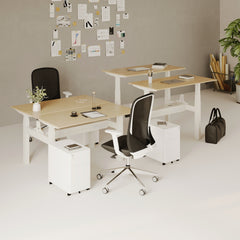
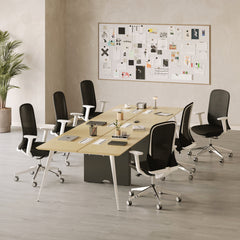




What to Check Before You Buy Conference Room Chairs for Your Meeting Room - Urbanica Furniture's Checklist
People often order conference room chairs last and in a hurry, once the table is in and the first meeting is already on the calendar. They're also the part of the room every person at the table feels from the first minute.
TLDR
A set of conference room chairs has to pass three tests: it fits the table, suits the room, and arrives as planned. But there is much more to it than that. In this article, I'll walk you through the checklist I recommend our B2B clients use before any purchase order, so the set you buy fits the room, the table, and, most importantly, your people.
Here's what we're covering:
We start with the table itself, with the two measurements that decide whether the chairs fit. The first is where the armrests land against the table's edge. The second is the room the seat leaves under the top.
After that, the people. Who sits in the chair, and for how long, decides what kind of chair the room needs.
I'll also look at how the chairs move around the table and how the set's color works with your table's finish.
By the end, you'll know how many chairs to order, what the set costs, and which terms to have in writing before anyone signs.
Who This Article Is For
- You're choosing chairs for a meeting room your team and visitors will use every day.
- You're replacing worn chairs around a table that's staying put.
- You're the office or facilities manager signing off the chair order for one meeting room or several.
- Clients sit in this room, so the chairs have to look right from the doorway and still feel right when a meeting runs long.
- You've put a meeting table in your office for client calls and visitors, and it needs matching chairs.

Ben P.
Brand Manager, Urbanica Furniture
Author's Note
Most of my working week happens at home, yet I end up sitting in other people's meeting rooms a lot, and because I'm working with Urbanica Furniture, I look at the furniture every time I step into a new meeting room (and try to fit in my head Urbanica’s products in the space obviously 😉).
But I've noticed that some meeting rooms are, let's put it gently, better planned than others. The meeting rooms that did look good usually had someone planning the room's vibe, imagining how all the pieces connect, and how the people who sit will feel.
I also notice whether chairs slide under the table or stay parked a foot back, whether people are still sitting back in them forty minutes in, or have moved forward to perch on the edge of the seat.
Whether chairs slide in and people stay comfortable comes down to a few measurements and a few questions about who uses the room. Speaking with B2B clients day to day, along with our B2B project managers and the team, helped me build a go-to checklist that I run and recommend to clients before starting any project.
I'm assuming you've already chosen your table, since this article focuses mainly on the chairs. If you haven't picked one yet, start with the article where I compare our conference chairs and meeting tables, which begins with the room and the table, and come back here once the table is settled.
So I'll use my personal experience and research to actually try to help you catch up and understand what to look for in conference room chairs. And if you find any value in it, please share it with your friends, colleagues, and anyone who's about to order chairs for a meeting room and wants the whole set right in one order.
Disclaimer: I did use AI to help me write and do the research, but I'm editing myself, verifying the facts, and writing my own conclusions and takes.
This article is part of our On-site Office Fit-Outs and Teams category, which focuses on furnishing a workspace for a team rather than one person. We have many related articles that walk you through the rest of the room.
Ok, let's start!
Your Table Is the Measuring Stick for Conference Chairs, so Start There
The table you already own is the best measuring stick for the chairs that go around it. Two numbers taken from it settle the fit, the first check on the list: how high the underside of its edge sits off the floor, and the room that height leaves above a seat. A tape measure gets you the first in a minute, and the second is a quick sum.
Armrests That Clear the Edge Let Every Chair Slide All the Way In
The first thing we are measuring is the armrests. An armrest that sits higher than the underside of your table's edge hits the table before the seat gets close. The person in that chair spends the meeting several inches back from the top, leaning in to write, and when the meeting ends, the chair stays out in the walkway instead of tucking in under the table.
Cornell University's ergonomics researchers publish their teaching notes on sitting and chair design online. The notes say it plainly: "armrests shouldn't limit chair access if it is to be used at a table."
The Health and Safety Executive (HSE), the UK government body that regulates health and safety at work, makes the same point in its guide to seating. It says armrests should be set back or adjustable "to allow the chair to be drawn up close to the work surface."
So before I look at any chair, I measure from the floor to the underside of the table's edge, or to the bottom of the rail if the table has a frame running under its top.
The height from the floor to the underside of the edge, or to the bottom of the rail, is the ceiling for the armrests. A chair whose arms sit below it slides in, and a chair whose arms sit above it stays out.
Our Conference Chair has open chrome armrests shaped as a loop that runs back into the frame, with a padded top where your forearm rests while you listen. Exactly that kind of top Cornell's notes mentioned: armrests that are "padded and engage the fleshy part of the forearm."
Whether those arms slide under your table depends on the height you just measured, so send it to us through the “For Teams” page, and we'll check it against the chair before you order.
The Room Between the Seat and the Underside of the Top Is Where Everyone's Legs Go
The second thing we measure decides whether people can sit close once the arms clear. Cornell's notes set a fixed seat height of about 17 inches off the floor and call it a compromise. Treat it as a typical seat: if the chairs you're looking at sit higher, the room under the table shrinks by the difference.
HSE looks at the space between the seat and the top from the table's side. It names about 30 millimeters, a little over an inch, as a typical maximum thickness for a work surface because a thicker one leaves less clearance for the thighs and reduces how many people can sit comfortably.
You can work out your own gap with the measurement you already took: whatever is left after you subtract 17 inches is the room for the thighs.
A 30-inch-high table with a 1-inch top has its underside at 29 inches, leaving about 12 inches above a 17-inch seat. Add a four-inch rail under that same top, and the room drops to about eight.
Eight inches is tight for anyone with long legs, especially once they cross them. If your leg room comes out that low, tell us when you send the measurement, and we'll check the room under your table against our chairs before you order.
The height from the floor to the underside of the edge, or to the bottom of the rail, is the ceiling for the armrests. A chair whose arms sit below it slides in, and a chair whose arms sit above it stays out.
Ben P., Urbanica
Who Sits at the Table, and for How Long, Decides How Much Chair the Room Needs
Once a chair fits the table, the next question is about the people in it. A room booked for meetings of one to four hours needs something different from the chairs than a room a team takes over for a whole week for 8 focused hours a day, and a room clients walk into needs something else again.
So before choosing the model, I write down three things about the room: how long its meetings usually run, who sits in it, and whether anybody stays at the table to work.
Meetings That Run an Hour to Even Four Hours Are What Our Conference Chair Is Built For
Our Conference Chair is built for short and long meetings most rooms actually hold: presentations, planning sessions, interviews, and weekly team discussions. It has a padded seat and a tall padded back with ribbed stitching, set in a chrome frame that runs up both sides of the back.
The padding matters more in a meeting chair than most people expect, because a meeting keeps you still. At a desk you shift every few minutes to reach the keyboard or the phone, but around a table you sit and listen, so the seat and the back take the same pressure in the same places from start to finish.
For a room booked for meetings of one to four hours, I'd order the Conference Chair.
Some meeting rooms quietly turn into project rooms, where a team takes over the table for a week and works there from nine to six. That room needs work chairs, not meeting chairs, and I go through our options in the article comparing our conference chairs and meeting tables (the link above in the author’s notes).
Clients Judge the Room from the Chair They're Offered
When a client walks into a room, the chairs shape the first impression. A tall back on a polished frame reads as a boardroom before anyone says a word, and that's what people expect from executive conference chairs.
We designed our Conference Chair with that room in mind. The ribbed back, the chrome frame, and the five-star chrome base give it the presence of an executive chair, at a price that still works when you're ordering eight of them.
If clients sit at your table, that's the room where I'd order the Conference Chair over anything plainer, because its tall back and chrome frame carry that first impression for the whole meeting.
Look at How Conference Room Chairs Will Move Around the Table Before You Order
A meeting chair rolls back every time someone stands up, turns when the slides start, and gets pushed in and out a dozen times a day by people who aren't thinking about it.
That movement belongs on the checklist, from the way a chair turns to the floor it rolls on. The same chair behaves differently on a hard floor than on carpet, and the space around the table determines how much the chairs can roll.
A Swivel and Casters Let People Turn to the Screen Without Standing Up
Many meeting rooms have a screen or whiteboard at one end of the table, leaving most people sitting side-on to what they're meant to be looking at. HSE's guide says swivel chairs "provide flexibility" when someone has to move between tasks, and in a meeting room people look at the screen one minute and at each other the next.
Our Conference Chair turns a full 360 degrees on a five-star chrome base with smooth-rolling casters. Whoever sits in it can turn toward the screen without getting up, then roll back from the table when it's time to stand.
In any room with a screen at one end, I wouldn't order a chair that can't turn. Without a swivel, the people along the sides end up twisting in their seats to see it.
Hard Floors Change How Far a Chair Rolls, so Tell Us Your Floor Before You Order
HSE flags one more thing about chairs on casters. It warns that they shouldn't "slide away too easily" when someone sits down or stands up, a common problem on hard floors. It also notes that casters come in different types for hard floors and for carpet.
On polished concrete, tile, or wood, a chair on casters rolls farther each time someone gets up, making the casters and the space behind the chair two parts of the same check. Look at what's behind each chair before you order: a glass wall, a cabinet, or a door that swings into the room.
Tell us the floor when you order our Conference Chair, and we'll talk the casters and the spacing through with you before the chairs ship.
Order the Set as One Piece of Furniture: the Color, the Count, and the Terms
With the fit, the people, and the floor settled, the last checks are about the order itself. A set of conference chairs is bought once and lives with the table for years, so get the color, the number, and the paperwork right the first time.
Pick Black or Gray Against the Table You Already Own
Our Conference Chair comes in Black or Gray, both on the same polished chrome frame. The color has to work with your table, since the chrome frame suits a modern table in any color.
On a dark top like walnut, or on a table with a black frame, I'd order Black so the chairs and table read as one set, and the chrome gives the room shine. On a light top, white or light oak, I'd lean toward Gray, which keeps the room bright and lets the table stay the lightest thing in it.
Whichever you pick, order the whole set in one color so every chair matches the one beside it.
Count the Places at Your Table, Then Add One More
The count starts at the table: one chair for every place along its edge. If you haven't worked out how many places your table holds, I go through it, with the measurements, in my comparison of our conference chairs and meeting tables.
Then add one. The spare chair is the one I'd never leave off the order. It covers the extra guest and the colleague who joins late, and if a chair needs attention that day, it's already there and matches because I bought it with the rest.
The Conference Chair is $315. A table of six with its spare comes to $2,205, and a table of eight with its spare comes to $2,835.
If you're furnishing more than one room, our For Teams service puts the whole order on one itemized quote.
Get the Warranty, the Delivery, and the Returns Window in Writing
Before the purchase order goes out, I want three terms on paper, because people always ask about them a month after the chairs arrive.
- Warranty: The Conference Chair carries a 5-year warranty.
- Delivery: standard shipping is free within the 48 contiguous states, and delivery typically takes three to five business days.
- Returns window: you have 30 days to return the chairs for a full refund or exchange, as long as they're unused and in their original packaging.
Ask for all three on the quote or order confirmation, and nobody has to hunt for them when the boxes are in the hallway.
FAQ
How Many Chairs Should I Order for a Conference Table?
One for each seat at your table, plus one spare. A six-place table takes seven chairs, and an eight-place table takes nine.
The spare is there for the visitor nobody planned for, and because it comes in the same order, it matches the rest of the set.
Do Conference Chairs Need Armrests?
Armrests make a long meeting easier, because they give your forearms somewhere to rest while you listen. Cornell notes ask for padded armrests.
The condition is that the armrests clear your table. Measure up to the underside of the table's edge, or to the bottom of its rail if it has one, and choose arms that sit below that line, so every chair still slides in.
Should Conference Chairs Swivel?
In a room with a screen or a whiteboard at one end, yes. A swivel lets people turn toward whoever is presenting without standing up or moving the chair.
Our Conference Chair swivels a full 360 degrees on smooth-rolling casters, which suits a room where the focus moves around the table.
Can a Conference Chair Work in a Home Office?
Yes, but not for deep work, only as an extra chair. A conference chair makes a good guest chair across a desk, a chair for client calls, or the seat a client takes at the small meeting table in your home office.
Our Conference Chair works for the same reason it does in a boardroom: the tall padded back and chrome frame look polished on camera and across a desk. But for deep work, I would recommend you check out one of our ergonomic chairs - the Onyx, Novo or Muse.
Measure Under Your Table Tonight, Then Order the Chairs Once the Numbers Check Out
Measure the table first, because the fit determines which chairs are worth considering. Then think about who sits at it, check the floor, and finish with the color, the count, and the terms.
For most meeting rooms, I'd order our Conference Chair in Black or Gray to suit your table, one for every seat plus a spare, at $315 each.
If you'd rather talk through the room layout with one of our professionals, we're happy to help. We are Urbanica Furniture, a family-owned business with three decades in furniture manufacturing, at 1705 NW 38th Ave, Lauderhill, FL 33311, at +1-(888)-350-9545.
Send your under-the-edge measurement, floor type, and number of places through our contact page, and we'll get back to you with the chairs that fit.
For a whole office, our For Teams service turns a sketch or a floor plan into a 3D layout and an itemized quote in two business days. I also wrote about the best office workstations for teams, including desks for the rest of the floor.
References
- Cornell University Ergonomics, "Ergonomics of sitting" (DEA 3250 course notes): armrests "shouldn't limit chair access if it is to be used at a table", armrests "should be padded and engage the fleshy part of the forearm", and a fixed seat height "should be about 17" (43cm). This is a compromise." https://ergo.human.cornell.edu/DEA3250Flipbook/DEA3250notes/sitting.html
- Health and Safety Executive (HSE), Seating at work (HSG57): armrests set back or adjustable "to allow the chair to be drawn up close to the work surface"; the checklist question "Do the armrests allow the user to bring the chair far enough forward?"; a typical maximum work-surface thickness of 30 mm, because thicker surfaces "tend to restrict the number of people who can sit comfortably at the workstation" and do not provide sufficient clearance for the thighs; swivel-action chairs "provide flexibility"; chairs with castors should "not slide away too easily", a common problem on hard floors; castor types for hard and carpeted floors. https://www.hse.gov.uk/pubns/priced/hsg57.pdf
- Urbanica shipping and returns terms: complimentary standard shipping within the 48 contiguous states, standard delivery typically 3 to 5 business days, and 30-day returns for a full refund or exchange in original unused condition and packaging. https://urbanicafurniture.com/pages/shipping-and-returns
- Urbanica For Teams: a customized 3D layout, curated product selection and itemized quote in 2 business days. https://urbanicafurniture.com/pages/for-teams

About the Author
Ben P. I'm the brand manager and marketing director at Urbanica. I've been working from home for over eight years, and I spent the years before that in offices.
I write here about Work-From-Home Lifestyle, home office gear & workstation pro-tips that make those hours better, and ergonomic solutions that help me work for hours without pain:
What helps a back that starts complaining by mid-afternoon, what makes a room worth walking into in the morning, which upgrades turn out to be worth the money, and how a growing team can furnish an office properly. Most of it comes from my own setup and from the questions our customers ask.
Related Articles
-
 Must-Have Office Furniture for Conference Rooms
-
 Better Seating Around Executive Conference Tables Today
-
 Make Long Meetings Feel Easier With a Conference Chair Now
-
 How to Pair Executive Conference Tables With Better Chairs
-
 Better Guest Seating Ideas Around a Round Meeting Table
-
 Choosing the Right Furniture for Client Meeting Rooms


