



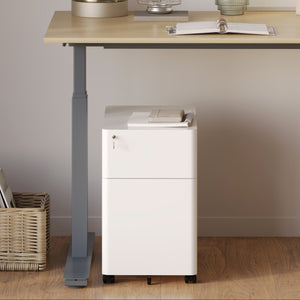






















Filing Cabinet Choices for Cleaner Workstation Planning
Cleaner workstation planning starts with filing storage that matches the desk, document volume, security needs, and daily workflow. Explore how cab...
Learn more
Visit quiz page to see how we makes it easy to create an inspiring workplace


Many professionals finish their workday feeling physically and mentally depleted, attributing this exhaustion to their workload or stress levels. While these factors certainly play a role, a significant and often invisible drain on your energy is the physical position of your monitor. When your screen is set at an improper height, your body is forced into a compensatory posture that places constant strain on the muscles of the neck, shoulders, and upper back.
This sustained muscular effort requires a continuous flow of energy that should otherwise be dedicated to your cognitive tasks. By simply adjusting your sightline to match your natural eye level, you can eliminate this physical friction and preserve your energy for the work that truly matters.
The human head weighs approximately ten to twelve pounds when held in a neutral, upright position. However, for every inch you tilt your head forward and downward to look at a poorly positioned screen, the effective weight on your neck increases significantly. This phenomenon, often referred to as tech neck, forces the small muscles of the cervical spine to work overtime to prevent your head from drooping further.
This constant state of contraction limits blood circulation to the brain and reduces the efficiency of your respiratory system. Over several hours, this postural struggle leads to a depletion of glycogen in the muscles and a buildup of lactic acid, manifesting as that familiar afternoon slump. Understanding this connection is the first step toward reclaiming your daily vitality through proper workstation research data.
When your monitor is too low, you naturally round your shoulders and collapse your chest. This slumped position restricts the movement of your diaphragm, which is the primary muscle responsible for breathing.
As your breathing becomes shallower, your body receives less oxygen, and your heart must work harder to circulate blood. This systemic inefficiency is a massive drain on your internal battery, leaving you feeling lethargic even if you have had enough sleep.
Shallow breathing is a physiological signal to your nervous system that you are under stress. This can trigger a mild but persistent sympathetic nervous system response, commonly known as the fight or flight mode. Being in this state for eight hours a day is exhausting.
Muscle Fatigue: The trapezius and levator scapulae muscles become chronically tight.
Reduced Circulation: Pinched nerves or restricted vessels in the neck can lead to tension headaches.
Mental Fog: Lower oxygen levels in the bloodstream directly correlate with slower cognitive processing.
You might notice yourself leaning closer to the screen as the day progresses. This is a clear sign that your eyes are struggling and your neck muscles are giving up, creating a feedback loop of exhaustion.
Maintaining the same posture all day is inherently tiring, regardless of how perfect that posture might be. The human body is designed for movement, and static positions lead to blood pooling in the lower extremities and a general sense of stiffness. Utilizing a workstation that allows for height transitions is one of the most effective ways to keep your energy levels high from morning until evening.
By periodically switching between sitting and standing, you re-engage your core muscles and encourage better venous return. This movement acts as a mechanical pump for your circulatory system, pushing fresh, oxygenated blood back up to your brain.
Active Recovery: Standing for fifteen minutes every hour can act as a reset for your metabolism.
Focus Bursts: Many people find that standing during creative or collaborative tasks increases their verbal fluency and confidence.
Posture Correction: It is often easier to maintain a neutral spine while standing than while sitting in an unsupportive chair.
An adjustable height workstation provides the mechanical freedom to implement these transitions without disrupting your creative flow or forcing you to leave your work area.
When you move from sitting to standing, remember that your eye level changes. You must ensure that your screen moves in tandem with your torso to prevent you from looking down at your desktop while standing.
For those working in urban settings where space is at a premium, the challenge of maintaining a perfect ergonomic sightline is even greater. In a small apartment or a shared living area, it is easy to settle for a laptop on a dining table or a cramped corner setup. However, the energy tax of poor ergonomics is even higher in a small space because you likely have fewer opportunities to move around throughout the day. Investing in a specialized unit that fits your footprint while offering full vertical range is a game-changer for professional longevity. In high-density areas, a Small Standing Desk Los Angeles is a popular choice for professionals who refuse to sacrifice their health for a smaller square footage.
To truly solve the energy drain of a low monitor, you need tools that offer precision. Simply propping a monitor up on a stack of books is a temporary fix that often lacks the stability and adjustability needed for a truly dynamic day. Mechanical support allows for the fine-tuning of depth, tilt, and height, which is essential because your eyes fatigue differently depending on the time of day and the complexity of the tasks you are performing.
Your eyes have a natural resting point of convergence. If your monitor is too close or too far, the tiny muscles that control your lenses must work constantly to keep the image in focus. This visual effort is a direct contributor to mental exhaustion and digital eye strain.
Depth Adjustment: Ideally, your screen should be about an arm's length away from your face.
Tilt Control: Angling the screen slightly upward can reduce glare from overhead lights.
Centered Alignment: Your screen should be directly in front of you to prevent repetitive neck rotation.
By using a high-quality articulating display mount, you gain the ability to move the screen precisely where your eyes need it to be at any given moment.
Don't forget that your keyboard and mouse placement are tied to your monitor height. If you raise your monitor, make sure your input devices remain at a height that keeps your shoulders relaxed and your elbows at a ninety-degree angle.

While monitor height is the primary focus of this discussion, it cannot be viewed in isolation from your seating. Your chair provides the base from which your sightline originates. If your seat is sinking or lacks lumbar support, your entire torso will collapse, causing your eye level to drop and your neck to strain upward or downward to compensate.
A high-quality high-performance task chair ensures that your pelvis is tilted correctly, providing a stable foundation that naturally aligns your head with the top of your monitor. This synergy between the seat and the screen is what creates a truly unstressed workspace.
|
Factor |
Low Monitor Placement |
Correct Eye-Level Placement |
|
Neck Muscle Strain |
Constant tension; high energy drain |
Neutral alignment; minimal effort |
|
Breathing Depth |
Restricted; shallow breaths |
Open chest; deep diaphragmatic breathing |
|
Blood Circulation |
Potentially constricted at the neck |
Optimized flow to the brain |
|
Mental Alertness |
Rapid decline after 2 hours |
Sustained focus throughout the day |
|
Spinal Alignment |
C-curve (slumped) |
S-curve (natural and supported) |
|
Visual Fatigue |
High; frequent blinking and dry eyes |
Low; relaxed focal distance |
The way we perceive our space also influences our energy. A monitor that is too low often means your field of vision is dominated by the clutter on your desk. This creates visual noise that the brain must constantly filter out. When your screen is at the correct height, your primary focus is elevated, and the surrounding environment falls into the periphery.
When your gaze is lifted, you are less likely to be distracted by the papers, cords, or small objects sitting on your desk. This heightens your sense of immersion in your work, which is a key component of entering a flow state.
Visual Horizon: An elevated gaze mimics the way we look at the horizon in nature, which is inherently calming.
Reduced Clutter: Raising the monitor often requires clearing the space directly in front of you.
Professional Confidence: A more upright posture is psychologically linked to higher levels of self-confidence and authority.
Every time you have to shift your posture because of a localized pain in your neck, you break your concentration. It can take up to twenty minutes to return to a state of deep focus after a distraction. By fixing your monitor height, you are protecting your time as much as your health.
For some, the answer isn't always a moving part, but a more substantial and reliable base. A traditional, fixed surface can offer the deep space required to push a monitor further back, which is a different way to reduce eye strain and manage energy.
If you prefer a static setup, you must ensure the surface itself is at the correct height for your torso length. A solid fixed work surface provides the vibration-free stability that prevents the micro-shaking of a screen, which is a subtle but real cause of eye fatigue over long durations.

Reclaiming your energy is not a one-time event but a series of small, intentional adjustments to your environment. By understanding that your monitor height is a direct valve for your physical and mental stamina, you can stop fighting against your own biology.
Start by evaluating your current setup today. Is your chin tilted down? Are your shoulders creeping toward your ears? If so, you are leaking energy that could be spent on your passions, your family, or your professional growth. Use the checklist below to audit your space and ensure you are set up for success.
Energy-Optimized Workspace Checklist:
Confirm the top third of the screen is at or slightly below eye level.
Check that your monitor is approximately an arm's length away.
Ensure your shoulders are relaxed and not hunched toward your screen.
Verify that your feet are flat on the floor or on a stable footrest.
Schedule a height transition or a quick stretch every 60 minutes.
Clean your screen to remove smudges that cause unnecessary eye strain.
Adjust your chair's lumbar support to meet the small of your back.


You have unlocked free shipping!
You're saving $29 and unlocked free shipping!
Leave a comment