



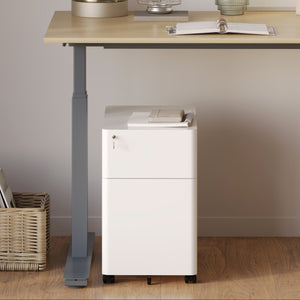






















Filing Cabinet Choices for Cleaner Workstation Planning
Cleaner workstation planning starts with filing storage that matches the desk, document volume, security needs, and daily workflow. Explore how cab...
Learn more
Visit quiz page to see how we makes it easy to create an inspiring workplace


Long workdays expose the difference between posture that looks good for a minute and posture that still feels stable by late afternoon. At Urbanica, we design workspaces around a simple reality: bodies are built to move, and desk work removes movement unless the environment and routine intentionally bring it back.
“Good posture” at a standing desk is not a rigid pose you clamp into. It is a neutral baseline you can return to easily, paired with small, regular changes in position. The goal is durability, not perfection.
Most discomfort patterns trace back to the same trio of shifts.
As focus narrows, eyes drift closer to the screen. The chin follows. The head moves forward relative to the shoulders, and the upper back stiffens to hold it there. Over hours, even a small head-forward position can feel like constant neck effort.
When ribs flare up and forward, the lower back often arches to compensate. When ribs tuck down aggressively, the upper back can round and the shoulders can collapse forward. Either extreme turns breathing into shallow chest work, which feeds neck and shoulder tension.
A tucked pelvis often creates a slumped lower spine. An overly tilted pelvis can crank the lower back into an arch. A hip hike can happen when you stand on one locked leg and “hang” into a hip. All three reduce the feeling of a stable core.
A practical posture routine aims for:
Ears roughly over shoulders, shoulders relaxed
Ribs stacked over the pelvis, not flared up or clamped down
Weight balanced over the mid-foot, with knees soft rather than locked
A setup that lets your hands work close to your body instead of reaching
When that stack starts slipping, the best fix is rarely to “try harder.” It is usually to reset your geometry, change position, or move briefly.
A routine only works when the workstation makes neutral posture easy. If your desk height forces shrugging or your screen position forces leaning, the body will choose compensation every time.
The most reliable sequence is elbow first, then hands, then eyes.
Start with the surface height.
Bring the desk to where your elbows can rest around a right angle, with shoulders relaxed.
Keep forearms roughly parallel to the floor, wrists neutral, and hands close enough that elbows do not drift forward.
Place keyboard and mouse in a zone that allows a small bend at the elbows, not straight arms.
If you are building or upgrading a sit-stand station, our Urbanica Standing Desk is designed as a dedicated standing desk product page where you can review the core concept and see how the desk is positioned for daily work. The key posture point is simple: the surface should meet your arms, not force your shoulders to lift.
Once arms are comfortable, move to screen geometry.
Put the primary screen directly in front of you so your head is not rotated for long stretches.
Position the screen at a distance that allows you to read without leaning. If you notice your chin drifting forward, the screen is often too far away or too low.
Aim for a top-of-screen height that encourages a neutral head and neck. Tiny adjustments matter more than dramatic changes.
For dual monitors, keep the most-used screen centered and angle the second screen toward you. If both are used equally, center the seam between them so your neck does not live in rotation.
A standing desk is only helpful if switching positions does not create new strain.
Keep keyboard and mouse relationship consistent during transitions. The hands should not end up farther away when standing.
Keep the screen relationship consistent. Your eyes should not have to search for the right angle every time.
When transitions feel awkward, people stop switching. That is why routine and setup must be treated as one system.
A posture routine fails when it demands constant willpower or when it breaks focus. The best routines are lightweight, repeatable, and forgiving.
Instead of trying to stand all day, rotate through three states:
Sit for focused tasks that benefit from stability
Stand for lighter cognitive work, calls, reading, review, or admin
Move briefly to reset your tissues and attention
The ratios vary by person, footwear, flooring, and workload. What matters is the recurring pattern of change. If you feel the urge to lock your knees, lean on one hip, or crane your neck, treat that as a prompt to switch position or move.
1. Start-of-day setup check: shoulders relaxed, hands close, screen readable without leaning
2. First sit block: choose sitting for the first deep-focus task
3. First stand block: stand for email review, light planning, or calls
4. Movement reset: short walk, water refill, or a quick change of room
5. Second sit block: return for precision tasks or creative work that needs steadiness
6. Second stand block: stand for review, reading, and meeting notes
7. Midday reset: longer walk if possible, then re-check screen and hand position
8. Afternoon rotation: shorter stand blocks if feet fatigue, with more frequent micro-movement
9. End-of-day decompression: brief walk and a gentle upper-back opener before shutting down
This list is deliberately simple. Complexity is not the goal. Consistency is.
Use short resets that do not disrupt flow.
Calf pumps while standing
Gentle glute squeeze and release to bring the pelvis back under you
Shoulder blade set: pull shoulder blades slightly back and down, then relax
Walk to another room and back
Step up and down on a stable step
Gentle thoracic rotation with arms crossed, turning left and right slowly
These are not performance drills. They are posture resets that restore neutral alignment.
Standing should not feel like a test of toughness. Sit when you notice:
Knee locking or pressure behind the knees
Foot numbness or hot spots
Sharp low-back pinching
Shoulders creeping upward or neck tightening
Sitting is not a failure. It is a strategic position change that protects your ability to keep rotating through the day.
Standing well is less about “holding posture” and more about avoiding static loading.
Shift weight gently from foot to foot without collapsing into one hip
Change foot angle occasionally so the same tissues are not loaded for hours
Use a small stable footrest or step to alternate placing one foot up briefly, which can reduce low-back tension for many people
The goal is micro-variation. You are creating small, frequent changes in the way your body loads the floor.
Locked knees often lead to hanging on ligaments rather than using muscles to support you. When knees lock, the pelvis tends to drift and the lower back can take the strain.
A helpful cue is “soft knees, heavy heels.” It encourages grounded standing without pushing the pelvis forward.
Use posture strategy, not posture willpower.
Stand for calls and lighter work
Sit for fine motor tasks, intense writing, or detailed design
Move after transitions, not only when you feel sore
This approach reduces the chance that standing becomes a static endurance event.
Cable management is rarely discussed as posture strategy, yet it is one of the most common friction points that breaks standing-desk habits. When cords snag, pull, or dangle, people shorten the desk travel, lean to untangle, or adopt awkward reaches that twist the torso.
At Urbanica, we treat cable management as part of ergonomic usability, not as a cosmetic add-on.
Snags restrict height transitions, which encourages half-standing or hovering
Visual clutter increases fidgeting and leaning, especially during fatigue
Power bricks on the floor can reduce foot space, pushing you into narrow stances
A clean system usually needs two components.
A dedicated vertical cable path helps cables travel smoothly as the desk changes height. Our Spine Cable Management accessory is designed for that vertical organization function so the cord path stays controlled through movement.
Keeping slack and power components secured under the surface reduces desktop clutter and prevents cords from tugging as you reposition. The Under-Desk Cable Management accessory supports that under-surface routing so you can keep the work zone clear and predictable.
Unplug and identify what is truly needed at the desk
Group cables by destination (monitor, laptop, power)
Route the vertical path first, then secure slack under the surface
Raise and lower the desk fully to confirm nothing pulls or catches
Adjust once, then keep it stable for daily use
When cables behave, posture gets easier because movement becomes effortless again.
A standing desk routine is strongest when sitting is also aligned. Otherwise, the day becomes a swing between two poor positions.
Sit with feet supported and weight balanced
Keep the keyboard close enough that elbows stay near your sides
Keep the screen readable without leaning forward
If your seated station needs a consistent surface for focused work, the Urbanica Office Desk product page shows a dedicated office desk option you can review for a stable seated baseline. The posture principle remains the same: the desk should support neutral arms and a readable screen position.
When you switch positions:
Keep your input devices in the same relative place so you do not reach farther when standing
Re-check screen height and distance quickly so the neck does not start searching
Transitions should feel automatic, not like a full reset each time.
| What you feel | Likely workstation cause | Fast correction that is realistic |
|---|---|---|
| Neck tightness and chin jut | Screen too low or too far | Raise screen slightly or bring it closer so reading does not require leaning |
| Shoulders creeping upward | Desk too high or hands too far | Lower surface or pull input devices closer so shoulders can relax |
| Wrist discomfort | Keyboard angle forces extension | Flatten keyboard angle and keep wrists neutral, not bent up |
| Low-back compression while standing | Locked knees or pelvis drifting | Soften knees, shift weight, and alternate foot position on a small step |
| Hip ache on one side | Hanging into one hip | Switch stance frequently and re-center weight over both feet |
| Foot fatigue | Standing too long without variation | Shorten standing blocks and add brief movement resets |
This table is intentionally conservative. It avoids promising a perfect solution, and it keeps corrections within what most people can safely test.
The “best desk” is the one that supports consistent geometry and makes position changes frictionless.
For long workdays, prioritize:
A surface that feels stable during typing and transitions
Enough depth to keep screens at a comfortable viewing distance
Space to keep keyboard and mouse close without crowding
Dual monitors benefit from depth and stable screen placement
Laptop-only work still benefits from controlling screen height and input reach
Creative work benefits from clear zones so tools do not push inputs out of reach
If you are comparing layout options, the Urbanica desk collection is the most direct way to see different desk formats in one place. The practical lens is not aesthetics alone. It is whether the surface lets you keep hands close, screens readable, and transitions easy.
When multiple people use the same station, posture problems multiply because the setup rarely matches any one body. The solution is not perfection. It is quick adjustability and a few shared rules.
Monitor height is often wrong for most users
Keyboard and mouse drift away during quick meetings
People rush transitions and accept awkward angles
Keep a default keyboard and mouse zone marked by placement, not by memory
Keep the primary screen centered whenever possible
Encourage brief standing blocks rather than long static standing at shared stations
In team environments, standing often works best as a quick touchdown mode for collaboration, review, and brief check-ins. For layouts built around multi-user collaboration, the Quad Workstation Desk product page reflects a quad configuration intended for shared productivity. The posture goal in these zones is variety: short standing intervals, frequent micro-movement, and easy returns to neutral.
A posture routine is easier when the environment is consistent across stations. That matters in studios, shared offices, and growing teams where people move between desks.
Standardize monitor placement targets where feasible
Standardize cable routing rules so sit-stand movement stays smooth
Create clear movement prompts in the space, such as water placement that encourages walking
When outfitting multiple stations, it helps to have a single place to coordinate product exploration and support questions without turning decisions into a maze. Our office ordering and delivery support page is built for that purpose, connecting workspace planning with practical support details while keeping the focus on real work environments.
Long-workday posture improves when the system is designed to be repeated. The strongest approach is a feedback loop: the workstation makes neutral posture easier, the routine adds variety, and the environment removes friction so you keep doing it.
Setup reduces strain so you start the day closer to neutral
Routine creates frequent changes so tissues do not fatigue in one pattern
Environment removes friction so switching positions stays effortless
Look for changes you can actually trust:
Less end-of-day neck tightness
Less low-back compression during standing blocks
Fewer moments of shoulder shrugging
More consistent use of sit-stand transitions without dread
When those signals improve, posture is working in the only way that matters for long workdays: it supports focus, comfort, and repeatable performance without relying on unrealistic expectations.


You have unlocked free shipping!
You're saving $29 and unlocked free shipping!
Leave a comment