












Filing Cabinet Choices for Cleaner Workstation Planning
Cleaner workstation planning starts with filing storage that matches the desk, document volume, security needs, and daily workflow. Explore how cab...
Learn more
Visit quiz page to see how we makes it easy to create an inspiring workplace


Apartments turn “normal desk advice” into a guessing game because space is shared, walls are closer, and every layout choice affects more than the desk area. Two monitors add another layer. The screens need stable placement, consistent eye height, and predictable cable routing, all while the workstation has to coexist with your bed, sofa, dining table, or entryway.
At Urbanica, we see the same patterns in small homes again and again: shallow desks that push monitors too close, power bricks that block a flush-to-wall setup, and chairs that do not have enough room to roll back when the desk is tight to a wall. The goal is not to cram gear into a corner. The goal is to design a two-monitor station that feels calm, usable, and easy to maintain.
A “tight wall space” rarely means a perfectly flat wall with a clean outlet at desktop height. More often, it includes baseboards that push furniture forward, a window ledge that collides with monitor arms, or an outlet hidden behind the desk where plugs get crushed.
Two monitors can magnify these small constraints:
Monitor stands and arms need room behind the desktop for joints, clamps, and cable bends.
Power bricks can create hard pressure points when the desk is pushed tightly against a wall.
Cable routing becomes visible faster in a small room, especially when the desk faces into the living space.
The safest approach is to assume the desk cannot be perfectly flush, then plan a controlled gap that is small enough to preserve floor space while large enough to prevent cable strain and plug damage.
A standing desk works when switching positions feels effortless. If you dread the transition because cables pull tight, monitors wobble, or the desk bumps into something at standing height, the habit disappears.
A sit-stand desk makes the most sense when:
You work at the desk long enough that posture changes matter to your comfort.
You can route cables to move cleanly across the full height range.
Your floor and wall constraints allow stable placement.
If those conditions are not realistic, a fixed desk can still support excellent dual-monitor ergonomics when paired with smart monitor mounting and disciplined cable management.
Depth is the number that determines whether a two-monitor setup feels balanced or claustrophobic. With shallow depth, people tend to pull screens forward to fit stands, then push the keyboard to the edge. That posture can feel tense quickly.
Instead of chasing an “ideal” that your apartment cannot support, choose a depth strategy:
If your desktop is compact, prioritize monitor mounting that reclaims surface depth and keeps screens from encroaching on the keyboard zone.
If your desktop is moderate, aim to keep the keyboard and mouse fully supported with your wrists relaxed and shoulders down.
If your desktop is generous, you gain flexibility for notebooks, speakers, and a comfortable viewing distance.
Two 24-inch monitors generally tolerate closer viewing distances better than two 27-inch monitors, simply because the visual field is smaller. Mixed monitor sizes can also work, but only if you commit to a clear “primary” screen position that stays centered.
Reach is not just arm length. It is about keeping the most-used tools in a zone where your shoulders stay neutral and your elbows rest comfortably near your torso.
A reliable two-zone plan:
Primary zone: keyboard, mouse, trackpad, and any writing surface you use constantly.
Secondary zone: dock, chargers, audio interface, external drive, or anything you touch occasionally.
In tight apartments, the secondary zone often needs to move off the desktop to avoid crowding. A shelf, a small rolling cart, or even a nearby side table can keep the desktop clear without expanding the footprint of the desk itself.
Behind-desk clearance determines whether the desk can live near a wall without creating cable stress. It is also the hidden factor that makes monitor arms either feel effortless or annoying.
The clearance needs usually come from:
Cable bend radius at the back of monitors and docks.
Power brick thickness.
Monitor arm joints and clamp geometry.
Sit-stand travel, where the desk rises and cables need slack.
Even a small intentional gap can make the difference between a neat setup and a constant battle with pinched cords.
Before committing to a desk location, a fast mockup can reveal problems that measurements alone miss:
1. Use painter’s tape to mark the desk footprint on the floor.
2. Tape a second outline behind the desk to represent a small cable corridor.
3. Mark the chair arc: where the chair needs to roll back and where your elbows move when you sit.
4. Mark a standing stance: feet placement with hips close enough to the desk that you do not lean forward.
If the taped zones overlap in a way that forces you to stand sideways or keeps the chair pinned, the space may need a different desk size, a different placement, or a different monitor arrangement.
The most common mistake in narrow spaces is placing two monitors evenly left and right, which forces your neck to rotate constantly. A better pattern is simple:
Center the primary monitor directly in front of you.
Angle the secondary monitor inward so you can glance, not turn.
This works even with narrow desks because the primary screen gets the best position. The secondary screen becomes a reference display for chat, email, docs, timelines, or dashboards.
In apartments, vertical orientation can be a space saver because it reduces horizontal spread. It can also reduce neck twist because the secondary screen can sit closer to center.
Vertical placement often shines for:
Coding and terminal work
Document review and editing
Long web pages and research
Reading-heavy workflows
It is less ideal if your secondary screen is mainly used for wide spreadsheets, video editing timelines, or side-by-side design comparisons.
Ergonomics in small rooms is about controlled compromise. If the desk is shallow, the screens may end up closer than you would prefer. The goal becomes ensuring your posture stays neutral:
Keep text legible without leaning forward.
Keep the top portion of the screen near eye level, then adjust based on your comfort and the size of the display.
If you use progressive lenses, you may need slightly lower screens to avoid tilting your head back.
A stable monitor mount helps because it lets you fine-tune height and angle without sacrificing desktop depth.
Standing desks add movement. Movement introduces failure points:
Cables pulling tight at full height
Cables snagging on the wall or baseboard
Monitor arms shifting angle under motion
Power bricks tapping or rattling underneath
A safe, realistic approach is to plan cable slack intentionally. Think in terms of two loops:
A service loop: extra length behind monitors so tilt and rotation do not tug on ports.
A strain relief loop: slack that stays controlled under the desk so movement does not pull on the outlet.
When the cable plan is right, your setup feels like one integrated workstation, not a delicate arrangement that must be handled carefully.
For a true stand up desk in an apartment, the practical priorities are stability, usable depth, and compatibility with monitor mounts. You want a desktop edge that accepts clamps securely and a frame that stays steady at standing height.
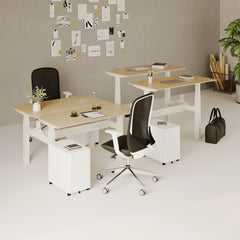
If your plan is to work seated and standing regularly, a dedicated height-adjustable desk is the cleanest foundation. Our Urbanica Standing Desk is designed as a sit-stand workstation option, which makes it easier to build a dual-monitor setup that transitions without you rethinking the whole layout each time you raise the surface.
Monitor arms typically clamp at the rear edge. For tight wall placements, pay attention to:
Whether the desk edge shape allows the clamp to sit flat.
Whether any under-frame elements block the clamp screw.
Whether the desk can be pulled slightly off the wall to accommodate the clamp depth and cable bends.
Even a small corridor behind the desk can keep the clamp area accessible and reduce pressure on cables.
A fixed desk can be an excellent choice when you want simplicity and stability in a small room. Many apartment workstations become more usable when they have fewer moving parts and fewer cable demands.
Our Urbanica Office Desk is a straightforward desk option that can support a two-monitor layout when paired with the right mounting strategy. The key is keeping the primary work zone clear and ensuring the monitor bases or clamp mounts do not steal the space your hands need.
A fixed desk often wins when:
The workstation must live in a bedroom and you want a visually calm footprint.
You share walls and prefer minimal movement noise.
Your outlets are awkwardly placed and you want the simplest routing possible.
You can still build a posture-friendly workstation by focusing on monitor height, screen alignment, and clean reach zones.
When space is tight, you do not want to fall in love with a style before confirming that it fits. A smart approach is to shortlist by dimensions first, then evaluate finishes and design details.
Use the Urbanica desks collection to scan options with a footprint-first mindset. In apartments, the most important early filter is often depth and width. Everything else is secondary until you know the desk can physically support the dual-monitor geometry you need.
Cables are not a finishing touch in a small apartment. They are structural. A messy cable path makes a small room look cluttered quickly, and it can create real day-to-day friction when plugs are hard to reach or cords snag on chair wheels.
Two monitors usually bring:
Two power cables
One or two video cables
Peripheral cables for keyboard, mouse, webcam, audio, or lighting
A laptop charger or docking connection
The goal is to treat those cables like one organized system with a single predictable route.
A controlled vertical drop from desk to floor keeps cords from spreading out and turning into a visible tangle. It also helps standing desks by allowing cables to travel in a managed path rather than floating freely.
For that vertical structure, our Spine Cable Management accessory is intended to guide cables in a single run. In tight wall spaces, this approach reduces the visual noise that makes a small room feel crowded and helps keep cords from pulling sideways when the desk moves.
A reliable apartment-friendly method:
1. Bundle monitor and peripheral cables behind the screens.
2. Route them to one side of the desk, then into a single vertical path.
3. Keep the path consistent so nothing crosses into the chair zone.
This reduces snags and makes cleaning easier because you are not chasing cables across the floor.
The underside of the desk is your best opportunity to hide cables without hiding problems. If everything is crammed into a tight bundle with no airflow or access, it becomes annoying to troubleshoot.
Our Under-Desk Cable Management accessory is suited to building a tidy under-desk zone where power and excess cord length can live out of sight. In apartments, the most important detail is placement. Put the cable storage where your knees do not travel and where you can still reach a power strip switch if needed.
A simple placement rule that keeps the desk comfortable:
Avoid placing trays directly where your thighs rise as you sit.
Favor the rear underside zone, offset from the center if you sit centered.
Keep enough room so the tray does not become a shin hazard when you shift positions.
Apartment outlets are often not where you want them. The safest plan is to design around what exists:
Keep a reachable power hub, not buried behind furniture.
Avoid tight bends that stress cables and plugs.
Make sure your sit-stand travel range does not pull the cord from the wall.
If your outlets are low and the desk must sit close to the wall, a small cable corridor can protect plugs and reduce friction without turning the desk into a floating island.
In small spaces, mounting is often the difference between “this fits” and “this feels cramped.” Each option has tradeoffs.
Two-monitor stand:
Usually easier to set up and reposition.
Can consume desktop depth, especially if the base is large.
Monitor arms:
Often reclaim desktop depth by lifting stands off the surface.
Require clamp compatibility, behind-desk clearance, and disciplined cable slack.
Wall mounting:
Can free the desktop dramatically.
Can be risky in rentals and depends on wall construction and lease rules.
For most apartment setups, a clamp arm is the best balance when the desk can support it and you can maintain a small clearance behind the desk. A dual stand can be the simplest option when you want fewer variables and a stable base.
Clamp arms need more than a desk edge. They need room to exist behind the desk, and they need enough clearance to route cables without pinching.
Key checks:
The clamp needs a flat surface where it contacts the desktop.
The clamp screw needs space under the desk without hitting a frame element.
The arm joints need a small rear corridor so they do not collide with the wall.
If you cannot create that corridor, a stand may be the safer and more predictable choice.
Mount decisions impact cables directly:
Stands tend to keep cables shorter but can leave them visible if they drape across the surface.
Arms require slightly more cable planning but can produce a cleaner desktop when routed properly.
Wall mounts can reduce surface clutter but often require longer cable runs and careful wall-to-desk routing.
In apartments, the cleanest outcome usually comes from choosing one mounting approach and then designing cables around it. Mixing strategies can work, but it is easier to maintain a coherent look when the system follows one logic.
Standing desks are tallest when they are most vulnerable to motion. In apartments, floors can be uneven and the desk may sit on carpet or a rug.
A practical stability check:
At seated height, type normally and observe monitor shake.
Raise the desk to standing height, then type again.
Lightly press the desk side-to-side and front-to-back to see how it responds.
Two monitors on long arms can amplify motion. If stability matters most, shorten the arm extension, keep monitors closer to the column of support, and avoid placing heavy items at the extreme front edge of the desktop.
These are different issues:
Front-to-back wobble is often tied to depth, monitor arm leverage, and how far you lean on the desk.
Side-to-side sway can relate to floor leveling, frame rigidity, and how the desk legs contact the floor.
Small adjustments in placement, leveling, and monitor positioning can improve stability significantly without changing the desk.
Carpet can make chair movement harder and can allow slight desk shifting. Hardwood can transmit vibration.
Realistic apartment tactics:
Use leveling feet if available to stabilize contact points.
Place the desk so all feet are fully supported, not perched on a rug edge.
If you use a rug, choose a setup where your chair casters roll smoothly and do not catch on the rug boundary.
Avoiding unnecessary vibration is not just comfort. It reduces monitor shake and keeps the setup feeling premium and intentional.
Small living spaces often mean shared walls and close neighbors. A standing desk does not need to be disruptive, but it helps to be mindful:
Move between heights smoothly, not abruptly.
Keep under-desk cables secured so they do not slap the frame.
Avoid loose power bricks that knock against the tray or the wall.
These habits make the workstation feel more refined, especially in a studio where you hear everything.
If your room is narrow, a vertical stack can keep the workstation centered without spreading wide. It can also reduce the temptation to twist your torso toward a far-left or far-right monitor.
To make stacking comfortable:
Keep the primary screen at a natural eye height.
Angle the upper screen slightly downward so your gaze shift is small.
Use the upper screen for reference and the lower for primary interaction, or vice versa based on your workflow.
Stacking is especially useful when the desk must fit into a tight alcove or between two pieces of furniture.
An ultrawide can reduce the number of screens and stands, which can simplify the desktop. It can also demand more depth for comfortable viewing because the screen spans a wider field.
Two monitors remain a strong choice when:
You like dedicating one screen to focused work and the other to reference.
You want flexibility in orientation, such as one vertical and one horizontal.
You want the ability to upgrade one screen at a time.
The safer decision is the one you can keep stable, readable, and organized in your space. The best screen plan is the one that supports your daily use without constant adjustment.
A laptop with one well-placed monitor can outperform a cluttered dual-monitor setup in a small apartment. It can also reduce cable complexity.
A reliable arrangement:
Place the main monitor centered.
Use the laptop as a secondary screen off to the side or on a riser if you prefer.
Keep the keyboard and mouse in the primary reach zone.
This approach often feels calmer in bedrooms, where you want the workspace to disappear visually when the day ends.
In many apartments, the desk must live against a wall to preserve walking space. The trick is to be close without being crushed.
A tight-wall layout works when:
You preserve a small behind-desk corridor for cables and monitor mounts.
You keep the chair arc clear so sitting does not feel trapped.
You avoid letting cables spill into the floor zone.
When a desk faces a wall, lighting becomes crucial:
Use a task lamp that aims down onto the workspace rather than straight at the screens.
If a window is to the side, angle monitors to minimize glare.
Keep screen brightness in a comfortable range rather than fighting reflections with maximum brightness.
These choices improve comfort without requiring a bigger footprint.
A floating layout means leaving a deliberate gap behind the desk. In apartments, it can be the most practical way to support monitor arms and cable routing.
Benefits of a small gap:
Cables bend naturally rather than being crushed.
Plugs are easier to access.
Monitor arms can move without colliding into the wall.
A floating layout is especially helpful when the wall has a baseboard that pushes furniture forward anyway. Instead of fighting it, use the gap as a functional cable corridor.
When the desk shares a room with living or sleeping space, the workstation needs visual discipline. Dual monitors can dominate a room if the cables and accessories spread out.
A shared-room layout stays calm when:
The desktop remains mostly clear, with only the essentials visible.
Cables drop in one controlled route rather than multiple directions.
Lighting is intentional and contained, so the desk does not glow like a spotlight in the rest of the room.
This is where cable management is not just neatness. It is the difference between “home” and “workstation” competing for your attention.
A well-designed workstation is modular. Even if you upgrade your desk later, parts of the system can travel with you:
Monitor arms or stands
Cable routing tools
Under-desk power organization
Lighting and input devices
When the cable plan is clean and repeatable, moving is less stressful because you know exactly how the system is supposed to work.
Some people start with a tight apartment workstation and later need a setup that supports collaboration, shared work, or multiple users. When that happens, the logic behind the apartment desk still applies: define zones, keep cables controlled, and maintain usable space for people, not just equipment.
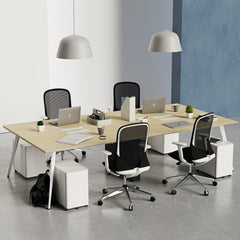
For environments that need multiple positions and a structured layout, the Quad Workstation Desk represents a different category of solution, designed around multiple work areas rather than a single corner. The lesson from apartments still holds: a workstation works best when it is planned as a system, not assembled as a pile of parts.
Small spaces demand practical logistics. Elevator access, stairwells, door widths, and room maneuvering can matter as much as the desk itself. Planning ahead reduces the chance of a desk that technically fits, but is difficult to place.
For customers who want local context and ordering support details, the delivery and ordering FAQs for local buyers page is a helpful reference point for setting expectations around the purchasing process without relying on assumptions.
When the room is small, order matters. A calm setup is built from the floor up:
1. Lock the desk position using tape mockups so the chair arc and standing stance both work.
2. Choose the monitor layout with one primary centered and one secondary angled, or consider vertical orientation if width is tight.
3. Decide the mounting approach, then commit to a single cable route.
4. Build a controlled cable system before adding accessories and decor.
This sequence prevents the common problem of decorating a workspace first, then realizing the monitors need to move and cables become exposed.
A two-monitor workstation feels bigger when the desktop stays visually clean. In apartments, clutter reads louder because there is less space to absorb it.
A calm desktop tends to include:
Only the tools you touch every hour
A clear keyboard and mouse zone
Screens positioned so you do not need to turn your body
One cable path that disappears quickly under the desk
With a clean reach zone and deliberate routing, even a compact corner can support serious work without feeling like your apartment became an office supply closet.
A small apartment setup does not need to chase a mythical “perfect.” The most reliable goal is repeatable comfort:
Your body stays centered and relaxed.
Your screens are stable and readable.
Your cables do not fight your desk movement.
Your workstation looks intentional instead of improvised.
That combination is what makes a stand up desk for two monitors genuinely work in tight wall spaces, not marketing promises or overbuilt complexity.


You have unlocked free shipping!
You're saving $29 and unlocked free shipping!
Leave a comment