























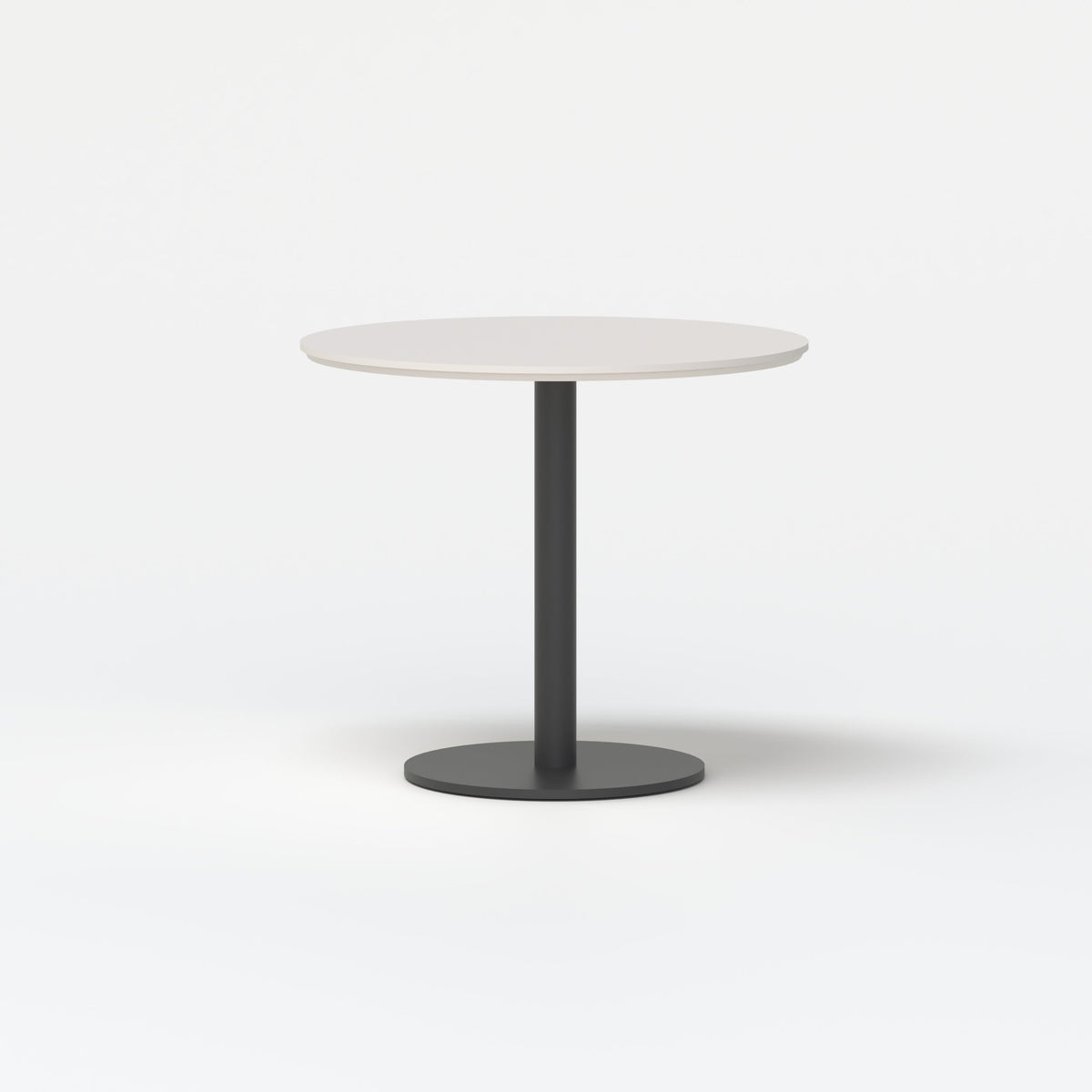
Small Round Bistro Table vs Standard Desk: Which Saves More Space?

The better space-saver is not always the smaller-looking piece. In compact homes, a furniture choice succeeds or fails based on how it shapes movement, how much of the room it visually occupies, and whether it supports the way the room actually functions every day. A small round table and a standard desk can both work in limited square footage, but they solve different space problems.
A round bistro table often saves more circulation space because it has no sharp corners projecting into walkways. It can also feel lighter in a room that needs to serve more than one purpose. A standard desk usually saves more functional work space because its rectangular shape creates clearer zones for a laptop, monitor, notebook, task light, and daily accessories. That means the best answer depends on whether the room needs flexibility or a more stable workstation.
Space saving begins with room behavior, not furniture dimensions
Why footprint alone gives an incomplete answer
Most people compare width, depth, or diameter and stop there. That is only part of the picture. A piece of furniture also claims invisible space around it. That includes the area needed to pull out a chair, shift posture, pass by comfortably, and reach nearby storage or lighting.
This is why two surfaces with fairly similar measurements can perform very differently. A desk may sit tightly against a wall and use square footage efficiently, but still make the room feel more fixed and visually dense. A round table may use a similar amount of floor area, but its curved perimeter can preserve movement paths and soften the room’s layout. The real comparison is not just how much floor is covered, but how much freedom remains around it.
The four questions that reveal the better choice
Before choosing between a small round bistro table and a standard desk, it helps to ask four practical questions:
-
Will the surface be used only for focused work, or for several purposes?
-
Does work equipment stay out all day, or get cleared away after use?
-
Will the furniture sit against a wall, in a corner, or within a shared room?
-
Is the bigger goal visual openness, or work efficiency?
These questions matter because “saving space” can mean different things. It may mean reducing bulk, protecting circulation, keeping the room adaptable, or fitting more work function into a limited footprint.
Small round bistro table vs standard desk: the geometry changes everything
Why a circular top often improves circulation
A round table changes how people move around it. There are no corners extending into walkways, no hard edges catching the eye, and no single “correct” side for access. In a compact room, that creates a softer footprint. Even when the table occupies a measurable area, it often feels less intrusive because the body can pass around it more naturally.
This is especially useful in rooms where the workspace sits near a bed, sofa, or main circulation path. A circular form is often easier to live with because it reduces those tiny daily frictions that make a room feel cramped.
Why a desk uses space more predictably
A standard desk has a clear structural advantage when placed against a wall. Its straight back edge aligns neatly with the room, which reduces wasted gaps. That predictability matters in alcoves, guest rooms, and dedicated office corners where the goal is to make every inch work hard.
Urbanica’s desks collection is positioned around adjustable and ergonomic office desks designed for a range of spaces, which makes it a relevant reference point when comparing the functional benefits of a traditional workstation. ergonomic office desks often support cleaner surface zoning and wall-based layouts than a round table can.
Diameter versus width and depth
A round table is measured by diameter, but that number does not fully explain how it behaves. The usable work zone is concentrated near the center, and the curved edge narrows usable placement around the perimeter. A desk, by contrast, gives its full width across a straight front edge, which creates more predictable room for a keyboard, notebook, and lamp.
That does not make the desk universally better. It simply means the desk usually delivers more structured work capacity per inch, while the round table often delivers more spatial ease per inch.
Where a small round bistro table gains a real advantage
Better in mixed-use rooms
If the room has to switch roles throughout the day, a bistro table often becomes the more intelligent choice. It can support laptop work in the morning, casual dining at midday, reading in the evening, or a temporary landing spot for household tasks. It does not dominate the room with a strong office signal.
That matters in studio apartments, bedrooms, and open living spaces where a permanent office setup can make the whole room feel overcommitted. In these settings, a compact bistro table can function as a lighter visual and spatial presence while still giving enough surface area for focused laptop-based work. Urbanica’s product page presents the Bistro Table specifically as a modern, compact, collaborative table for office and home use, which supports that positioning.
Better for laptop-first work patterns
A round bistro table is usually strongest when the work itself is simple and portable. Writing, planning, calls, reading, email, and light administrative tasks are all well suited to a smaller, flexible surface. If the setup begins and ends with a laptop, notebook, and coffee mug, a large rectangular desk may create more visual and spatial commitment than the routine actually needs.
Better when visual softness matters
In small interiors, visual weight can matter almost as much as actual measurements. A desk often reads as task-driven furniture. A bistro table reads as more adaptable. That subtle difference can make a room feel calmer and less divided into rigid zones.
Where a standard desk earns its footprint
Better for longer work sessions
A standard desk becomes stronger as work complexity increases. Once a monitor, external keyboard, documents, charger, stand, lamp, and daily tools enter the picture, a desk starts to justify the extra visual weight. It creates a stable working zone with fewer compromises.
That is important because many people mistake small surface area for smart surface area. In reality, a surface that is too small for the workflow often spreads clutter outward into nearby shelves, side tables, and floor baskets. The room may look smaller because the workstation is underbuilt.
Better for fixed routines and repeatable setup
A desk also reduces reset time. If work happens in the same place every day, the ability to leave things positioned properly matters. That consistency supports comfort, focus, and order. It is often the better choice for people who spend long hours seated or who need equipment ready at all times.
Better when the wall should do the work
When the room offers one clear wall for a workstation, a desk often uses that opportunity more effectively than a round table. It can sit flush, reserve the center of the room for movement, and create a dedicated work boundary without floating awkwardly into circulation space.
Chair clearance is often the hidden space calculation
The seat changes the true footprint
A surface is never the whole story. The chair determines how much operating room the setup really needs. A small table paired with a bulky task chair can lose much of its spatial advantage. A desk paired with a slim, well-scaled chair may perform more efficiently than expected.
Urbanica’s chair collection is explicitly focused on ergonomic office seating, so it fits naturally into this part of the comparison. ergonomic office chairs can improve posture and daily comfort, but they also require honest planning around pull-back space, swivel room, and circulation.
Dining-style pullback versus task-chair movement
With a bistro table, people often use lighter seating and simpler pull-out movement. With a desk, the chair is more likely to remain in place as part of a dedicated workstation. That means the desk setup may occupy more operational space even if the desktop itself fits neatly.
The right takeaway is not that one category always saves more space. It is that the table and chair must be evaluated as a single system.
Lighting and accessories can tip the decision either way
Small surfaces need disciplined support pieces
Lighting and accessories can either preserve a compact setup or overwhelm it. A smaller workstation benefits from a few highly useful items rather than many scattered add-ons. This is where category-level planning matters more than impulse additions.
Urbanica’s office accessories collection centers on modern office support pieces, making it a logical destination for readers thinking about how to keep a small workspace functional without overcrowding it.
H4: When a multi-use light supports a bistro setup
A compact table usually benefits from lighting that stays flexible and does not visually overtake the surface. The Alumina Lamp is presented by Urbanica as a multi-use LED table and wall light, which makes it especially relevant in a small workspace that may need adaptability and a restrained footprint.
H4: When a classic table lamp supports a desk setup
A standard desk can usually absorb a dedicated light more comfortably because its geometry provides clearer zones for work tools. The Shore Table Lamp is a table-lamp product made from recycled glass, so it fits most naturally in a paragraph about desk-centered tabletop lighting rather than as a generic accessory claim.
Real room scenarios where each option performs best
Studio apartment corners
In a studio, a small round table often wins because the same square footage needs to support work, living, and occasional dining. Its softer shape and flexible identity help the room stay open-ended.
Bedroom workspaces
In a bedroom, the better answer depends on placement. If the setup sits beside a dresser or at the edge of the bed zone, a round table often feels gentler and less cramped. If there is one uninterrupted wall and the workday is substantial, a desk often brings more order.
Guest room offices
In a guest room that doubles as a work area, a desk usually makes sense when the room is regularly used for focused tasks. A round table is stronger when work is occasional and the room still needs to feel multipurpose.
Small urban homes
Compact urban layouts benefit from furniture planning that matches daily reality rather than idealized office images. Urbanica’s Los Angeles page focuses on ergonomic and modern office furniture, but the more useful contextual takeaway for this topic is how modern workspace planning supports thoughtful choices in homes where flexibility, scale, and visual restraint matter.
Which saves more space under different conditions?
| Condition | Small Round Bistro Table | Standard Desk |
|---|---|---|
| Best for preserving visual openness | Strong | Moderate |
| Best for wall-to-wall efficiency | Moderate | Strong |
| Best for shared or mixed-use rooms | Strong | Moderate |
| Best for monitor-based work | Weak to moderate | Strong |
| Best for laptop-only routines | Strong | Strong |
| Best for leaving equipment out daily | Moderate | Strong |
| Best for softening circulation paths | Strong | Moderate |
| Best for a dedicated workstation | Moderate | Strong |
The most honest answer to the space-saving question
Choose a bistro table when adaptability is the priority
A small round bistro table usually saves more perceived space and circulation space. It is often the better choice when the room must stay flexible, when work is laptop-based, and when the furniture should not visually overpower the rest of the home.
Choose a desk when functional workspace is the priority
A standard desk usually saves more productive space. It earns its place when work is longer, more equipment-heavy, and more consistent from day to day. In those conditions, the desk prevents clutter migration and reduces the inefficiency of working on a surface that is simply too small.
The bistro table question answered clearly
If the goal is to make a compact room feel less crowded, a small round bistro table often saves more space. If the goal is to fit the most reliable work function into a limited area, a standard desk usually wins. The right choice comes down to whether the room needs freedom of movement or dependable work capacity.
Related Articles
-
 This Is How To Build A Small Home Office You Actually Want To Work From, And How To Pick Desks For Small Spaces - Urbanica Furniture's Full Guide
-
 Filing Cabinets for Small Spaces That Still Look Clean Now
-
 Minimalist Office Table Ideas That Work Like a Bistro Table
-
 Make Small Shared Spaces Work Better With a Bistro Table
-
 Best Filing Cabinet Layout Ideas for Small Home Offices and Shared Rooms
-
 What Size Filing Cabinet Makes Sense for Small Workspaces?


