



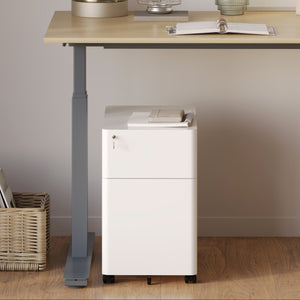






















Filing Cabinet Choices for Cleaner Workstation Planning
Cleaner workstation planning starts with filing storage that matches the desk, document volume, security needs, and daily workflow. Explore how cab...
Learn more
Visit quiz page to see how we makes it easy to create an inspiring workplace


The right office chair height is one of the smallest adjustments in a workspace, yet it influences nearly every part of the seated experience. It affects how the feet meet the floor, how the knees bend, how the pelvis settles, how the shoulders respond to keyboard work, and how much unnecessary tension builds by the end of the day. Daily comfort gains usually do not come from dramatic posture corrections. They come from consistent, well-matched setup choices that reduce friction hour after hour.
A chair that sits too high can make the body feel suspended and unstable. A chair that sits too low can push the hips into a cramped position and invite slumping. Both situations can create subtle compensation patterns that spread upward into the lower back, upper back, neck, and wrists. Proper office chair height setup is less about chasing a rigid ideal and more about creating a stable base for normal work movement, steady breathing, and repeatable comfort.
Seat height is not an isolated adjustment. It is the foundation that determines how the body connects with the desk, keyboard, monitor, and floor. When chair height is right, everything else becomes easier to refine. When it is wrong, even a well-designed workstation can feel awkward.
The seated body needs support from below before it can relax above. That starts with the feet. Full foot contact with the floor gives the lower body a sense of stability. From there, the knees can bend naturally, the hips can settle more evenly, and the spine has a better chance of staying supported without forcing a stiff posture.
When the feet do not feel planted, people often respond without noticing. They brace through the toes, grip through the thighs, lean forward, or pull their shoulders upward while working. These are not always dramatic signs of discomfort. More often, they show up as restlessness, fatigue, or a constant need to shift.
A chair that is only slightly too high or too low might feel acceptable for a few minutes. Over a full day, that minor mismatch becomes repetitive strain. The body compensates with tension, not efficiency. This is one reason people sometimes describe a workstation as "fine" in the morning and irritating in the afternoon.
Proper height setup protects against that accumulation. It supports a neutral, sustainable position without making the user feel locked in place.
Before adjusting armrests, lumbar tension, or monitor height, it helps to establish a clear seated baseline. This baseline is simple, repeatable, and practical.
The first check is whether both feet rest fully and comfortably on the floor. Flat contact matters more than appearance. A person whose heels barely touch the floor may still be carrying tension through the legs. Full support should feel steady and natural, not forced.
If the feet are unsupported, the chair is often too high for the user, the desk, or both. If the desk height requires the seat to go up, the solution may involve the desk setup as much as the chair.
For many people, a useful target is a knee angle around 90 to 100 degrees, with the hips level with or slightly higher than the knees. This tends to support a more neutral pelvic position and reduces the chance of feeling compressed in the lower back.
When the knees sit much higher than the hips, the body often rounds backward into the chair. When the feet dangle because the chair is too high, pressure can build under the thighs. Both setups reduce comfort even if the chair itself feels soft.
A common mistake is focusing only on knee angle while ignoring thigh pressure. If the front edge of the seat presses firmly into the underside of the thighs, circulation and comfort can suffer. A proper chair height should allow the thighs to feel supported without making the user feel pinned in place.
The pelvis is where many chair-height problems begin. If seat height pushes the pelvis into a poor position, the spine and shoulders usually compensate next. This helps explain why neck or shoulder fatigue is sometimes rooted in a lower-body setup issue rather than an upper-body one.
One of the most common setup mistakes is adjusting the chair in isolation. The seat can be technically well-positioned relative to the body while still being wrong for the work surface.
When the user sits back in the chair with relaxed shoulders, the elbows should be able to bend naturally near working height. Forearms should rest comfortably at the desk or input surface without reaching upward or collapsing downward.
If the shoulders rise to type, the desk may be too high. If the torso folds or the wrists bend sharply upward, the desk-chair relationship is likely off even if the chair feels stable.
For this reason, chair height works best when paired with suitable work surfaces such as adjustable office desk options, which Urbanica presents as ergonomic desk solutions for different spaces and workspace needs.
Many users lower the chair to stop their shoulders from lifting, only to find their knees rise too high. Others raise the chair to meet a tall desk and end up losing foot support. In both cases, the chair adjustment was not the true problem. The workstation was asking the chair to solve a desk issue.
That is why proper chair height should always be tested while doing real work, not just while sitting still for a quick posture check.
Typing, writing, reviewing printed documents, and taking video calls all change arm position and visual behavior slightly. A workstation does not need a new setup for every task, but it does benefit from small refinements. The goal is not static perfection. It is flexible support.
A reliable setup routine helps remove guesswork. It also makes daily resets much faster.
Start with the hips contacting the backrest. This prevents false height adjustments caused by sitting on the front edge of the seat. Perching usually makes the chair feel lower than it actually is.
Raise or lower the chair until both feet rest flat and feel stable. Do not settle for toe contact or light heel contact. The body should feel anchored.
Look for a natural bend at the knees and a sense that the hips are not dropping below them. Then notice the front edge of the seat. The thighs should feel supported without pressure that encourages fidgeting or forward sliding.
Move into working position and let the shoulders relax. Bend the elbows naturally and check whether the forearms meet the desk without strain. If the body has to shrug or reach, the desk-chair relationship needs more work.
Type for several minutes. Use the mouse. Read from the screen. Shift between tasks. Good chair height should continue to feel stable after movement, not only during a perfect seated pose.
Both feet are still planted.
Knees are not compressed.
Shoulders stay relaxed during typing.
Wrists are not sharply bent upward.
Lower back feels supported without stiffness.
The user is not sliding forward to escape pressure.
This kind of reset is often more valuable than constantly chasing a single "ideal" posture.
Clear signals can help identify what needs to change.
A chair that is too high often creates:
incomplete foot contact
pressure under the thighs
raised shoulders while typing
a tendency to slide forward
leg restlessness or toe bracing
These signs usually point to a loss of stability. The user may still be able to work, but the body is doing extra balancing work the whole time.
A chair that is too low often creates:
knees sitting above the hips
a rounded lower back
more upward wrist bend
a compressed feeling through the hips
extra forward head posture during screen work
This setup tends to crowd the lower body and make the upper body work harder to stay engaged.
Sometimes the chair height is reasonable, but the workstation still feels wrong. In those cases, the issue may be seat depth, armrest interference, desk thickness, monitor placement, or under-desk clearance. Height is foundational, but not magical. It has to operate within a complete workstation fit.
Not every chair responds the same way once height is dialed in. Support structure, adjustability, and seat behavior all influence how easy it is to maintain a stable position.
A chair with stronger ergonomic intent tends to make accurate setup more noticeable. When height is right, the body can settle into support rather than constantly managing instability.
That makes a model like the Novo Chair relevant in discussions of daily comfort, since Urbanica positions it as a bestselling ergonomic office chair designed around support that extends beyond the workday.
Some people do not work in one fixed posture. They alternate between focused typing, short calls, note-taking, and collaborative work. In those cases, a chair that adapts easily can make day-to-day height refinement more practical.
The Muse Chair fits that context because Urbanica presents it as an adjustable office chair shaped around functionality, comfort, and design for productive use.
Even a chair built for all-day use will not perform well if the height is mismatched to the desk or the body. Setup remains the bridge between product design and actual comfort.
The Onyx Chair is presented by Urbanica as an ergonomic office chair focused on premium comfort and all-day support, which makes it a useful example of how ergonomic intent still depends on accurate chair-height adjustment. Simpler work chairs benefit from the same height discipline
Users sometimes assume chair-height precision only matters for advanced ergonomic seating. That is not true. Practical daily-use chairs still rely on correct body and desk alignment.
The Seashell Chair is described by Urbanica as a dependable everyday performance chair with breathable mesh fabric and integrated armrests, showing that even straightforward office seating benefits from thoughtful setup.
Many comfort problems come from habits that seem harmless in the moment.
This is especially common in home offices and shared workstations. The user raises the chair so the arms reach the desk, then accepts dangling feet as a tradeoff. That tradeoff often leads to instability and thigh pressure.
Armrests should support the final posture, not determine the primary height setting. When they are adjusted first, they can trick the user into keeping the seat too high or too low.
A chair can be correctly set for keyboard work and still feel slightly off during writing or reading tasks. Small, reasonable changes are not a sign of poor ergonomics. They are part of using the workstation intelligently.
Shoes, slippers, and rugs affect effective seated height more than many people realize. A setup that feels right in one condition may feel subtly wrong in another.
| Setup area | Healthy cue | Common warning sign | Likely result |
|---|---|---|---|
| Feet | Flat and stable | Toes pressing down | Reduced lower-body stability |
| Knees | Natural bend | Knees much higher than hips | Hip compression and slumping |
| Thighs | Supported without pressure | Front-edge digging | Discomfort and frequent shifting |
| Shoulders | Relaxed while typing | Shoulders raised | Neck and upper-back tension |
| Wrists | Mostly neutral | Wrists bent upward | More strain during input work |
| Seat behavior | User stays back in chair | User slides forward | Poor pressure distribution |
A proper setup should respect body size, task demands, and workspace reality. There is no single chair height that works for everyone.
Shorter users are more likely to face a desk that sits too high relative to comfortable foot support. In these cases, a better result often comes from coordinating the chair, desk, and floor support rather than forcing one imperfect compromise.
Taller users may have enough seat height range but still feel restricted by desk structure, leg clearance, or seat depth. Good chair height cannot fully solve a cramped workstation footprint.
In shared environments, the best setup is the one people can repeat quickly. Clear adjustment priorities matter. Feet first, hips and knees second, desk relationship third, arm support last.
A broader ergonomic office chair collection can help users compare chair formats that better match body proportions, work patterns, and adjustment preferences, which is exactly how Urbanica frames its office chair category.
Work comfort improves when the whole workspace supports the body instead of asking one piece of furniture to do everything.
Correct chair height reduces unnecessary strain, but it does not replace movement. Brief posture changes, standing moments, and small shifts in task position help preserve comfort across the day.
Footrests, monitor risers, and keyboard accessories can be helpful, but they work best after the core chair-height relationship is already sound. Accessories should support the base setup, not hide avoidable problems.
Chair height is easier to get right when the broader environment supports it. Desk size, room layout, circulation space, and the balance between seating and work surfaces all shape how comfortably a chair can be used.
That is where broader planning resources such as modern workspace furniture solutions become relevant, since Urbanica uses that page to present ergonomic and modern office furniture for workspace planning rather than only a single product category.
The most effective office chair height is not the one that looks perfect in a photo. It is the one that supports stable, low-friction work on ordinary days. A useful setup keeps the feet grounded, the hips supported, the arms relaxed, and the body free from constant compensation.
That kind of comfort is built through consistency. Each adjustment should make the workstation easier to use, not more complicated. When chair height is treated as the foundation of seated work rather than a minor afterthought, daily comfort becomes more dependable, posture feels less effortful, and the workspace starts working with the body instead of against it.


You have unlocked free shipping!
You're saving $29 and unlocked free shipping!
Leave a comment