









Office Workstations Need Seating That Moves With Teams Today

Modern teams rarely sit still for long. A typical workday moves through focused desk work, quick teammate questions, video calls, shared document reviews, planning conversations, and short meetings that do not always need a formal room. The office workstation has become more than a place to sit. It is now a working environment that needs to support movement, concentration, collaboration, and reset throughout the day.
That shift changes how seating should be planned. A chair at a workstation is not just a finishing detail after the desk is selected. It affects how easily someone can turn toward a teammate, adjust posture during long work blocks, join a quick discussion, return to focused work, and leave the area organized for the next person. When seating does not move well with the team, small moments become daily friction. Chairs block aisles, people hunch over screens, desk clusters become informal meeting zones, and shared workstations feel cluttered instead of flexible.
The strongest workstation environments are designed as connected systems. Desks, chairs, panels, meeting tables, laptop accessories, and nearby collaboration surfaces all influence how people use the space. Seating that moves with teams today is not about constant motion. It is about giving employees enough support and freedom to work naturally without turning the office into a disorganized, noisy, or uncomfortable environment.
The Modern Office Workstation Is a Team Movement System, Not a Static Desk Assignment
Traditional workstation planning often assumed a simple relationship between one person, one desk, and one chair. That model still exists in some offices, but many teams now work in more fluid ways. Hybrid schedules, shared desks, cross-functional projects, and changing team priorities mean people may use the same workstation differently from one day to the next.
A workstation might support focused writing in the morning, a project handoff before lunch, a virtual meeting in the afternoon, and a quick teammate review before the day ends. Seating has to keep up with that range of use. A chair that only works for one posture or one task can quickly become limiting.
Shared Workstations Need a Clear Team Footprint
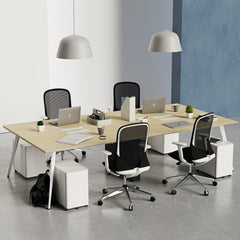
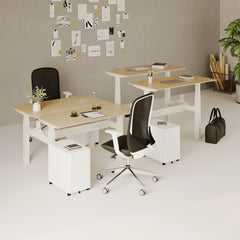
When several people work near one another, the desk layout sets the foundation for how seating will behave. A shared workstation should give each person enough personal space while still allowing practical interaction. For teams that need a defined shared setting, a six-person team workstation can create a central footprint where seating, circulation, and collaboration can be planned together.
The important part is not simply fitting more people into one area. It is creating a layout where people can sit, shift, turn, and reset without interrupting the rest of the team. A well-planned workstation gives employees enough proximity to communicate but enough structure to focus.
Movement Happens in Small Moments All Day
Workplace movement is often subtle. Someone rolls back slightly to stand up. A teammate swivels to answer a question. A project lead pulls closer to review a screen. A hybrid employee adjusts a chair before starting work at a shared desk.
These moments may seem minor, but they shape the daily experience of the office. If every small movement causes a collision, a blocked path, or an awkward posture, the workstation feels poorly matched to the team. Seating should make everyday transitions feel smooth and natural.
Seating Mobility Shapes the Shift Between Focus and Collaboration
Teams need collaboration, but not every conversation deserves a conference room. Some of the most useful workplace communication happens in short bursts near the work itself. A designer asks for feedback. A coordinator confirms a detail. A manager checks progress. A colleague shares a document on screen for a quick review.
Seating that supports these micro-collaboration moments helps teams stay aligned without forcing constant relocation. Employees can shift into a short conversation and return to their work with less disruption.
Useful Movement Is Different From Disruption
Not all movement improves a workstation. Useful movement gives people enough range to work comfortably and communicate naturally. Disruptive movement creates clutter, noise, and blocked circulation.
| Workstation Movement | Helpful Version | Problem Version |
|---|---|---|
| Turning toward a teammate | Smooth swivel with enough side clearance | Chair hits another user or desk leg |
| Pulling back from the desk | Clear space behind the chair | Main aisle becomes blocked |
| Joining a quick review | Two chairs reposition without crowding | Extra chairs gather in a narrow path |
| Returning to focus | Chair resets neatly after use | Seating remains scattered around the area |
| Moving between zones | Clear route to nearby table or meeting room | People cut through active workstations |
The goal is not to stop movement. The goal is to shape it. Offices that support team movement need boundaries, circulation paths, and work zones that make behavior intuitive.
Open Work Areas Need Boundaries That Preserve Focus
Movable seating works best when the surrounding space has some definition. In an open workstation area, employees should understand where focused work happens, where short conversations belong, and how people move between those zones. Without that structure, every chair can become movable in the wrong way.
Thoughtful use of workspace panels for focus can help define workstation areas while preserving the openness teams often need. Panels can support a clearer sense of territory around desks, which is especially helpful when seating shifts throughout the day. The best result is not a closed-off office. It is an open environment with enough visual and spatial order to protect concentration.
Ergonomic Seating for Office Workstations Must Support Motion, Not Just Sitting
Ergonomic seating is often discussed as if the goal is to hold one perfect position. Real work does not happen that way. People adjust their posture constantly. They lean back during calls, sit upright for typing, turn toward teammates, move closer to a screen, and shift weight during long work sessions.
A good workstation chair supports these changes instead of fighting them. It should make movement feel controlled, comfortable, and easy to reset.
Dynamic Sitting Belongs at the Workstation
Dynamic sitting means the body is not locked into one rigid position. It allows small posture changes that can help people remain more comfortable during varied tasks. At an office workstation, dynamic sitting might include adjusting seat height, rotating toward a teammate, moving closer to the desk surface, or leaning back during a discussion.
This is especially important for teams that move between individual work and collaboration. A chair that supports only one position may feel acceptable for a short task, but it can become restrictive during a full workday filled with changing activities.
Shared Seating Must Work for Different Bodies and Work Styles
In shared or hybrid environments, one chair may serve several users across a week. Each person may have different height, posture, and task needs. Seating should be easy to adjust, simple to understand, and suitable for more than one work style.
Important workstation seating considerations include:
1. Seat height that adjusts easily for different users
2. Back support that works during focused and conversational postures
3. Arm clearance that does not interfere with desk access
4. Mobility that matches the floor surface and workstation layout
5. A shape that allows users to turn without feeling confined
6. A design that can reset neatly after use
The simpler the reset, the more likely people are to use the seating correctly. Complicated adjustments may be ignored, especially in shared workstation areas where users are trying to settle in quickly.
Meeting Seating Should Support the Same Workday Rhythm
Teams do not experience the office as separate furniture categories. They move from desks to meeting rooms, from meeting rooms to huddle tables, and from huddle tables back to workstations. If seating comfort drops sharply in one zone, the whole workday feels less supportive.
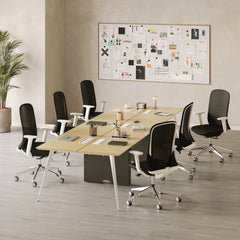
When longer reviews, client conversations, or planning sessions move away from the workstation, conference chair seating can help create a consistent meeting environment. The point is not to make every chair identical. It is to keep the office experience cohesive enough that movement between spaces does not feel like a comfort compromise.
Seating-to-Surface Pairings Make Flexible Workstations Feel Intentional
A chair does not function alone. It works in relationship to the surface in front of it, the people nearby, the distance behind it, and the task being performed. That is why seating and tables should be considered together.
A task chair at a workstation supports a different kind of work than seating around a small meeting table. A chair for short check-ins does not need to behave the same way as a chair used for extended desk work. When each surface has the right seating purpose, the office feels planned rather than improvised.
Different Work Modes Need Different Seating Decisions
| Work Mode | Typical Team Behavior | Seating Priority | Supporting Surface |
|---|---|---|---|
| Shared production | Employees work side by side for longer periods | Adjustable posture support and controlled movement | Multi-person workstation |
| Desk-side review | Two or three people review a task quickly | Easy turning and short-range repositioning | Shared desk surface |
| Small-group planning | Team members gather for alignment | Accessible seating with clear sightlines | Round or compact table |
| Formal discussion | Longer meeting or client conversation | Comfortable professional seating | Meeting or conference table |
| Hybrid touchdown | Rotating employee works briefly | Simple setup and easy reset | Compact temporary surface |
| Focus recovery | Employee returns to concentration | Stable support and fewer distractions | Desk with spatial boundaries |
This kind of planning prevents one workstation from carrying every activity. When an office gives teams multiple nearby options, employees can choose the right setting without overloading the main desk area.
Round Surfaces Help Teams Gather Without Awkward Angles
Some conversations need more structure than a desk-side chat but less formality than a large conference setup. Round tables are useful because they create shared access from multiple sides. People can see each other more easily, and no single person is positioned as the obvious head of the table.
A round meeting surface can give teams a natural place for small-group planning, project reviews, or quick decision-making. When paired with seating that is easy to approach and reposition, this type of surface supports collaboration without turning the main workstation into a crowded meeting area.
Compact Table Zones Protect the Main Workstation
Every office needs places for short conversations that do not interrupt focused work. Without those areas, people often pull extra chairs into workstation aisles or hold discussions directly over someone’s desk. That can make the workspace feel crowded and reduce concentration for nearby employees.
A bistro table for office check-ins can support brief conversations, laptop reviews, or informal one-on-one updates. Placing compact tables near workstation clusters gives teams another option for collaboration while keeping the main desk area clearer.
Hybrid Teams Need Seating Systems That Reset Cleanly
Hybrid work has made reset behavior more important. A workstation may serve different people on different days, and even assigned seating areas may need to accommodate visiting teammates, contractors, managers, or project partners. Seating that cannot reset easily creates friction for the next user.
A clean reset is both physical and visual. The chair should return to the workstation without blocking movement. The seat should be easy to adjust. The area should look ready for the next person, not abandoned after the last task.
Shared Workstations Require Clear Circulation
The more people share a workstation area, the more important circulation becomes. Chairs need enough space to pull back. People need a clear path to enter and leave. Teammates should be able to move behind seated users without forcing them to stand up every time.
Poor circulation often creates frustration because the problem repeats all day. A chair that blocks an aisle once may seem minor. A chair that blocks an aisle every time someone stands up becomes a layout issue.
A Practical Test for Seating in Shared Work Areas
Before choosing seating for a workstation environment, it helps to test actual workday behaviors rather than judging only by appearance.
1. Can every chair pull back without blocking a main aisle?
2. Can seated users turn toward teammates without colliding with desk legs or storage?
3. Can each chair return neatly under or near the workstation after use?
4. Does the seating support laptop tasks, monitor work, calls, and paper review?
5. Is there enough clearance for people entering and leaving at different times?
6. Do nearby collaboration tables reduce pressure on the main workstation?
7. Are panels or visual boundaries used where concentration needs protection?
8. Does the seating look intentional when the entire team is present?
This checklist keeps the focus on real use. A seating plan should work when the office is active, not only when the room is empty and every chair is perfectly aligned.
Technology Accessories Make Mobile Seating More Effective
Even the best chair cannot solve every workstation problem. If screens sit too low, users may still hunch forward. If laptops are placed flat on the desk for long periods, employees may bend their necks or crowd the keyboard area. If power access is awkward, people may twist their bodies around cables or sit in positions that do not support the task.
Seating mobility works best when technology and accessories support natural posture. The workstation should allow the chair, screen, keyboard, mouse, and lighting to work together.
Laptop Positioning Influences How People Sit
Portable devices are common in modern offices, especially in hybrid and shared workstation settings. Laptops make work mobile, but they can also encourage poor posture when used flat on a desk for extended periods. Raising the screen can help users align their view more comfortably while seated.
A laptop stand for screen height can support a more practical setup at shared or temporary workstations where employees rely on portable devices. The benefit is not complicated. When the screen sits in a better position, the chair can do its job more effectively.
Digital Collaboration Adds More Seating Transitions
Video calls, shared documents, and virtual presentations create new posture changes throughout the day. An employee may sit upright for a camera, lean forward to type notes, turn toward a nearby teammate, then reposition again to review a shared screen.
These shifts are now part of everyday office work. Seating should allow them without making the person feel locked into one angle. Accessories, table depth, power placement, and screen height all influence whether those movements feel natural.
Workstation Layers Should Be Planned Together
A flexible workstation depends on several connected layers:
| Workstation Layer | Why It Matters for Seating Movement |
|---|---|
| Chair support | Helps users shift between focus, calls, and collaboration |
| Desk surface | Determines reach, clearance, and device placement |
| Screen height | Influences neck and shoulder posture |
| Keyboard and mouse position | Affects arm comfort and seated alignment |
| Lighting | Helps users avoid leaning toward the screen |
| Power access | Reduces awkward cable-driven seating positions |
| Panels or boundaries | Protect focus while allowing controlled movement |
When these layers are planned separately, the workstation can feel inconsistent. When they work together, seating movement feels purposeful rather than accidental.
Office Layout Planning Should Match Real Team Behavior
No two teams move through an office in exactly the same way. A sales team may spend much of the day on calls, turning between screens, headsets, and manager check-ins. A design team may need longer focus blocks interrupted by critique sessions. An operations team may rely on rapid updates, shared dashboards, and frequent handoffs. Leadership teams may move between private concentration, strategic conversations, and cross-functional meetings.
A seating plan should reflect these actual patterns. Choosing chairs based only on style or quantity misses the point. The right workstation seating strategy starts with how people work, where they move, and what kind of support they need at each transition.
Planning the Whole Office Prevents Furniture Mismatch
Workstations, chairs, meeting tables, panels, and accessories should not feel like separate decisions. When they are selected without a shared plan, offices often end up with attractive individual pieces that do not support the team as a complete environment.
Offices that need a cohesive approach to desks, seating, tables, panels, and accessories can benefit from workspace planning support that treats the workplace as one connected system. That kind of planning helps seating movement align with real circulation, team needs, and the look of the overall office.
Style Consistency Helps Flexible Offices Look Organized
Flexible does not have to look temporary. In fact, the more movement an office supports, the more important visual consistency becomes. Chairs that move between tasks, tables, and work zones should still feel like they belong in the same environment.
Consistent chair silhouettes, coordinated finishes, compatible table shapes, and well-placed panels help the office maintain order throughout the day. This matters for employees and visitors. A workplace that supports movement while still looking composed communicates care, professionalism, and operational clarity.
Workstation Seating Mistakes That Undermine Team Movement
A seating strategy can fail even when the furniture looks appropriate at first glance. The most common problems usually come from planning for the room when it is still, rather than planning for the team when it is active.
Choosing Chairs Only for Appearance
A chair can look polished and still perform poorly at a workstation. If it does not allow comfortable posture changes, easy turning, or practical reset, it may not support modern team behavior. Appearance matters, but it should work alongside function.
The best workstation seating has a clear job. It should support the employee sitting in it, the teammate working nearby, and the overall movement of the office.
Ignoring Clearance Behind the Seat
Clearance is one of the easiest details to underestimate. A workstation may appear spacious until every chair is occupied. Once people start standing up, turning, or moving between zones, tight spacing becomes obvious.
Aisles should remain usable even when chairs are pulled back. People should be able to enter and leave the workstation without repeatedly interrupting others. This is especially important for multi-person desks and shared seating areas.
Treating Meeting Seating and Workstation Seating as Separate Worlds
Teams do not stop needing support when they leave the desk. Meeting rooms, huddle spaces, and touchdown areas are part of the same workday. If these zones feel disconnected, employees may avoid them or use workstations for conversations that belong elsewhere.
A strong seating plan creates continuity. Task seating, meeting seating, and compact collaboration seating do not need to match exactly, but they should support the same overall rhythm of movement, comfort, and reset.
Letting Every Conversation Happen at the Desk
Workstation clusters become strained when they serve as the only collaboration point. Quick conversations are valuable, but too many of them can disrupt focused work. Nearby tables, meeting areas, and defined huddle zones help distribute collaboration more evenly.
This keeps the workstation from becoming a bottleneck. It also gives employees clearer choices about where each type of conversation should happen.
A Practical Framework for Choosing Seating That Moves With Teams
Selecting seating for office workstations becomes easier when the process starts with behavior rather than product categories. The goal is to understand how teams use the office, then match seating to those patterns.
Map the Team’s Real Workday
Start by identifying how employees spend their time. A team may need long focus periods, quick reviews, frequent calls, shared workstation use, or regular small-group planning. Each pattern creates a different seating need.
Useful questions include:
1. How often do employees collaborate at the desk?
2. How often do they move to nearby tables or meeting rooms?
3. Are workstations assigned, shared, or mixed?
4. Do users rely mainly on laptops, monitors, or both?
5. Where do short conversations currently happen?
6. Which areas feel crowded during active hours?
The answers reveal whether the seating plan needs more mobility, more boundaries, more meeting support, or better accessory coordination.
Match Seating to Each Workstation Zone
A single chair type may not serve every area equally well. Workstation seating should support longer periods of use and posture adjustment. Meeting seating should support group discussion. Compact table seating should make quick conversations easy. Shared touchdown seating should be simple, approachable, and easy to reset.
When each zone has the right seating role, people can move through the office without forcing one area to do everything.
Test Transition Moments Before Finalizing the Layout
The real test of workstation seating is movement. A layout should be judged by what happens when someone sits down, pulls back, turns to a teammate, joins a short discussion, returns to focus, and resets the chair.
If those transitions feel awkward, the seating plan needs adjustment. If they feel natural, the workstation is more likely to support the way the team actually works.
Team-Ready Office Workstations Turn Seating Into Everyday Infrastructure
Office workstations now carry more responsibility than ever. They support individual concentration, quick collaboration, hybrid use, digital meetings, shared devices, and team movement throughout the day. Seating is central to that performance because it determines how comfortably people shift between those activities.
A strong workstation environment does not force teams to choose between mobility and order. It gives chairs enough freedom to move, desks enough structure to support shared work, panels enough presence to protect focus, tables enough variety to absorb collaboration, and accessories enough purpose to support posture.
When seating moves with teams, the office feels more responsive. People can turn toward the work, connect with colleagues, return to concentration, and leave the workstation ready for the next task. That is what modern office workstations need today: not just places to sit, but seating systems that support the real motion of the workday.
Related Articles
-
 How Team Desks and Panels Create Better Daily Work Zones
-
 Workstation Panels That Support Focus Without Closing Space
-
 Better Office Workstations Start With Smarter Panel Layouts
-
 How Panels Help Commercial Office Furniture Feel Organized
-
 Open Plan Office Furniture Needs Smarter Privacy Panels
-
 Why Collaborative Furniture Needs Flexible Privacy Panels


