



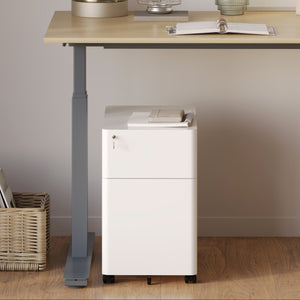






















Filing Cabinet Choices for Cleaner Workstation Planning
Cleaner workstation planning starts with filing storage that matches the desk, document volume, security needs, and daily workflow. Explore how cab...
Learn more
Visit quiz page to see how we makes it easy to create an inspiring workplace


Neck support should feel like a quiet backup, not a constant reminder that you are sitting. When an office chair headrest or neck pillow starts to hurt, it usually is not because your neck is weak or your posture is “bad.” It is almost always a mismatch between how your chair is set up, how your screen is positioned, and how your body is trying to stay upright for hours.
At Urbanica, we look at neck pain the same way we look at any comfort problem: start with mechanics, make the smallest change that removes the irritation, then build a setup you can repeat every day without thinking about it.
Neck pain from a headrest tends to show up quickly because the contact point is small, the tissue is sensitive, and the body responds fast to pressure in the wrong place.
A headrest is meant to support the back of your head during recline, not to prop up your neck while you sit upright. When the headrest contacts your neck instead of your head, your body often reacts in one of two ways:
If the headrest pushes the head forward at the wrong height, many people tilt the chin slightly upward to “get comfortable.” That position narrows space in the back of the neck, and the muscles at the base of the skull can start to feel compressed.
If the headrest meets the back of your head but is too far forward, it can act like a lever that nudges your head ahead of your shoulders. Your neck then works overtime to keep your eyes level with the screen.
Many desk workers describe the problem as a neck ache, but the sharpest discomfort often sits right where the skull meets the neck. That area is loaded with small muscles that stabilize your head. When your setup asks those muscles to do constant micro-work, you feel it as a deep ache, a pressure sensation, or a headache that builds as the day goes on.
Use this quick map to narrow the cause before you adjust anything:
Base-of-skull ache or pressure often points to headrest contact that encourages chin-up posture or screen height that is too low.
One-sided pinch near the shoulder blade often tracks to armrest height, mouse reach, or phone habits that pull one shoulder up.
Tight band across the tops of the shoulders often appears when armrests are too high or the desk is forcing your shoulders to lift.
Headache after screen time can be a combination of neck tension plus squinting, glare, or leaning in for text.
If you have numbness, tingling, radiating pain down the arm, progressive weakness, sudden severe headache, fever, or pain after a fall or accident, it is safer to seek medical evaluation. A chair adjustment is not the right tool for those situations.
Most headrest pain is not about the headrest alone. It is about the entire sitting chain. Here are the most common mechanics we see, plus the fastest way to identify them.
If the seat is too deep, you tend to slide forward to avoid pressure behind the knees. Sliding forward reduces back support and moves your head ahead of your torso.
Sit back fully, then check the space between the front edge of the seat and the back of your knees. A small gap helps circulation and lets you stay back in the chair. If there is no gap and you feel pressure, you are likely to perch forward.
When the pelvis rolls backward, the spine rounds and the head drifts forward. In that posture, a headrest either misses you entirely or contacts the wrong spot and increases pressure.
A small recline often reduces the urge to slump because it lets the backrest share the load. The goal is not to lean back dramatically. The goal is to stop holding your upper body up with neck tension.
If the armrests are too high, your shoulders lift and the upper trapezius muscles stay active. That tension can refer pain into the side of the neck and the base of the skull.
If your shoulders rise when you rest your forearms, or if you feel like your elbows are being pushed upward, the armrests are likely too high.
Armrests that are too low make your shoulders and neck stabilize your arms, especially while typing or mousing. Armrests that are too wide force your shoulders to rotate outward and can create a “pulled” sensation up the neck.
A useful cue: your forearms should feel supported without your shoulders changing position.
A headrest cannot fix a screen that makes you look down and forward. When the monitor is low or distant, your head searches for a clearer view. Over a day, that searching becomes a constant forward-head position.
When you are sitting comfortably, your eyes should naturally land in the upper portion of the screen without lifting your chin. If you have to tilt your head up or down to see clearly, fix the screen first.
Correct headrest contact is light, stable, and mostly on the back of the head. If the headrest presses into the neck, it can feel like your throat tightens or your head is being pushed forward.
A practical way to explore chair shapes and adjustability styles is to scan the Urbanica chairs collection and compare headrest designs, arm configurations, and backrest profiles across models.
Fast relief comes from two ideas: reduce muscle guarding, then remove the setup trigger that keeps reloading the same tissue. This sequence is gentle and realistic for a workday. Stop if anything increases symptoms.
Sit with your feet on the floor. Let your shoulders drop. Place your tongue gently on the roof of your mouth and unclench your jaw.
Inhale quietly through the nose.
Exhale slowly, longer than the inhale, and feel the ribs soften downward.
Repeat for about five breaths.
This is not a cure. It is a way to tell your neck it can stop bracing.
Gently nod “yes” with a tiny range, as if you are making the back of the neck long. Avoid lifting the chin. Do 6 to 8 slow reps, then rest.
Turn your head slightly away from the painful side, then tip the ear slightly toward the shoulder. Keep the shoulder down. Hold a mild stretch for 10 to 15 seconds and repeat once. It should feel like relief, not a pull.
Raise both shoulders up toward your ears, hold one second, then let them drop completely. Repeat 6 to 10 times, then add two slow shoulder rolls back. The goal is to teach your shoulders to release, not to “work out” the area.
Lower the armrests until your shoulders soften. Then raise them slightly until your forearms are supported without your shoulders changing position. If armrests do not adjust well for your body, using a desk surface to support your forearms can be a safer fallback than forcing armrest contact.
Move the screen closer so you stop leaning in. Raise it so your eyes naturally land high on the screen. If you are on a laptop, separate keyboard and mouse help, even if the solution is simple and not fancy.
A headrest should feel optional. You should be able to sit without it, then enjoy it when you recline.
If you try to use a headrest to hold your head up while you sit upright, it often backfires. During typing, many people do best with the headrest barely touching or not touching at all. During thinking, reading, or calls, a modest recline can let the headrest do what it is designed to do.
Aim for contact on the back of the head, not the neck. If you feel pressure in the neck, lower or raise the headrest until the contact point moves upward. If you cannot get the contact point off the neck, it is a sign that the headrest design may not match your proportions.
A headrest that sits too far forward encourages forward head position. Back it off until the contact becomes lighter. If light contact disappears, that is okay. It is better to have no contact than pressure in the wrong place.
A small recline can unload the neck and upper back. Adjust tension so you do not have to fight the chair. You should be able to lean back slightly and return upright without effort. Think of two modes:
Typing mode: upright, headrest not pressing, arms supported.
Thinking mode: slight recline, headrest lightly supporting the back of the head.
If you cannot get a comfortable headrest position, that is not a personal failure. It often means the chair needs different adjustment points or a different headrest geometry. When you want to compare adjustment layouts in a straightforward way, a product page like Novo Chair product details can help you check what actually adjusts and how the chair is built, without guessing.
If you only change one thing, change the visual zone. Neck pain often improves when your eyes and screen line up so your head stops searching.
Place the screen close enough that you do not lean forward to read.
Raise the screen so your gaze lands naturally in the upper portion.
Increase font size and zoom before you lean in.
This approach is honest and sustainable because it works with how people actually read and focus.
A laptop tends to pull the head down because the screen and keyboard are attached. A practical fix is to raise the laptop screen and use a separate keyboard and mouse. Even a stable stand and a simple external keyboard can change the posture problem immediately.
If you are squinting, you often move your head forward. Reduce glare by adjusting the screen angle, repositioning lights, or shifting the monitor away from direct reflections. Comfort is not only about posture. It is also about visual effort.
Place items based on how often you use them:
Primary zone: keyboard and mouse within easy elbow reach.
Secondary zone: phone, notebook, water within a short reach.
Tertiary zone: rarely used items farther away.
This reduces constant micro-reaches that pull your neck and shoulders out of alignment.
Even with the right chair, desk mismatch can keep your neck on edge.
When your hands are on the keyboard, your elbows should be roughly level with the desk surface and your shoulders should feel heavy, not lifted. If the desk is too high, your shoulders creep up. If the desk is too low, you hunch to reach it.
A shallow desk can force the monitor too close or the keyboard too close. A deep desk can push the monitor too far away, which invites leaning. The goal is a layout that lets you keep your ribcage stacked over your pelvis while your eyes stay on the screen.
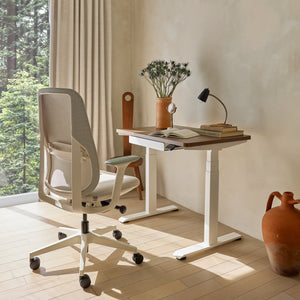
If you are evaluating a desk, it helps to look at real dimensions, materials, and how the surface supports your workflow. A page like Office Desk sizes and materials gives you a concrete reference for what to verify when you are trying to reduce neck strain through better workstation fit.
If your cable management forces you to twist for ports, chargers, or headphones, your neck pays for it. Keep frequently used cables within the secondary reach zone and avoid routing that pulls devices behind the monitor where you have to crane.
Some neck pain comes from constantly adjusting and fidgeting. Chair design that reduces fidgeting can reduce neck tension.
When you overheat, you shift and slump. A breathable back can reduce that restless movement, which reduces repeated neck repositioning.
Chairs with wide, high side frames can encourage shoulders to round forward. If your neck is sensitive, you often do better with a backrest shape that supports without pressing your shoulder blades inward or limiting arm movement.
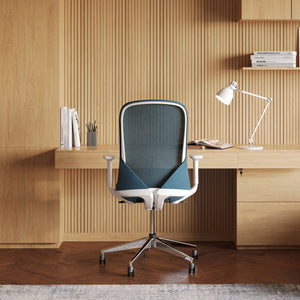
For many workdays, integrated arm designs feel stable and simple, especially when the arm height and desk height match. If you want a concrete example of this style, Seashell Chair with integrated armrests shows how a breathable back and a streamlined arm configuration can fit a straightforward desk routine.
Adjustability is useful when it solves a specific mismatch. More knobs are not automatically better. The right adjustments are the ones you will actually use.
Seat height sets whether your pelvis feels stable and whether your shoulders can relax. Seat depth affects whether you can sit back fully and use the backrest. When these two are off, the neck often compensates.
Armrests matter because your neck and shoulders do not like being the primary support for your arms all day. A good setup makes your forearms feel supported while your shoulders stay relaxed.
Some people chase neck comfort by aggressively pushing lumbar support. That can create stiffness and force compensation higher up. Aim for gentle support that keeps you from collapsing, not a shape that locks you into a posture.
Sit back, then check if you can keep a small knee gap without sliding forward.
Rest forearms, then check if shoulders drop naturally.
Look at the screen, then notice if your head wants to move forward to see.
If a chair’s adjustment range does not let you pass these checks, it is likely not a match for your body and desk.
Some people like to tune throughout the day, especially in hybrid setups where one chair serves multiple tasks. If you want a grounded reference for a supportive ergonomic build, Onyx Chair product details can be used to compare structure and adjustment intent against your needs, without assuming a chair will “fix” pain on its own.
The goal is to stop guessing. Use this table to connect what you feel with what to change first.
| Symptom pattern | Most likely setup cause | Fastest correction | If it persists, adjust next |
|---|---|---|---|
| Base-of-skull pressure while typing | Headrest contacting neck or monitor too low | Reduce headrest contact during typing, raise screen | Check seat depth and slight recline tension |
| Tight band across shoulder tops | Armrests too high or desk too high | Lower armrests, support forearms on desk | Move keyboard closer, check mouse reach |
| One-sided neck pinch | Mouse reach or phone habits pulling one shoulder | Bring mouse closer, switch phone side | Adjust armrest width or reduce twisting |
| Headache after screen time | Leaning forward to read, glare, squinting | Increase zoom and font, reduce glare | Recheck screen distance and height |
| Neck fatigue during calls | Sitting upright with unsupported arms | Slight recline, support forearms | Recheck armrest height and desk height |
| Neck pain only when leaning back | Headrest too far forward | Reduce headrest depth, lighter contact | Verify headrest height to meet back of head |
Sustainable comfort is more about rhythms than rigid rules.
Instead of trying to remember breaks on a timer, attach movement to transitions:
After a call: stand, roll shoulders back twice, then sit.
After emails: look far away for a few breaths, then reset screen distance.
After focused work: walk to refill water, then return and drop shoulders.
These are small on purpose. Consistency matters more than intensity.
Put your phone and water on the side you rotate least comfortably toward, so you do not reinforce a one-sided pattern. Place your notebook directly in front of you if you reference it frequently, so you are not twisting your head every few minutes.
Try “heavy ribs, long back of neck.” It encourages stacked alignment without forcing you to brace your abs or squeeze your shoulder blades. If you feel stiff, you are trying too hard.
Comfort improves when your setup is coherent. Chair, desk, and screen should work together so you do not have to actively manage posture all day.
People sit better in chairs they like using. That is not fluff. When a chair feels stable and comfortable, you shift less. Less shifting often means fewer neck flare-ups.
If your work shifts between typing, reading, and leaning back, it helps to look for a chair that supports multiple modes without forcing one posture. Muse Chair adjustment overview is one reference point for how an adjustable chair can be presented clearly, so you can evaluate whether the adjustment style fits your day.
1. Raise or reposition the screen so you stop searching with your neck.
2. Support your forearms so your shoulders stop bracing.
3. Tune the chair so you can sit back without sliding forward.
4. Confirm desk height and layout so the setup remains natural.
When outfitting a home office or a team space, practical considerations like delivery logistics and showroom access can matter as much as chair specs. If you are coordinating a workspace setup and want to understand how we handle regional support, fast and free delivery information for local workspaces lays out the relevant details in one place.


You have unlocked free shipping!
You're saving $29 and unlocked free shipping!
Leave a comment