



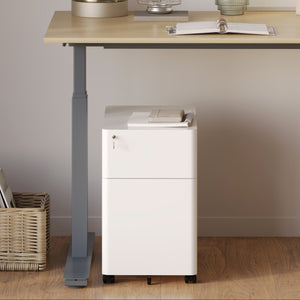






















Filing Cabinet Choices for Cleaner Workstation Planning
Cleaner workstation planning starts with filing storage that matches the desk, document volume, security needs, and daily workflow. Explore how cab...
Learn more
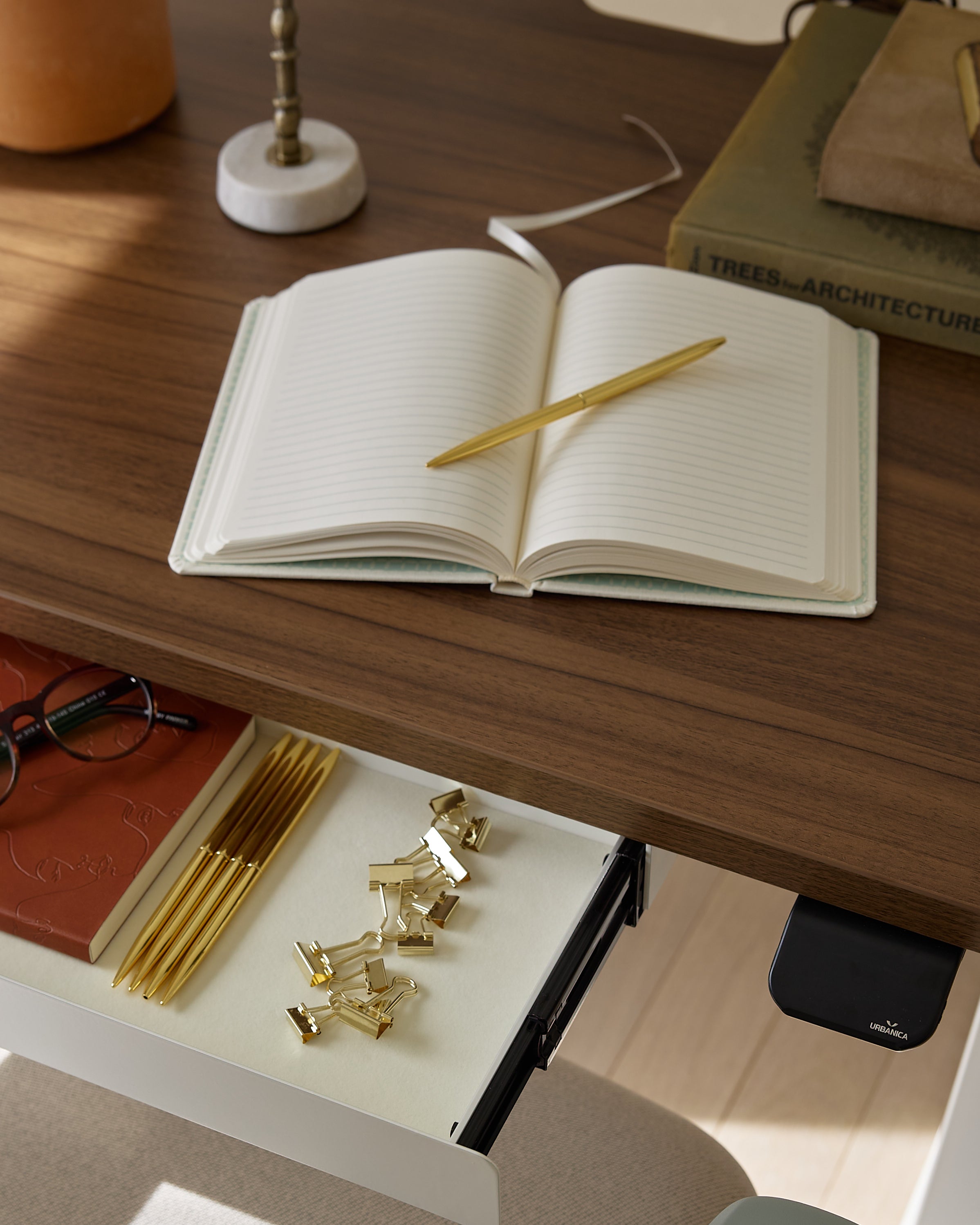
Visit quiz page to see how we makes it easy to create an inspiring workplace


A cable manager under a desk earns its keep when you stop noticing it. Not because it is hidden, but because your knees never bump it, your ankles never snag it, and your chair rolls without tugging anything loose. That is the standard we use when we design and recommend cable routing for real workspaces.
Cables usually become an ergonomic problem in three ways. First, loose slack creates loops at floor level that your feet and casters find easily. Second, bulky adapters and power strips migrate into the footwell, forcing you to sit with your legs angled or tucked. Third, a cable drop from the desktop to the outlet becomes a swinging line that catches shins when you swivel or stand up.
“Fit” is the buyer’s advantage here. A system that fits your desk and your body disappears into the underside of your setup. A system that does not fit turns every reposition into friction. Comfort-first cable management is less about achieving a perfectly straight line and more about protecting a clear leg corridor and a predictable chair path.
The fastest way to buy the right cable manager is to map your movement envelope, meaning the space your legs and chair occupy during normal work. This is the part most shopping lists miss, and it is the difference between “tidy” and “comfortable.”
Sit the way you actually work, not the way a product photo sits. Slide your feet forward and back. Let your knees open outward slightly. Cross one ankle over the other if you do that often. Then roll your chair back a few inches and forward again. You are looking for three things:
Where your shins pass under the desk front edge
Where your heels drag during micro-movements
How far your casters travel during quick scoots
Anything that lives in those paths is a future irritation, even if it is visually neat.
Most cable problems happen in predictable zones:
Shin-height edges: front-mounted trays or channels can become impact points if mounted too close to the desk edge.
Heel drag zone: floor-level loops catch the underside of shoes, especially when you shift posture.
Caster sweep zone: chair wheels pull on slack and can peel adhesives over time if tension is constant.
If you mark these zones first, your buying decision becomes about keeping hardware out of the way, not hoping it will be fine.
Once the movement envelope is clear, take four measurements. These determine which styles are even possible, and they prevent the common mistake of buying a great-looking product that becomes a shin magnet.
1. Front-to-back underside depth: This is your mounting real estate. Many desks have less usable space than expected because of supports and modesty panels.
2. Lowest obstruction point: Aprons, crossbars, and brackets create “no-mount” areas and reduce clearance.
3. Seat-to-desk distance in your real posture: Measure from the front edge of your seat to the desk front edge while you are seated normally. This helps you judge how close you mount any hardware.
4. Outlet location and route direction: Know whether the cleanest path is down the left leg, right leg, or center, and whether the outlet is on the wall, floor, or baseboard.
If you are evaluating a desk purchase alongside cable management, start by confirming the desk footprint and underside layout. The Office Desk size options page is a practical reference point for thinking through surface width, depth, and how they affect cable run distance.
Use painter’s tape on the underside of the desk to mark a “no-contact corridor,” a zone where nothing should protrude. Sit down, place your feet as you work, and estimate where your shins pass. Then mark a band a few inches behind the desk front edge and keep cable hardware behind that band whenever possible.
This method is simple, reversible, and honest. If tape placement feels intrusive while you move, a hard plastic tray in that location will feel intrusive too.
Different cable managers solve different problems. The right choice depends on device load, outlet location, and how sensitive you are to legroom changes.
Containment is for the bulky part of your setup: power strips, power bricks, and excess length that you do not want on the floor. A dedicated accessory can simplify this by giving you a single “home base” under the desk where everything is secured.
If you want a designed solution that focuses on concealment and organization under the desktop, the Under-Desk Cable Management accessory is built for that purpose. The key fit question is whether you can mount it far enough back to protect your shin corridor while still keeping plugs reachable.
If you have a shallower underside space or you sit close to the desk edge, guided routing can be more comfortable than containment. Low-profile channels and clip-based routes keep cables pinned to the underside so they do not drift into the footwell.
In this style, the goal is not to “store” cables, but to guide them along safe edges and away from moving legs. It is often the best match for minimal device setups or desks with limited mounting area.
When an outlet is off to one side, or when a desk needs a clean desk-to-floor drop, vertical management matters. A controlled vertical path prevents swinging slack and keeps cables from brushing your legs.
The Spine Cable Management accessory is designed around that vertical routing use case. The practical comfort test is whether it can be positioned where your chair and feet rarely travel, usually closer to a desk leg or along the side of the setup rather than the center.
Adhesives can be effective for lightweight routing, especially for channels and clips. Screws are generally better for heavier loads and frequent bumps. Comfort is not only about strength, it is also about stability. A cable system that shifts a little every time it is nudged will eventually drift into your leg corridor.
If you are in a rental or you prefer minimal surface impact, choose lighter loads, distribute weight, and reduce tension on adhesives by managing slack thoughtfully. For heavier power setups, consider mounting that can handle repeated contact without shifting.
This checklist is designed to keep the focus on comfort and fit, not perfection. The goal is a workspace that stays calm and predictable as you move.
Tall users: Knees sit higher and travel farther forward. Keep hardware farther back and keep drops away from the centerline.
Cross-legged sitters: Knees sweep side to side. Avoid side-mounted protrusions near the front edge.
Active sitters: Micro-movements are constant. Prioritize snag-free routing and eliminate floor loops entirely.
Slack should be deliberate. Too little slack makes plugs tug under movement. Too much slack creates loops that catch feet and chair wheels. A good rule is to keep any extra length secured under the desk, then leave only a controlled service loop near the device end, not near the floor.
Power bricks can be bulky, and some setups include multiple adapters, hubs, and chargers. The comfort-first decision is to keep bulk out of the footwell and keep access reasonable, so you do not avoid using your own outlets because they are annoying to reach.
1. List devices and count adapters that need power under the desk. Note which ones run warm and which ones need regular unplugging.
2. Map your movement envelope using the leg-swing test and mark danger zones.
3. Measure the four numbers that decide fit: underside depth, lowest obstruction, seat-to-desk distance, outlet location.
4. Choose a style based on your constraints: containment for bulk, guided routing for tight footwells, vertical drop for clean desk-to-floor paths.
5. Select mounting positions behind the no-contact corridor, with corners treated as high-risk snag areas.
6. Route power first, then data to reduce electromagnetic clutter and to keep thicker cables in stable paths.
7. Secure slack under the desk and eliminate floor loops near casters.
8. Test movement by rolling, swiveling, and repositioning. If you can feel the system, shift it until you cannot.
Plan access for one future device so you do not have to undo everything later.
Comfort and fit are not only physical. They are also about day-to-day usability, including how easy it is to plug in a device and how safely power hardware lives under the desk.
Many tidy-looking solutions are designed for cable routing only, not for supporting power strips and heavy adapters. Buyers run into trouble when they treat every under-desk organizer as a load-bearing platform.
A safer approach is to separate functions:
Use one stable area for power distribution where weight is supported securely.
Use lighter routing for signal cables and peripheral lines along the underside edges.
Avoid suspending heavy bricks by their own cords, since that creates strain at the connector.
Adapters and power supplies can produce heat during use. Keeping them tightly bundled with no airflow can make the under-desk zone warmer than it needs to be. The goal is not to engineer a cooling system. It is to avoid trapping warmth in a dense cluster and to keep plugs from being pressed hard against each other.
Leave small gaps where you can, keep materials from compressing adapters, and avoid wrapping cords so tightly that the bundle becomes stiff and unserviceable.
Cable wear tends to happen where cords bend sharply, rub on hard edges, or carry constant tension. Under the desk, the common failure points are:
Drop points near the desk edge where a cable bends downward
Edges where cables rub during chair or leg movement
Outlet zones where plugs are pulled sideways by slack
Use smooth routing paths, avoid tight bends, and make sure the cable drop is supported so the connector is not carrying the full weight of the run.
A cable system that feels fine with one chair can become annoying with another. The reason is simple: chair height changes knee position, recline changes leg reach, and rolling behavior changes where casters travel.
When seat height increases, knees rise and approach the underside. When seat depth and recline encourage you to sit slightly farther back, your shins can sweep a different path during repositioning. Cable hardware that was “out of the way” can drift into contact.
This is why we treat cable planning and seating as one system. If you are dialing in an ergonomic setup, it helps to look at seating options as part of the decision. The office chair collection is a useful place to compare chair styles that influence posture and movement patterns.
Chair movement introduces two cable risks:
Caster sweep catches slack at floor level.
Chair legs bump low-mounted drops or hardware when you roll in close.
The fix is usually not more clips. It is eliminating floor loops, controlling the desk-to-floor path, and keeping all low hardware away from the chair’s natural approach zone.
Different chairs create different movement patterns. Instead of guessing, use your chair behavior to choose a cable manager style that stays out of the way.
If you adjust posture often, shift forward and back, or change recline throughout the day, your cable system needs to handle constant motion without catching. In this profile, vertical drops should be positioned away from the centerline, and slack should be secured under the desk so it never reaches the floor.
The Novo Chair is a reference point for an ergonomic chair style that can encourage frequent repositioning. In setups like this, snag-free routing matters more than hiding every inch of cable.
If you tend to sit in a consistent posture with fewer position changes, you can often use under-desk containment more easily, since your leg corridor is more predictable. Even then, placement still matters. The footwell must stay clear, and the underside should not become crowded with bulky adapters.
The Onyx Chair is a reference point for a stable seating profile. With a consistent posture, you can plan clearances more precisely and mount hardware farther back with confidence.
Chair changes can alter seat height, rolling behavior, and how close you sit to the desk. A future-friendly cable setup leaves routing paths that are adjustable without leaving loose slack. Favor systems that let you re-route a drop point, add a device, or shift a channel location without starting over.
Installation is where comfort is either protected or compromised. A technically correct install can still be irritating if placement ignores how people move.
Mount containment farther back than you think you need, then test with the leg-swing movement envelope.
Treat front corners as high-risk snag zones. If you must mount near a corner, keep the profile low and the edges smooth.
Keep the centerline clear whenever possible, since that is where legs and chair approach naturally.
1. Power lane first: Secure the power strip or power cluster under the desk so it does not shift.
2. Data and peripherals second: Route thinner cables along stable edges and away from power bulk.
3. Slack management last: Secure excess length under the desk and leave only a small service loop at the device.
This order keeps the heavy, stiff cables from forcing awkward paths for lighter lines.
A comfort-first setup is also easy to live with. Before you finalize everything, try two tests:
Add-a-device test: Can you plug in a new charger without unmounting hardware?
Cleaning test: Can you vacuum or sweep near the desk without catching a loop?
If either test fails, adjust now. A small change in drop position or slack control usually fixes it.
Room reality matters. Outlet placement, baseboards, and furniture layout determine the cleanest path to power.
Wall outlets often favor a side drop near a desk leg so the cable line follows the perimeter of the room. Floor outlets can tempt a center drop, but center drops are where legs and chairs travel most. If you have to route toward a floor outlet, keep the drop close to a desk support and protect slack from chair wheels.
If you avoid drilling, prioritize:
Low-tension routing so adhesives are not constantly pulled
Lighter loads for adhesive-mounted channels and clips
A vertical drop positioned where it is less likely to be bumped
If you want guidance that aligns product selection with real room constraints, delivery considerations, and workspace planning support, the shipping and workspace support page is a helpful reference point for how we think about fitting furniture and accessories to a specific space.
A cable manager under a desk should handle the setup you have now and the setup you will likely grow into. The safest path is choosing a system that preserves legroom today and leaves structured expansion space tomorrow.
Expansion capacity: room for one extra adapter and one extra device cable without becoming crowded
Adjustable routing: the ability to shift a drop point or reroute a bundle without removing the entire system
Serviceability: quick access to plugs without forcing cords to bend sharply
| Cable management approach | Best match for comfort and fit | Strengths for daily use | Watch-outs that affect comfort |
|---|---|---|---|
| Under-desk containment | Multiple adapters and power distribution under the desk | Keeps bulk out of the footwell when mounted far back | Can reduce clearance if mounted too close to the front edge |
| Guided routing channels and clips | Tight footwells, minimal device load | Low-profile, keeps lines pinned away from legs | Adhesive systems need low tension and clean surfaces |
| Vertical drop routing | Off-center outlets, desire for one clean desk-to-floor path | Reduces swinging slack and keeps cords off the floor | Placement matters, keep it away from the centerline and caster paths |
| Hybrid approach | Mixed needs, power bulk plus tidy routing | Lets each component do one job well | Requires planning so the underside does not become crowded |
After installation, run a practical test that mirrors daily movement:
Roll in and out, swivel left and right, and place feet in your usual positions.
Reach for a plug and connect a device without pulling on a cable bundle.
Look under the desk once, then stop thinking about it.
When a cable manager fits correctly, comfort improves because nothing interrupts movement. That is the goal we design for, and it is the standard that helps buyers choose with confidence.


You have unlocked free shipping!
You're saving $29 and unlocked free shipping!
Leave a comment