























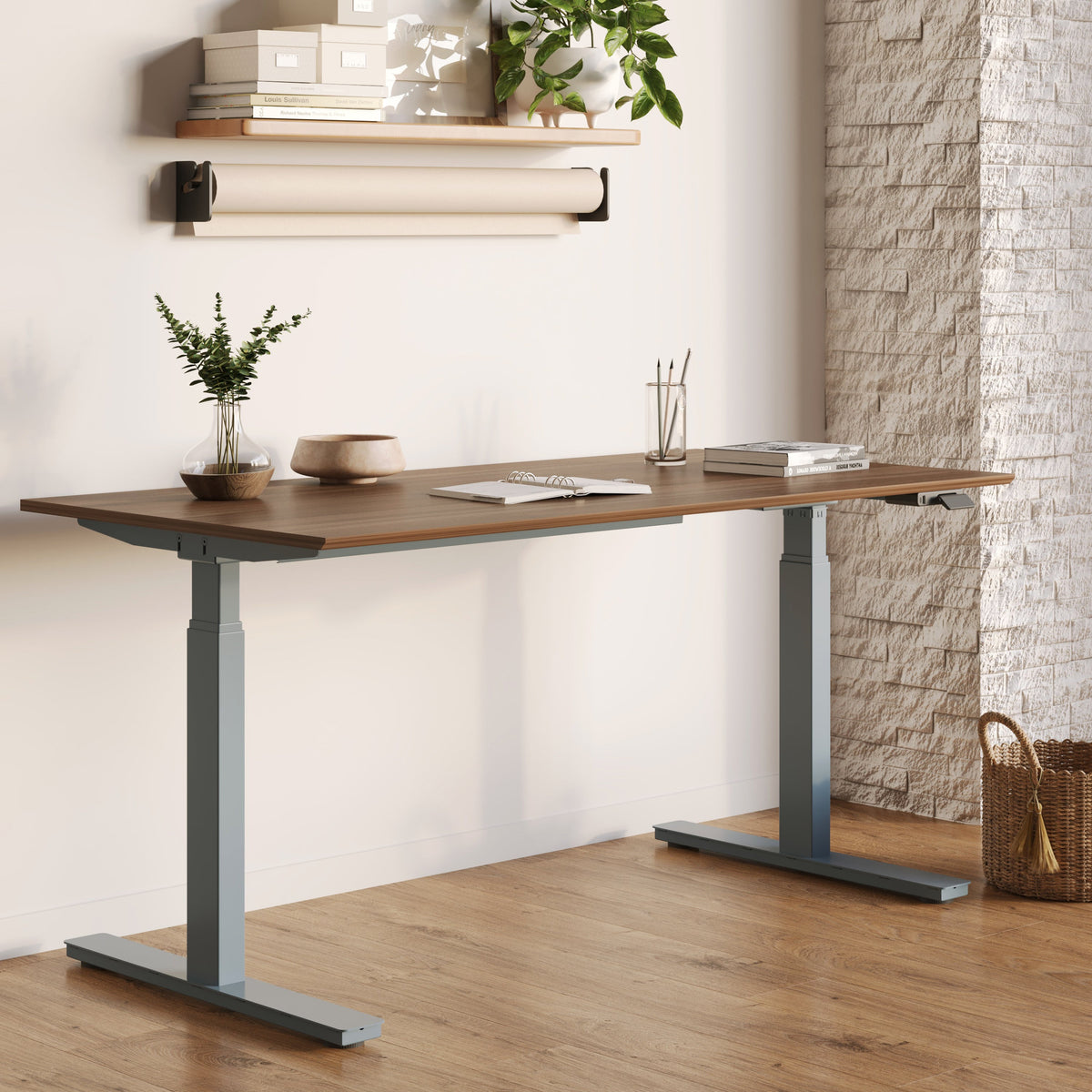
Mini Standing Desk vs Compact Desk for Small Rooms

Why Desk Selection Becomes a Defining Decision in Small Rooms
Limited space amplifies every design choice
In small rooms, a desk is never just a background element. It shapes how the room functions, how movement flows, and how comfortably work can be sustained day after day. A difference of a few inches in depth or height can determine whether a room feels workable or restrictive. Unlike larger offices, compact rooms do not absorb inefficiencies. Every design decision carries weight.
Desk type influences posture, movement, and mental clarity
The desk selected for a small room quietly dictates daily behavior. Fixed desks reinforce long seated sessions, while adjustable desks invite posture variation. Over time, these patterns influence comfort, focus, and energy levels. The comparison between a mini standing desk and a compact desk is ultimately a comparison between two different approaches to working within constraints.
Furniture designed for modern living spaces prioritizes adaptability, proportion, and long-term usability. These principles guide many modern home office furniture options created for apartments, studios, and converted rooms.
Defining a Mini Standing Desk Within Compact Living Environments
A standing desk scaled for spatial efficiency
A mini standing desk is a complete sit-stand workstation with a reduced footprint. It is not a desktop riser or an accessory layered onto existing furniture. Instead, it replaces the desk itself while preserving height adjustability. The defining characteristic is vertical flexibility without unnecessary bulk.
Height adjustment as functional versatility
In small rooms, vertical movement can be more valuable than additional surface area. Height adjustability allows the same footprint to serve multiple postures throughout the day. Sitting and standing occur within the same zone, reducing the need for extra furniture or rearrangement.
Practical surface capacity for compact setups
Mini standing desks typically support laptops, monitors, keyboards, and essential accessories. The limited surface area encourages intentional setup decisions that often improve ergonomics and reduce clutter. This approach aligns well with small room realities, where simplicity supports usability.
A well-engineered height-adjustable mini standing desk allows posture variation while respecting spatial boundaries, offering flexibility without overwhelming the room.
Understanding Compact Desks and Their Role in Small Rooms
Fixed-height design and structural reliability
Compact desks rely on simplicity. With no moving components, they provide predictable stability and minimal maintenance. This straightforward design appeals to users who value consistency and a visually calm environment.
Common compact desk configurations
Compact desks appear in several formats suited to small rooms.
Writing desks
Lightweight and shallow, often used for laptops or light work.
Narrow workstations
Slightly deeper surfaces that support monitors while remaining space efficient.
Wall-aligned desks
Designed to sit flush against walls to preserve walking clearance.
How fixed desks shape work habits
A compact desk establishes seated work as the default posture. This makes chair selection and desk height alignment especially important. While posture variation is limited, predictability can support focus for users who prefer routine.
Exploring different small-space desk designs helps clarify how fixed desks perform across varied room layouts.
Core Functional Differences Between Mini Standing Desks and Compact Desks
Floor footprint versus vertical adaptability
Compact desks often occupy marginally less floor space because they do not require clearance for height transitions. Mini standing desks trade a small increase in depth for the ability to adjust vertically. In practice, the distinction lies more in how the space is used than how much space is taken.
Posture variation and daily movement
Mini standing desks encourage regular posture changes by making standing accessible without disruption. Compact desks support stability and consistency but rely on seating for ergonomic variation. Neither approach is universally better. Each supports different working styles.
Integration into small room layouts
Standing desks require access to power and thoughtful cable management. Compact desks integrate easily into rooms with limited outlets or older infrastructure. In small rooms, ease of integration often influences long-term satisfaction more than feature sets.
Durability expectations and maintenance
Fixed desks depend primarily on material strength and joinery. Standing desks introduce mechanical components that benefit from mindful use. Both can offer long-term reliability when expectations align with design intent.
Functional comparison overview
| Consideration | Mini Standing Desk | Compact Desk |
|---|---|---|
| Primary posture | Sitting and standing | Sitting |
| Space strategy | Vertical flexibility | Minimal footprint |
| Setup requirements | Power access | Immediate use |
| Workflow style | Dynamic | Consistent |
| Ergonomic range | Desk-driven | Chair-driven |
Ergonomics in Small Rooms Requires a System Approach
Why seating becomes critical in compact workspaces
Limited room size often reduces opportunities for movement during the day. As a result, seating quality plays a larger role in comfort and posture. A desk alone cannot compensate for inadequate seating support.
Aligning chair dimensions with desk constraints
Seat height, armrest clearance, and back support must work in harmony with desk height and depth. Fixed desks demand precise chair adjustment, while standing desks benefit from chairs that support brief seated intervals without encouraging prolonged slouching.
Choosing ergonomic seating for home offices ensures the desk and chair function together as a cohesive system.
Chair Selection for Compact Desk Workflows
Supporting extended seated focus without visual bulk
Compact desks pair best with chairs that provide proper support while maintaining a streamlined profile. Overly large chairs can dominate small rooms and restrict movement.
Matching chair adjustability to fixed desk height
Since the desk does not adjust, the chair must accommodate the user. Seat height adjustment and lumbar support are essential for maintaining neutral posture during long sessions.
The Novo ergonomic task chair supports seated work while maintaining proportions suited to compact environments.
Chair Selection for Mini Standing Desk Workflows
Supporting smooth transitions between postures
Mini standing desks work best with chairs that allow quick shifts between sitting and standing. These chairs support brief seated breaks without anchoring the user to the chair.
Reducing fatigue during posture changes
Proper seating support helps maintain comfort throughout posture transitions, making standing a sustainable option rather than a novelty.
The Onyx ergonomic office chair complements sit-stand routines by supporting balance and posture without overwhelming the workspace.
Situations Where a Full-Size Standing Desk Works in a Small Room
Evaluating functional clearance rather than room size alone
Some small rooms can accommodate larger desks if circulation paths remain unobstructed. Door swings, storage access, and walking routes matter more than wall-to-wall measurements.
Work requirements that exceed compact surfaces
Users who rely on multiple monitors, creative tools, or technical equipment may find compact surfaces limiting. In such cases, a larger desk can support productivity without necessarily compromising spatial efficiency.
A full-size adjustable standing desk can be appropriate when layout and workflow demands justify the additional surface area.
Matching Desk Type to Common Small Room Scenarios
Studio apartments with shared living functions
Mini standing desks often suit studio layouts by offering flexibility without permanently defining the space as an office.
Bedrooms converted into dedicated workspaces
Compact desks align well with bedrooms used as permanent offices, where visual calm and routine support long work sessions.
Shared rooms and flexible work zones
Mini standing desks adapt easily to shared environments where different users or activities rotate through the same space.
-
Studio work zones benefit from vertical adaptability
-
Dedicated offices benefit from fixed stability
-
Shared spaces benefit from flexible configurations
Long-Term Adaptability Without Overstatement
Furniture that evolves with changing habits
Work habits evolve gradually. Furniture that supports multiple postures or simple reconfiguration remains useful over time without relying on novelty or complexity.
Relocation and room changes
Compact desks are easy to move and reposition. Mini standing desks offer adaptability through adjustability rather than relocation. Both approaches support longevity when chosen with realistic expectations.
Choosing Based on How Work Is Actually Done
Deep focus versus intermittent tasks
Users engaged in long, uninterrupted sessions may value the stability of a compact desk. Those with varied schedules or frequent breaks often benefit from the movement encouraged by standing desks.
Equipment needs and spatial discipline
Minimal setups work well on either desk type. Equipment-heavy workflows require careful planning regardless of desk choice. Surface area should reflect actual use rather than aspirational setups.
Creating a Small Office That Feels Functional and Balanced
Visual openness through proportion and placement
Desk height, depth, and placement influence how open a room feels. Furniture that respects sightlines contributes to mental clarity and comfort.
Ergonomics without excess
Effective ergonomic design focuses on essentials rather than accumulation. In small rooms, restraint often leads to better outcomes than feature saturation.
Designing for continuity and change
The most successful small offices balance present needs with future flexibility. Whether through adjustability or simplicity, the right desk choice supports consistent work while leaving room for evolution.
Related Articles
-
 This Is How To Build A Small Home Office You Actually Want To Work From, And How To Pick Desks For Small Spaces - Urbanica Furniture's Full Guide
-
 Filing Cabinets for Small Spaces That Still Look Clean Now
-
 Minimalist Office Table Ideas That Work Like a Bistro Table
-
 Make Small Shared Spaces Work Better With a Bistro Table
-
 Best Filing Cabinet Layout Ideas for Small Home Offices and Shared Rooms
-
 What Size Filing Cabinet Makes Sense for Small Workspaces?


