



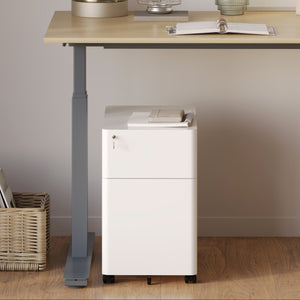






















Filing Cabinet Choices for Cleaner Workstation Planning
Cleaner workstation planning starts with filing storage that matches the desk, document volume, security needs, and daily workflow. Explore how cab...
Learn more

Visit quiz page to see how we makes it easy to create an inspiring workplace


Shoulder tension during long study sessions rarely begins in the shoulders alone. In most cases, it develops because the body is working around a chair that does not support steady, neutral posture. When the seat is too high, the shoulders lift to compensate. When the backrest does not support the spine, the upper body starts holding itself up. When the chair places the arms too far out, too low, or too high, the neck and upper back gradually tighten.
This is why a chair that feels comfortable for ten minutes can become a problem after two or three hours. Early comfort is often based on softness or appearance. Long-session comfort depends more on posture, support, and how well the chair works with the desk.
For students, this matters even more because study posture is rarely static. Reading, typing, handwriting, reviewing notes, and switching between screens all create small changes in arm position and upper-body load. A poorly chosen chair turns those normal movements into repeated stress. A better chair reduces the need to shrug, reach, hunch, or brace.
A strong selection process starts with one question: does this chair help the shoulders stay relaxed while the rest of the body stays supported? That is a more useful test than asking whether the seat feels plush or whether the silhouette looks modern in a room.
Seat height has a direct effect on the shoulders because it changes where the elbows naturally fall relative to the desk. If the chair is too low, the student often reaches upward toward the work surface. If it is too high, the feet may lose stable contact with the floor, creating instability that can travel upward through the hips and spine.
A better setup allows the elbows to rest close to the body with the forearms supported by the desk or armrests without lifting the shoulders. This is especially important for writing, keyboard use, and mouse work, where repeated upper-arm elevation can create tightness across the neck and trapezius area.
Many people shop for a study chair by focusing only on the seat cushion or visual style. In reality, the backrest often matters more for shoulder comfort. When the lower and mid-back are supported, the upper body does not need to hold itself upright all day. That reduces strain in the muscles that often become tense during extended studying.
A backrest does not need to feel rigid to be effective. It needs to support upright sitting without forcing the shoulders forward. A chair that encourages collapse through the lower spine often leads to rounded shoulders and a forward head position, both of which increase tension over time.
Armrests can help, but only when they fit the desk and the body. Poorly placed armrests can create just as many problems as having none at all. If they are too high, the shoulders rise. If they are too wide, the arms drift outward. If they prevent the chair from moving close enough to the desk, the student may lean forward for hours.
For some study setups, lower-profile or more adaptable arms work better than oversized ones. In others, simple arm support can make a meaningful difference. The key is not whether a chair has armrests, but whether they help the shoulders stay quiet and natural through different tasks.
Not every student needs the same level of adjustment, but some flexibility is valuable because studying is not a single-position activity. A chair that can adapt to typing, reading, and note-taking usually supports the body better than one locked into a single posture.
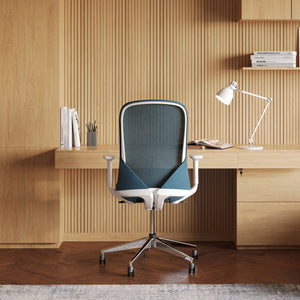
Height adjustment is the minimum. Beyond that, tilt, back support, and arm positioning can improve how the chair responds to long sessions. This is one reason many shoppers begin by reviewing ergonomic office chairs instead of style-first seating. A category built around ergonomic use tends to offer options better suited to long sitting periods and changing work positions.
Seat depth is often overlooked, yet it can strongly affect shoulder comfort. If the seat is too deep, the student may sit forward to avoid pressure behind the knees. Once that happens, the back loses contact with the chair and the shoulders begin carrying more of the upper body. If the seat is too shallow, the body may not feel grounded enough for long sessions.
A good fit allows the student to use the backrest without feeling pushed forward. This makes it easier to stay supported during reading, writing, and screen-based work.
A heavily padded chair can feel inviting at first, but softness alone does not equal good support. Overly plush seating may allow the pelvis to sink and the spine to round, which eventually affects the shoulders. Balanced cushioning usually works better than exaggerated softness because it supports rather than swallows the body.
A model such as the Novo Chair fits naturally into this part of the conversation because it belongs in the category of task-oriented seating intended for work-focused use, not occasional lounging. That distinction matters when the goal is to reduce tension during repeated, long-duration study blocks.
Laptop use is one of the biggest contributors to rounded shoulders because the screen and keyboard are attached. That makes it difficult to keep both the neck and arms in an ideal position at the same time. In this case, the chair has to do more of the support work.
A student who spends hours on a laptop often benefits from a chair that encourages upright sitting, keeps the shoulders from drifting forward, and remains comfortable through frequent posture shifts. The chair will not solve every laptop-related issue by itself, but it can reduce how much the upper body compensates.
Many study sessions involve moments of leaning in. Highlighting text, writing notes, solving equations, sketching diagrams, or reviewing printed material all pull the body slightly forward. A good study chair does not punish that movement. Instead, it supports a return to a more neutral posture afterward.
This is where the relationship between seat stability and back support becomes important. A chair should allow focused work without making the body feel as if it must hover over the desk. For spaces where visual refinement also matters, the Muse Chair can enter the discussion as an example of seating that belongs in a design-conscious workspace while still being relevant to everyday function.
Some students move constantly between tasks. They may start by reviewing readings, shift to typing an assignment, then move into a video lecture or collaborative call. A chair for that kind of day needs to perform well across transitions, not just in one fixed posture.
The more varied the routine, the more valuable adaptability becomes. What matters is not an extreme number of controls, but a chair that remains supportive as the body changes angle and focus throughout the day.
Many people blame the chair when the real problem is the workstation relationship. Even a supportive chair will feel wrong if the desk forces the shoulders into a raised or collapsed position. A desk that is too high encourages tension through the neck and shoulders. A desk that is too low can pull the body downward and forward.
That is why chair shopping should never happen in isolation. The chair has to work with the surface where the studying actually happens.
Shoulder tension is not only about vertical position. It is also about how far forward the arms must travel during the day. If the keyboard, books, notebook, or monitor are placed too far away, the shoulder blades may stay protracted for hours. That repeated forward reach can build fatigue even when the chair itself feels supportive.
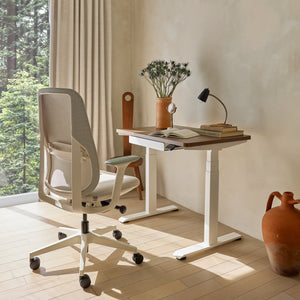
Reviewing ergonomic office desks alongside seating options helps create a more realistic setup. The right chair works best when paired with a desk depth and height that allow the arms to stay close, the shoulders to stay relaxed, and the student to keep useful items within comfortable reach.
The most effective study setup is a system made up of chair, desk, screen placement, and movement habits. A chair can improve support, but it cannot fully correct an environment that keeps the body in poor alignment. Choosing with the full setup in mind leads to better results than judging the chair alone on appearance or first impression.
Different chair types can work for different students, but their strengths are not identical. The table below helps frame the trade-offs without turning the decision into a one-size-fits-all rule.
| Chair Type | Best Fit | Shoulder Support Potential | Adjustability | Space Impact | Long-Hour Study Use |
|---|---|---|---|---|---|
| Ergonomic task chair | Daily study sessions with mixed tasks | High | High | Moderate | Strong |
| Mid-back adjustable chair | Regular study in smaller rooms | Moderate to high | Moderate | Moderate | Good |
| Design-led work chair | Style-conscious spaces with moderate use | Moderate | Low to moderate | Lower | Moderate |
| Basic occasional chair | Short sessions or backup seating | Low to moderate | Low | Lower | Limited |
A table can guide the decision, but it does not replace fit. A well-matched mid-back chair may outperform a poorly sized ergonomic chair. A stylish chair may work well for moderate sessions but feel limiting during heavy workloads. The key is to judge each option through the lens of actual study duration, desk compatibility, and the ability to keep the shoulders relaxed over time.
One of the simplest tests is to sit down and notice whether the shoulders settle or brace. A promising chair often creates a sense that the arms can rest naturally and the upper back is not working too hard. A less suitable chair may cause immediate lifting, outward arm drift, or a subtle urge to lean forward.
The first minute can be misleading. A chair deserves a little more time. After several minutes, ask whether you have slid forward, whether the shoulders have rounded, and whether the neck has started reaching toward the task surface. These changes often reveal the real support level better than quick first impressions.
When comparing options, use a clear framework:
1. Does the seat height help the elbows stay relaxed at desk level?
2. Can the back support upright sitting without pushing the shoulders forward?
3. Does the seat depth allow contact with the backrest?
4. Do the arms help posture, or do they interfere with desk use?
5. Can the chair support the way you actually study, not just how it looks in a room?
For shoppers who want a broader look at pieces that can shape a complete workspace, workspace furniture guidance is relevant because it aligns with the process of choosing furniture based on room needs and working style rather than impulse alone.
Students who spend long hours at a desk often need a chair built for sustained use rather than occasional sitting. In that context, the Onyx Chair makes sense as a relevant product example because it belongs in the conversation around ergonomic seating intended for extended daily work and study.
Not every room can accommodate a large office-style chair, and not every student needs one. In some bedrooms, apartments, or shared spaces, a lighter visual profile matters. What matters here is being honest about the trade-off. A chair can contribute to a more refined space while still serving regular study needs, but it should not be expected to behave like a fully adjustable task chair if it is not designed that way.
The Seashell Chair fits this discussion well because it represents a cleaner, more design-aware seating direction that still belongs in a practical workspace conversation. It works as an example of how visual lightness and everyday function can coexist, provided the user matches the chair to realistic study duration and desk conditions.
The best study chair is not necessarily the one with the most dramatic appearance or the softest first impression. It is the one that continues to support neutral posture when the hours add up, the assignments get heavier, and the body starts losing focus. Shoulder comfort is a useful signal because it reflects many parts of the setup at once: seat height, back support, arm position, desk pairing, and how well the chair matches the actual tasks being performed.
A thoughtful choice starts by understanding how shoulder tension develops, then filtering options through practical criteria instead of marketing language. Look for a chair that supports the spine, keeps the arms in a natural position, works with the desk, and fits the real rhythm of studying. When those elements come together, the shoulders are far more likely to stay relaxed, the body can work with less strain, and long sessions become more sustainable.


You have unlocked free shipping!
You're saving $29 and unlocked free shipping!
Leave a comment