



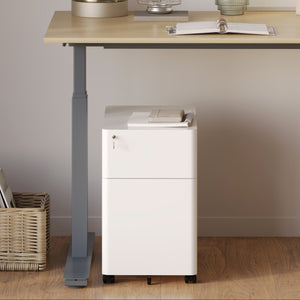






















Filing Cabinet Choices for Cleaner Workstation Planning
Cleaner workstation planning starts with filing storage that matches the desk, document volume, security needs, and daily workflow. Explore how cab...
Learn more
Visit quiz page to see how we makes it easy to create an inspiring workplace


Monitor height looks like a small detail until it starts affecting the way a full workday feels. A screen that sits too low can pull the head forward, round the upper back, and make the neck work harder than it should. A screen that sits too high can push the chin upward and create tension behind the eyes and across the shoulders. For everyday office work, the right monitor stand height is the height that lets the eyes look naturally toward the upper portion of the screen while the neck stays relaxed, the shoulders stay down, and the arms can work without strain.
That usually means the top edge of the visible screen lands at or slightly below eye level for most people doing standard computer tasks. It does not mean every workstation should look identical. Screen size, desk depth, chair fit, eyewear, and whether someone works mostly with spreadsheets, email, design files, or long documents all influence the final position. The safest approach is to treat monitor height as part of a whole workstation system rather than an isolated measurement.
For most office workers, the most reliable starting point is simple: when sitting or standing in a neutral posture, the eyes should meet the upper area of the display, not the middle and not the bottom. This encourages a slight downward gaze, which is generally more comfortable for prolonged viewing than looking straight ahead or upward.
That small downward viewing angle matters because office work rarely involves only brief glances. People read lines of text, compare windows, scan rows of numbers, and shift attention across tabs for hours at a time. When the screen begins too low, the head often follows the eyes downward. When it begins too high, the head tends to lift. Neither pattern is ideal if repeated all day.
A monitor should support the body’s natural alignment, not force it into a pose that looks ergonomic from a distance but feels unnatural after lunch. Neutral posture means the ears sit roughly over the shoulders, the shoulders remain relaxed, and the head does not lean forward to meet the screen. If reaching visual comfort requires jutting the chin, shrugging the shoulders, or perching on the edge of the chair, the monitor height is not truly correct.
A helpful way to think about it is this: the screen should come to the user, not the user to the screen. That is why flexible support can be valuable in changing work routines. An adjustable monitor arm is built for customizable support around monitor placement, which makes it easier to fine-tune height and position as tasks and postures shift.
The larger the display, the more important the top edge becomes. On a small monitor, the difference between the center and upper third may feel minor. On a larger screen, centering the entire display at eye level can place too much content above the natural line of sight. That can lead to a subtle but persistent upward gaze.
With larger monitors, it is often better to anchor the setup around the top line of text or the browser toolbar rather than the exact center of the panel. That keeps the most frequently viewed content in a comfortable zone.
A monitor that sits at a good height can still feel wrong if it is too close or too far away. When the display is too close, users often raise the chin or lean back to take in the whole screen. When it is too far, they tend to lean forward and crane the neck. A practical everyday range is generally about an arm’s length, adjusted slightly based on screen size and visual comfort.
Desk depth plays a major role here. Deeper surfaces give the screen room to sit farther back, which can reduce visual crowding. Shallower desks may require more careful height adjustment because the viewing angle becomes steeper when the monitor is close.
Tilt is often overlooked, but even a small angle can change how the head behaves. A slight upward tilt can help when the monitor is positioned lower. A neutral or only lightly tilted screen often works better when the monitor is already near the correct height. Extreme tilting tends to create compensation elsewhere, especially in the chin and shoulders.
Some monitor problems are actually readability problems. If text is too small, users may lean toward the display and assume the monitor needs to be raised. If text is too large, they may sit farther back and feel disconnected from the work surface. Before making major hardware changes, it helps to check zoom level, system scaling, and default document size. Comfort is not just about where the monitor sits. It is also about whether the content can be read without chasing it.
Monitor placement does not begin with the monitor. It begins lower, at the relationship between the body, the chair, and the desk. If the desk is too high, people often raise the shoulders to type and then blame the screen for upper-back discomfort. If the desk is too low, they may collapse through the torso and again assume the monitor is the main problem.
The best sequence is to set chair height first, then confirm that the feet are well supported, then evaluate keyboard and mouse position, and only then adjust monitor height. Once the arms can rest comfortably with elbows near a natural angle, the screen becomes much easier to place correctly.
A stable chair does more than provide a place to sit. It influences pelvic position, spinal support, shoulder tension, and how far the head drifts forward during focused work. That is why monitor advice often fails in poorly supported seating. The chair may be setting the body up to compensate before the work even begins.
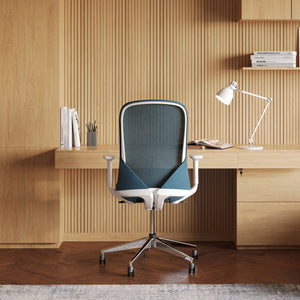
Collections built around ergonomic office chairs emphasize support for everyday work rather than one fixed sitting posture, which aligns with the practical reality that monitor comfort depends on how the whole body is held throughout the day.
Desks also shape monitor comfort more than many people expect. Height, leg clearance, depth, and usable surface area all affect where a screen can sit without crowding the keyboard, lamp, notebook, or docking setup. A workstation that allows better control over typing position and screen distance makes it easier to maintain a reliable monitor height across different tasks.
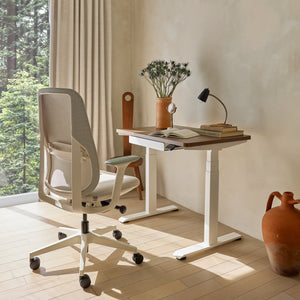
That is one reason many workspaces rely on adjustable office desks, especially when users alternate between seated and standing work or when a setup must serve more than one person. The desk collection is presented specifically around ergonomic office use and adaptable work surfaces.
The most common error in office settings is a screen that sits below the natural viewing line. This often happens with laptops, monitors placed directly on deep desks, or setups where the user has adjusted the chair downward to match the desk. At first, the position may feel acceptable. A few hours later, the upper back rounds, the chin drifts forward, and the back of the neck starts carrying the load.
A high monitor can feel productive because it appears upright and alert. In reality, it often encourages the opposite of relaxed posture. Users lift the chin, create compression at the back of the neck, and increase eye fatigue because the gaze angle is no longer natural. This mistake is common when people stack books under a monitor without checking where the top edge ends up.
A perfectly sized monitor can still cause discomfort if it is not centered with the user’s main task. If the keyboard is centered but the monitor is shifted to one side, the torso may rotate slightly for hours. That repeated asymmetry can create shoulder and upper-back tension even when the height is technically correct.
For one primary monitor and one secondary reference screen, the main display should stay centered. For two equally used screens, the split between them should align with the body’s midline. Otherwise, the neck keeps returning to one side, and the benefit of extra screen space is reduced by a poor viewing pattern.
Many people adjust monitor height when the real problem is light. Reflections from windows, overhead fixtures, or glossy surfaces can make a comfortable monitor feel unusable. The body responds by dipping the head, tilting it sideways, or shifting the screen to an awkward angle.
The best desk lighting improves visibility around the monitor without shining directly into the eyes or onto the screen. Soft, well-placed lighting helps reduce squinting and unnecessary head movement, especially during document review or late-day detail work.
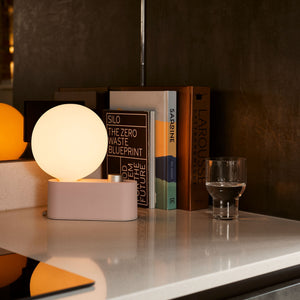
A multi-use LED table and wall light can be relevant in this context because it is presented as a flexible lighting piece rather than a screen-side gimmick, making it useful for shaping light around the workstation instead of forcing the monitor to compensate for poor brightness conditions.
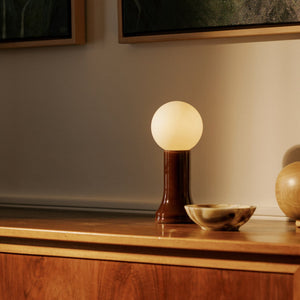
Smaller workstations often combine monitor, keyboard, paperwork, and lighting in a limited footprint. In those environments, a harsh or oversized lamp can create as many problems as it solves. A recycled glass table lamp can fit better when the goal is softer peripheral light that supports the workspace without dominating it. The page describes the Shore lamp specifically as a recycled glass table lamp within Urbanica’s lighting assortment.
Not every setup needs a complex adjustment system. A fixed riser may be enough when one person uses one monitor at one desk every day. A monitor arm becomes more valuable when the screen must move forward, back, up, or sideways to match changing tasks, desk depths, or shared users. Accessories are most effective when they remove a real ergonomic obstacle instead of adding visual clutter.
Useful workstation accessories support the space around the monitor. They create cleaner cable paths, preserve writing space, and reduce the tendency to place objects between the user and the screen. Collections organized as office workspace accessories are most helpful when they support a cleaner, more functional viewing setup rather than distracting from it. Urbanica’s accessories collection is positioned around modern office solutions, including monitor, laptop, power, and lighting support items.
Use this sequence before adding or changing anything:
1. Set chair height so the body feels supported and the shoulders can relax.
2. Check keyboard and mouse position before adjusting the screen.
3. Place the monitor so the top area sits at or slightly below eye level.
4. Confirm viewing distance and readability with a real work task.
5. Add a riser, arm, or lighting change only if a specific problem remains.
| Workstation type | Best monitor-height priority | Common mistake | Better adjustment |
|---|---|---|---|
| Single monitor, seated desk | Top of screen at or just below eye level | Screen placed too low on desk | Raise display and verify viewing distance |
| Laptop plus external keyboard | Elevate laptop screen or use separate monitor | Looking down all day | Lift screen first, then align input devices |
| Dual monitors with one primary screen | Center primary screen to body | Both screens angled awkwardly | Keep main monitor central, angle secondary inward |
| Sit-stand setup | Preserve same eye-line relationship in both modes | Only desk height changes, screen stays static | Recheck screen height after each posture shift |
| Compact home office | Balance monitor height with lamp and storage placement | Crowded surface reduces monitor distance | Clear the sightline and simplify accessory layout |
When several people use the same station, a fixed monitor height rarely works for everyone. Different heights, eyewear needs, and task patterns mean adjustability becomes a practical requirement, not a luxury. The same principle applies in larger workplace planning. Page-level content around ergonomic office setup solutions emphasizes modern ergonomic office furniture and workspace planning rather than one-size-fits-all positioning, which supports the broader idea that healthy monitor placement depends on the full environment around it.
A monitor setup should not be judged by how it looks in the first five minutes. It should be judged by whether the neck stays easy, the eyes stay calm, and the shoulders stay unforced after repeated rounds of email, documents, meetings, spreadsheets, and browser work. For everyday office use, that nearly always means keeping the top of the monitor at or slightly below eye level, pairing it with a sensible viewing distance, and making sure the chair and desk are helping rather than fighting the posture.
The most durable setups are rarely the most complicated. They are the ones that respect how people actually work. Screens are read from top to bottom. Bodies shift throughout the day. Lighting changes. Tasks change. A good monitor height leaves room for those realities. It supports neutral posture without asking the user to hold a rigid pose. It makes the workstation feel calm, readable, and sustainable. That is the standard worth aiming for in any office where comfort and daily function matter.


You have unlocked free shipping!
You're saving $29 and unlocked free shipping!
Leave a comment