



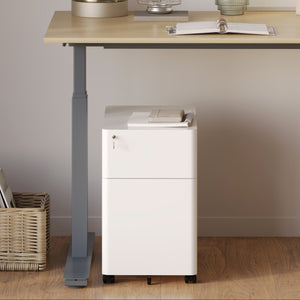






















Filing Cabinet Choices for Cleaner Workstation Planning
Cleaner workstation planning starts with filing storage that matches the desk, document volume, security needs, and daily workflow. Explore how cab...
Learn more
Visit quiz page to see how we makes it easy to create an inspiring workplace


A clean desk rarely comes from buying fewer things. It usually comes from giving every tool a defined “home” and protecting the space your hands use most. In our experience at Urbanica, the monitor is the biggest space thief on a typical workstation because the base squats in the prime reach zone and forces everything else to pile up around it.
A monitor mount can change that footprint in minutes, but only if the desk can support it, the arm matches your screen, and the setup stays tidy once the novelty wears off. The steps below focus on practical ergonomics and honest clutter reduction. No gimmicks, no unrealistic claims, and no overpromising.
A desk feels cluttered when your surface map stops making sense. The keyboard has no room, the mouse drifts into the edge, notebooks stack under cables, and chargers migrate onto the desktop because there is nowhere else to put them.
Most monitor stands take up a wide, shallow area that overlaps with the same space your forearms want for typing and mousing. When that zone is blocked, people start shifting items sideways, then stacking them, then living with friction all day.
When the desk surface is cramped, papers and accessories become vertical piles. Even if the total number of items is small, stacks make the desk feel chaotic because they hide what is underneath.
Loose cables are rarely a cable problem. They are a routing problem. If there is no defined path, cords naturally spill into your typing zone.
Think of a typing lane as the rectangle in front of your body where your hands work most of the day. Keep that lane reserved for the keyboard, mouse, and one intentional writing space. Everything else needs a different home.
A stable mount starts with a stable desk. If the desk flexes, the monitor will move. If the underside is obstructed, the clamp will never seat correctly. A two-minute check prevents most frustrations.
A clamp needs a solid, flat bite. Very rounded edges or decorative beveled edges can reduce grip. If your desk has a delicate finish, protect it with a thin pad between the clamp and the desk.
Look under the desktop for rails, drawers, cable trays, and crossbars. These can block the clamp plate or force the clamp into an unstable position. If the obstruction is close to the back edge, you may need to mount slightly off-center.
Place both hands near the back edge and gently apply pressure forward and back. If you feel the top flex or the legs sway, consider moving the clamp closer to a structural support point rather than the center of a wide span.
A mount makes it easier to place the screen at a comfortable viewing distance, but it cannot magically create depth. If your desk is shallow, prioritize vertical clearance and a mount with controlled reach so the screen can sit back without pushing your keyboard forward.
Clamp mounting is ideal when you want to reposition the monitor and you prefer the simplest installation. Grommet mounting is usually cleaner for a permanent layout when the desk has a dedicated cable hole that can be used safely.
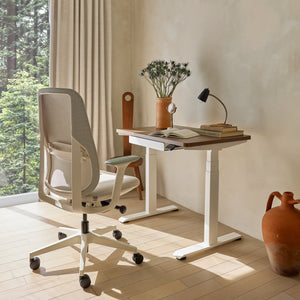
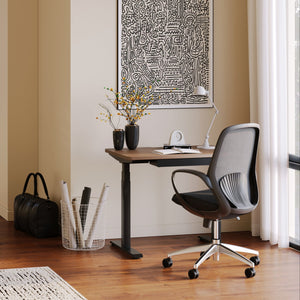
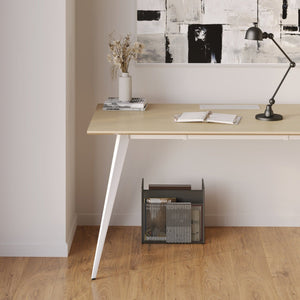
If your current surface is due for an upgrade, choose a desk that offers clean rear-edge mounting space and predictable stability, such as the Office Desk with flared legs. The goal is not a “bigger desk,” it is a desk that supports a clear layout and consistent mounting.
A monitor mount is not one-size-fits-all. The best setup depends on how you use the screen, whether you share the workspace, and how often you change positions.
If one monitor does most of the work, your mount priorities are straightforward: stable height adjustment, an easy tilt range, and a screen position that centers to your body. The benefit here is simplicity. A single-screen mount can free a surprising amount of desk space because you can reclaim the area where the base used to sit.
Ultrawide screens can be excellent for wide documents and multi-window workflows, but they can also encourage constant head turning if the screen sits too close. With an ultrawide, a mount should allow you to set the screen back and keep it centered. The right position reduces the urge to rotate your neck to “chase” information across the panel.
If both screens are equally important, side-by-side often makes sense. If one screen is reference-only, stacked layouts can reduce side-to-side neck rotation and preserve more desk width.
Aim for symmetrical height and a gentle inward angle so the screens feel like a single, curved plane. Center your primary work area and keep the second screen within an easy glance.
Place the primary monitor on the bottom, and use the top as a reference display. This can work well for documentation, calendars, and messaging, as long as the top screen is not so high that it forces neck extension.
Many desks feel messy because the laptop becomes a permanent second workstation. Decide whether the laptop is a true second screen or simply a computer that could be closed and docked. That choice determines whether you need a laptop stand, a second mount, or a cleaner dock-based layout.
Clutter reduction is only helpful if the setup is stable, predictable, and easy to live with. Compatibility checks keep the monitor from sagging, bouncing, or forcing awkward positions.
Most monitors use a VESA mounting pattern, which is the standardized hole spacing on the back of the display. Confirm that your monitor supports VESA mounting and identify the correct pattern before you install anything. If your monitor does not support VESA directly, it may require an adapter.
Monitor arm ratings are built around weight, but real-world load can change with accessories such as light bars, webcams, and mounting adapters. Staying comfortably within the rated range helps keep adjustments smooth and reduces the chance of gradual droop.
A mount needs enough vertical adjustment to place the screen at a comfortable height when you sit naturally. It also needs enough reach to position the screen at an ergonomic distance without forcing your keyboard toward the edge.
Portrait orientation can be great for reading long documents or coding, but it can also become annoying if you rotate constantly. If you need portrait often, confirm the arm supports easy rotation and that cables can follow the movement without binding.
If you are choosing an arm designed specifically for workstation flexibility, the Ergonomic Arm accessory is built for monitor positioning that adapts to real desk use. The most practical goal is smooth, repeatable adjustment, not constant tinkering.
A mount can either simplify your desk or add new visual noise. A clean install comes from staging the process and choosing the clamp position intentionally.
Move small items into a tray or box temporarily. Keep tools nearby so you are not hunting for a screwdriver while holding a monitor.
Use a thin pad where the clamp meets the desktop and underside. It helps prevent cosmetic marks and improves grip on some finishes.
Before mounting, decide where cables will drop toward power. If you skip this, cables often end up draped across the surface.
Mounting directly behind the monitor’s final position usually works best. Corner mounting can be excellent for small desks, but make sure the arm can still center the screen to your body.
A post that is slightly rotated can cause the monitor to drift. Take an extra moment to align the base so the arm’s movement feels natural.
Set the monitor face-down on a soft surface and attach the plate securely. Avoid overtightening screws beyond snug.
If the arm uses a hook-style plate, ensure it is fully seated and locked if a lock is included. Safety comes first.
Tension should be strong enough to hold position, but not so tight that the monitor springs upward when you release it. A good setup is one you can adjust gently with one hand.
Ergonomics does not have to be complicated. The best adjustments are the ones you can repeat, especially if you share the desk or move between sitting and standing.
A practical target is placing the top of the visible screen at or slightly below eye level when you sit upright. If the screen is too low, your neck bends forward. If it is too high, you may tilt your chin up and fatigue the neck.
Raising the monitor while keeping the keyboard too high can lift the shoulders and create tension. If your shoulders creep upward while typing, check chair height, desk height, and armrest height before blaming the monitor.
A comfortable distance is one where you can read without squinting and without leaning forward. If you lean in, the screen is probably too far, too low, or both. If you constantly lean back, the screen may be too close.
Tilt the monitor to reduce overhead reflections while keeping your head neutral. If glare is constant, consider adjusting light placement rather than forcing the monitor into an extreme angle.
Center the monitor to your body, not to the desk. If you type facing slightly left, your neck will compensate all day. For dual monitors, center the primary one and keep the secondary close enough for easy glances.
Cable management is where most clutter returns. The mount is only half the solution. The other half is a cable path that looks intentional and stays out of the typing lane.
Route cables from the monitor to the arm, then down a single drop toward your power zone. When every cable follows the same direction, the desk looks cleaner and feels easier to maintain.
Give the cables a small service loop near the monitor connection point. This loop provides movement room during tilt and swivel. Avoid tight ties that lock the arm’s motion, and avoid excessive slack that hangs into the workspace.
If chargers sit on the desktop, they tend to stay there. Instead, place power and charging below the desk or along the rear edge where cords can drop cleanly.
If your workstation moves up and down, cables need enough slack to accommodate standing height without tugging. At Urbanica, we recommend thinking of the cable path as a moving system, not a fixed one. A Standing Desk sit-to-stand desk can make movement feel natural, as long as the cable drop is designed for both positions.
Once the monitor base is gone, the temptation is to fill the new space. The cleanest desks keep the typing lane open and place support gear in predictable zones.
Keep only what you touch constantly. A keyboard and mouse deserve prime space. Everything else should live either to the side, on a vertical stand, or in a container that does not spread.
Keyboard, mouse, one notebook or pad, and one intentional drink.
Loose cables, spare adapters, external drives, and anything that “temporarily” sits in the middle.
If the laptop is mostly a computer, consider closing it and using the external monitor as the primary display. If you truly need the second screen, elevate the laptop so the laptop keyboard is not competing for space.
Stands can be perfect for flexible or shared environments. Mounts tend to win when you want precise screen positioning and a permanently open typing lane.
If you want elevation options beyond arms, our monitor and laptop stand collection supports cleaner vertical zoning, especially for hybrid laptop setups.
| Setup approach | Best fit for desk clutter reduction | Ergonomic flexibility | Typical trade-off to plan for |
|---|---|---|---|
| Monitor mount only | Clears the largest footprint fast | High, especially for height and distance | Requires compatible desk edge and careful cable routing |
| Stand only | Great for temporary setups and shared desks | Moderate, depends on stand height | Often preserves some footprint on the surface |
| Hybrid (mount plus laptop stand) | Strong for laptop users who need two screens | High when both screens align | Requires disciplined cable path to avoid double clutter |
A mount can put the screen in the right place, but a chair determines where your eyes and shoulders land. If seating is off, you will keep adjusting the monitor and still feel uncomfortable.
Start by adjusting seat height so your feet feel supported and your thighs are comfortable. Then set armrests so your shoulders can relax while your forearms stay level.
If you find yourself reaching up to type, the desk height and chair height combination may be forcing shoulder elevation. Small changes here often reduce tension more than any monitor adjustment.
At Urbanica, we see two common needs. Some people want a highly adjustable chair for long sessions and task switching. Others want streamlined ergonomic support that still keeps posture stable.
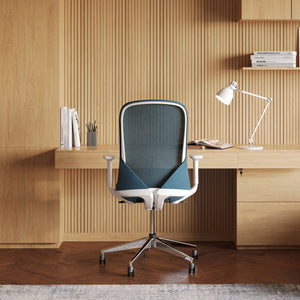
If you want a chair built around adjustability for daily work, the Novo Chair ergonomic office chair is designed for adaptable support. If you prefer a simpler approach that still prioritizes ergonomic structure, the Onyx Chair ergonomic chair can anchor the setup without overcomplicating adjustments.
A desk can look perfect on day one and drift back into clutter a week later. The solution is a tiny routine that restores the surface map quickly.
1. Re-center the monitor to your natural seated position.
2. Pull the keyboard and mouse into the typing lane, leaving space for your forearms.
3. Move any loose cables back into the arm path and single drop zone.
4. Remove paper stacks from the center and place them in one side zone or container.
5. Return chargers to the power zone instead of letting them sit on the surface.
6. Clear one “miscellaneous” item that does not belong on the desktop.
7. Do a quick glance for visual noise, then remove the one item that bothers you most.
Check clamp tightness, verify the arm tension still holds position, and confirm cables do not snag during swivel. These small checks keep the mount functional and help the desk stay clean without constant effort.
Even a good setup can hit friction points. Solving them quickly prevents the return of workarounds, and workarounds are where clutter starts.
If the monitor gradually settles, the arm likely needs tension adjustment, or the load is near the upper limit. Remove unnecessary add-ons temporarily, retune tension, then reintroduce accessories only if the arm remains stable.
Some movement is about desk stability rather than the mount. Try repositioning the clamp closer to a leg or structural support point, then confirm the desk itself is not flexing.
Binding usually means the service loop is too tight or placed too far down the arm. Move the loop closer to the monitor connections and simplify the route so cables do not cross each other.
A mount creates space, but space invites new items. Use a simple rule: one container beats three piles. If something does not have a home, the desktop becomes the home.
Not every workspace has a wide desk, a dedicated office, or a permanent layout. A mount can still reduce clutter, but the strategy shifts toward vertical layering and quick resets.
Move the screen up and back, keep tools low, and limit surface items to what you touch constantly. For small desks, the best clutter reduction comes from refusing to let the typing lane become storage.
If more than one person uses the desk, aim for repeatable alignment rather than “perfect” alignment. A consistent monitor position, a consistent cable path, and a consistent container location prevent the desk from becoming a negotiation every day.
Video calls tempt people to stack books under laptops or add extra lights that scatter cables. A stable monitor height, a clean cable path, and one intentional accessory zone keeps the desk looking calm on camera and feeling functional off camera.
A monitor mount works best as part of a coherent workstation. That coherence comes from matching desk space, seating adjustability, and accessory routing so the setup feels natural.
If you move between tasks often, prioritize adjustability in the chair and mount, and keep the desk surface minimal. If you do deep focus work, prioritize stable, centered screen positioning and reduce side zones so distractions do not spread.
Assembly needs, dimensions, and shipping policies affect how smoothly a workspace upgrade goes. For guidance and ordering information, including shipping terms and support resources, refer to our fast, free shipping details. A realistic setup plan reduces surprises and keeps the focus on building a desk that stays uncluttered.
A well-mounted monitor is a foundation. The next step is making sure growth does not bring clutter back.
When adding a second monitor, keep the one-path cable philosophy. Route both monitors into the arm paths, then merge into a single drop zone. Multiple drops create multiple places for clutter to return.
Add one item at a time and decide where it lives before it touches the surface. If a new tool does not have a home, it will become clutter.
Put hubs and docks where cables can drop cleanly, not where they create a new pile. Choose cable lengths that support your chosen route so replacements do not create loops and tangles. A mount gives you the freedom to position the screen well, but the real long-term win comes from keeping the desk’s surface map stable and intentional.


You have unlocked free shipping!
You're saving $29 and unlocked free shipping!
Leave a comment