



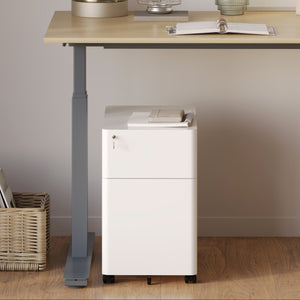






















Filing Cabinet Choices for Cleaner Workstation Planning
Cleaner workstation planning starts with filing storage that matches the desk, document volume, security needs, and daily workflow. Explore how cab...
Learn more
Visit quiz page to see how we makes it easy to create an inspiring workplace


A desk for 2 monitors and a laptop needs to do more than hold equipment. It has to support a layout that feels balanced, usable, and comfortable for long stretches of focused work. When the desk is too shallow, screens sit too close. When the surface is too narrow, the laptop ends up wedged into a corner or pushed into the keyboard zone. When power access is treated as an afterthought, cables start dictating the layout instead of the other way around.
The best buying decisions begin with the full setup in mind. That means looking at monitor placement, laptop use, keyboard clearance, cable routing, posture, and room fit as one connected system. A desk that looks generous in a product photo can still feel cramped once two displays, a laptop stand, speakers, chargers, and daily work tools are in place. A desk that fits the workflow well usually feels quieter, cleaner, and easier to use from the first day.
Two monitors and a laptop can create very different layouts depending on how the laptop is used. Some people keep the laptop closed and docked, using the two monitors as the entire working view. Others keep the laptop open as a third active screen for chat, email, or reference material. Some prefer the laptop off to one side, while others elevate it so its top line sits closer to the monitors.
Those differences matter because they change the true space requirement. The desk has to support not just the width of the screens, but the spacing between them, the reach to the keyboard and mouse, and the room needed for natural movement. A setup can technically fit on a surface and still feel wrong every day.
A large desktop is helpful, but raw dimensions alone do not guarantee a better setup. What matters more is active workspace, which is the part of the desk that remains useful after the equipment is placed. Monitor bases, laptop stands, docks, speakers, and power accessories reduce the surface that is left for actual work.
That is why browsing a broader range of adjustable ergonomic office desks can be useful early in the decision process. Looking at different formats helps clarify whether the goal is simply more width, more depth, cleaner cable access, or a layout that adapts better to the way the setup is used.
Two monitors placed side by side can quickly consume most of a desk if the width is planned too tightly. Even when the panels fit, the setup may still feel crowded if the screen edges sit too close to the desk ends or force the laptop into an awkward position. A better standard is not whether the setup fits, but whether it still leaves enough room for symmetry, repositioning, and small daily items.
A narrow margin often becomes a long-term frustration. The screens cannot be adjusted easily, accessories have no natural home, and the workstation starts to feel visually compressed.
A laptop can either save space or create pressure on the layout. In a closed docking setup, it takes up very little active room. In an open configuration, it becomes another display that must sit at a readable angle without crowding the two monitors. If it sits beside them, the entire desk often needs more lateral flexibility. If it sits below or above the monitors, the desk still needs enough room for a stable stand and a comfortable keyboard zone.
Many workstations expand gradually. A webcam, task light, notebook tray, charging stand, external drive, or speaker pair can turn a once-clean setup into a crowded one. Buying a desk with no expansion room often leads to a second round of compromises. A better approach is to treat future accessories as part of the original plan.
Depth is one of the most overlooked measurements in desk buying, yet it has a major impact on comfort. A shallow desk forces monitors closer to the face, especially when using their original stands. Even a setup with enough width can feel fatiguing if the screens sit too near the front edge.
This becomes even more important with two monitors and a laptop because the eye is shifting between multiple surfaces. A bit more distance can make the entire arrangement feel more relaxed and easier to work with over a full day.
The front portion of the desk should not become a leftover strip after the screens are placed. It needs to support natural typing posture, mouse movement, and often a notebook or wrist support. When that area shrinks too much, the user ends up perched at the front edge with little room to move.
A good setup keeps the input zone distinct from the screen zone. That separation is one of the clearest signs that the desk truly fits the workflow.
A deeper surface can help the desk look cleaner because it gives each layer of the workstation a clear role. Screens sit back where they belong. The keyboard and mouse remain centered and comfortable. Accessories have space without spilling into the main working area. That visual order matters more in a three-screen environment, where clutter can build quickly.
Many people measure only the screen width and forget the footprint of the stand. Monitor bases often consume valuable depth and create awkward dead space around them. In a dual-monitor setup, that effect doubles. The result can be a desk that looks wide enough on paper but feels unexpectedly shallow in practice.
Monitor arms can free up surface area and improve screen positioning, but they introduce their own checklist. The rear edge of the desk must allow for secure mounting. There must be enough clearance behind the desk for movement and cable drop. The desktop should also feel stable when the screens are adjusted.
An open laptop used as a third screen can either support the flow of work or interrupt it. A flat laptop often sits too low for constant viewing. A raised laptop creates a more cohesive visual field, but also adds another object that changes the vertical and horizontal balance of the setup. Choosing the desk first without considering that viewing pattern often leads to a less natural arrangement later.
Two monitors and a laptop can create a surprisingly demanding power setup. Add a dock, task light, phone charger, speakers, or an external accessory, and the desk starts relying heavily on where power is available and how cords travel. This is why cable strategy should begin before the desk is purchased, not after it is assembled.
When power access is integrated into the work surface, the setup often feels more intentional. Devices can connect where they are actually used, rather than stretching toward a wall or a floor strip. A built-in desk power module makes sense when the goal is to reduce visible cable clutter and support a cleaner daily routine without turning the back edge of the desk into a tangle of adapters.
Some setups need more flexibility than a fixed power location provides. A desk-mounted power outlet can be useful when the workstation is likely to evolve, when accessories move often, or when charging access is better placed closer to one side of the desktop. The benefit is not novelty. It is practical access where it is actually needed.
A dual-monitor laptop desk should guide cables naturally. That means keeping charging paths short, reducing hanging loops, and avoiding tension points where cords rub against edges or interfere with movement. When power is planned well, the desk feels more usable because less of the surface is being negotiated around cables.
A larger workstation can lead to longer stretches of uninterrupted sitting. With multiple screens open, it is easy to stay locked into the same posture for extended periods. That does not mean every setup needs height adjustment, but it does mean posture flexibility becomes more valuable once the desk is supporting a more immersive digital environment.
A height-adjustable standing desk suits workstations that are used heavily throughout the day, especially when the same desk supports different types of tasks. Writing, reviewing documents, attending meetings, and focused screen work do not always feel best in the same position. The ability to change posture can help the workstation remain useful across those shifts without redesigning the setup.
Some users have a highly consistent routine, a well-matched chair, and a layout that rarely changes. In those cases, a fixed desk can still perform very well if the size, clearance, and power planning are handled carefully from the start. The key is not whether the desk moves, but whether the overall setup supports sustained comfort and control.
A desk can have an excellent top surface and still feel frustrating if the space underneath is restricted. Crossbars, storage pieces, hanging accessories, and cable bundles can all interfere with leg movement. In long work sessions, that under-desk freedom becomes part of the overall ergonomic experience.
Two monitors and a laptop create a workstation with multiple concentrated load points. The surface should feel dependable during typing, screen adjustment, and normal movement around the desk. This is especially important when the laptop is elevated or the monitors are mounted on arms, since those setups magnify the effect of even small vibrations.
A desk used for multiple screens benefits from visual restraint. A simpler silhouette often makes it easier to organize the equipment and maintain a sense of order. A modern workspace desk can support that balance well when the goal is to create a setup that looks composed without sacrificing everyday function.
The workstation does not exist in isolation. Wall placement, window light, outlet location, shelving, and chair travel all influence how the desk will actually perform. A desk that fits dimensionally may still create awkward circulation if it blocks movement or forces the monitors into glare.
Seeing a desk in context often reveals scale issues that measurements alone do not. This can be especially helpful when choosing for a more complete office environment rather than a single isolated purchase. For buyers evaluating the setup more holistically, ergonomic workspace planning services can help connect furniture choice with room use, workstation flow, and practical layout decisions.
A desk for 2 monitors and a laptop is usually a personal productivity setup. Still, in some homes and offices, that decision overlaps with a larger planning question. When multiple people share the same room or work side by side, the conversation starts to shift from one workstation to the structure of the wider environment.
When the goal moves beyond one user, a shared height-adjustable workstation may be more appropriate than trying to stretch a single personal desk beyond its intended role. That kind of solution is relevant when paired work, adjacent setups, or a coordinated office plan becomes the real requirement.
A better desk decision usually comes from a structured review rather than one appealing product image. The checklist below helps bring the full setup into focus before anything is ordered.
1. Measure both monitors, including their stands or arm requirements.
2. Decide whether the laptop will stay open, be raised, or remain closed in a dock.
3. Protect enough front-edge space for keyboard and mouse comfort.
4. Check whether the desk depth supports a comfortable screen distance.
5. Count all devices that will need power on or near the desk.
6. Plan where cables will drop and where chargers will sit.
7. Review legroom and under-desk clearance, not just desktop size.
8. Leave room for accessories that may be added later.
| Setup factor | What to check before buying | Why it matters |
|---|---|---|
| Width | Monitor spacing, laptop position, side accessories | Prevents crowding and edge compression |
| Depth | Screen distance, keyboard clearance, writing space | Supports comfort and cleaner layout |
| Power access | Charging points, outlet reach, cable direction | Reduces clutter and layout limitations |
| Desk structure | Stability, edge compatibility, legroom | Improves usability with heavier equipment |
| Flexibility | Fixed or adjustable height, future accessory room | Helps the desk stay useful as needs change |
The strongest desk choice is the one that supports the entire working pattern. Two monitors and a laptop create a setup that asks for balance between space, posture, power access, and visual control. When those pieces are planned together, the desk stops feeling like a surface that is merely full enough and starts functioning like a workstation that is genuinely ready for daily use.


You have unlocked free shipping!
You're saving $29 and unlocked free shipping!
Leave a comment