



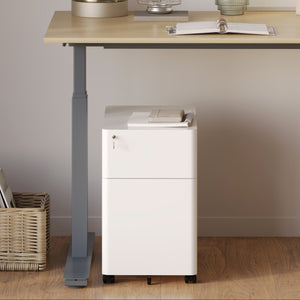






















Filing Cabinet Choices for Cleaner Workstation Planning
Cleaner workstation planning starts with filing storage that matches the desk, document volume, security needs, and daily workflow. Explore how cab...
Learn more
Visit quiz page to see how we makes it easy to create an inspiring workplace


Choosing between a corner desk and a straight desk for dual monitors looks simple until the setup is actually in the room. Two screens change the space equation fast. What feels generous for a laptop can become cramped once monitor stands, keyboard placement, charging accessories, and everyday work tools start competing for the same surface. The better layout is rarely the one with the biggest desktop on paper. It is the one that turns the available room into comfortable viewing distance, usable work surface, and clear movement around the chair.
That is why the real comparison is not corner desk versus straight desk in isolation. It is corner geometry versus wall efficiency. It is wraparound reach versus linear simplicity. It is also about how dual monitors behave in real use. A workstation that handles two screens well needs enough width for side-by-side placement, enough depth to avoid a cramped viewing angle, and enough organization to keep the desk from feeling crowded.
For many shoppers, the best starting point is comparing a broader range of adjustable ergonomic office desks to understand how shape, depth, and work style interact before narrowing the choice. A dual-monitor workspace should support the way the room functions every day, not just the way the desk looks when empty.
Space saving sounds like a simple measurement problem, but a productive workstation uses space in several ways at once. The first is footprint, or how much room the desk takes up on the floor. The second is functional surface, or how much of the top remains usable after the monitors are in place. The third is visual clarity, which often determines whether the room feels open or crowded.
Two desks with similar dimensions can perform very differently once dual monitors are installed. A desk may technically fit the room while still pushing the screens too close to the user. Another may seem larger, yet create a calmer workflow because it separates the screens, writing area, and charging points more effectively. That is why the question is not only which desk is smaller. The stronger question is which layout wastes less usable space once the full setup is in place.
This matters even more in home offices, spare bedrooms, apartments, and shared rooms where the desk is not the only thing competing for space. A workstation has to coexist with movement paths, storage, and sometimes non-work furniture. The desk that saves the most space is the one that allows the room to keep working as a room.
A corner desk often saves space by using an area many rooms leave underused. Instead of extending across a full wall, it turns the corner itself into an active workstation. That can be especially effective for dual monitors because the user sits into the angle rather than only in front of a flat edge.
One of the biggest strengths of a corner desk is zoning. Two monitors can occupy the main working position while the return section handles everything else, such as a laptop, notebook, headphones, docking accessories, or paperwork. That separation matters because it protects the keyboard and mouse area from becoming crowded.
For dual monitors, this layout often creates a natural viewing arrangement. One screen can remain centered for the primary task, while the second sits at a slight angle on the adjacent surface. That reduces the feeling that both monitors are fighting for one narrow strip of desk space. Instead of forcing everything into a straight line, the desk spreads activity across connected surfaces.
Corner desks tend to work especially well in square rooms, spare bedrooms with an open corner, and office nooks that would otherwise go unused. In those situations, the corner placement can preserve open floor area in the center of the room while still delivering substantial working surface.
They are also helpful for users who do more than stare at two screens all day. If the setup includes frequent note-taking, reference documents, a laptop dock, or small desk accessories, the wraparound layout can keep those items close without forcing them into the same zone as the keyboard and mouse.
A corner desk is not automatically the better space saver. It can lose efficiency in narrow rooms, in layouts where closet doors or windows interrupt one side, or in spaces where the chair backs into the main traffic path. Some corner desks also create more surface than the user truly needs, which can invite clutter rather than solve it.
That is why the corner option works best when the room actually offers a useful corner to claim. If the desk is being forced into a space that naturally wants a straight wall layout, the added geometry can become an obstacle rather than an advantage.
A straight desk takes a different approach to space saving. Instead of converting a corner into working area, it simplifies the room by aligning the workstation along a single wall. That cleaner footprint is often what makes it the better choice for narrow rooms, mixed-use rooms, and setups where flexibility matters.
A straight desk is easier to place, easier to move, and easier to plan around. When dual monitors are positioned side by side on one continuous surface, the result can feel visually calmer than a wraparound setup. In rooms where every inch of circulation matters, that clean wall line can make the whole space feel more open.
This can be especially useful in bedrooms, apartments, and guest rooms where the desk shares space with a bed, shelving, or lounge furniture. A corner desk may add more total surface, but a straight desk can preserve a more comfortable path through the room.
For users who want a clean wall-based setup that also supports movement during long screen sessions, a standing office desk fits naturally into the straight-desk format. The shape stays simple, and the workstation can still support posture changes throughout the day without adding another layer of complexity to the room layout.
The main limitation of a straight desk is that dual monitors consume a large share of the primary working strip. If the desk is too shallow, monitor stands can push the screens closer than ideal. If it is too narrow, there may be little room left for writing, charging devices, or anything beyond the screens and input devices.
That does not mean straight desks are poor for dual monitors. It means they benefit more from careful depth planning, better accessory choices, and a disciplined approach to keeping the top surface clear.
Desk shape starts the conversation, but monitor size often decides it. Two smaller displays can sit comfortably on many desks that would feel strained under larger screens. Likewise, the presence of bulky monitor stands can change an otherwise workable layout into a cramped one.
When people picture dual monitors, they tend to focus on width first. That makes sense because two screens side by side can quickly consume horizontal space. Yet depth is often the more important measurement for comfort. If the screens sit too close to the front edge, the keyboard gets pushed inward or the user ends up sitting too close to the displays.
A corner desk often feels more forgiving because the user occupies the inside angle, which can create a stronger sense of depth even when the measurements are not dramatically larger. A straight desk can perform just as well, but it needs enough front-to-back planning to keep the monitors from dominating the surface.
Dual monitors also affect how much neck turning and eye movement the setup requires. On a corner desk, one screen can stay directly ahead while the second rests slightly off to the side on the return. On a straight desk, both screens typically live on one axis, which can look cleaner but may require more careful centering to avoid pushing one display too far outward.
The more screen time a workstation handles, the more those small alignment decisions affect comfort and perceived spaciousness.
One of the most effective ways to make a dual-monitor desk feel larger is not always changing the desk. Sometimes it is changing how the monitors occupy the desk.
Standard monitor stands consume depth right where the keyboard and mouse zone needs breathing room. That is especially noticeable on straight desks, where the entire setup depends on one frontal strip of working space. Even on corner desks, bulky stands can take over the most usable central area.
An adjustable monitor arm can improve that by lifting the displays off the surface and allowing more flexible positioning. That often creates extra room for writing, better keyboard placement, and a cleaner overall sightline.
Straight desks benefit heavily because recovered depth directly improves the main work zone. Instead of sharing the same strip with screen bases, the keyboard and accessories can sit in a more comfortable layout.
Corner desks also benefit because the screens can be centered more precisely across the angle. One display can remain primary while the second sits in a more intentional position on the return. The result is often a cleaner layout with less awkward turning and less wasted surface.
A dual-monitor workstation adds more than screen hardware. It adds charging needs, outlet demands, and cable routes that can quickly make the desk look busier than it should. Even a large surface can feel cramped when wires, adapters, and chargers start occupying the working area.
For desks that will stay in a dedicated workstation layout, a desk power module can help keep daily power access integrated into the setup rather than scattered across the surface. This is particularly useful when dual monitors share the desk with task lighting, laptop charging, or regularly used accessories.
Not every workstation stays fixed. Some desks move between rooms, shift orientation, or change as the space evolves. In those cases, a clamp-on power outlet can support cleaner access to charging and power without committing the desk to one permanent arrangement.
The cleaner the power strategy, the less likely it is that charging cables and adapters will invade the keyboard zone or visual field. That directly affects whether the workstation feels efficient or overloaded.
The same dual-monitor setup can perform very differently depending on the room around it. That is why broad advice often falls short. Desk selection should reflect the room as much as the screens.
In a small bedroom office, a corner desk usually wins when there is a truly available corner and the user needs multiple zones for screens, notes, and accessories. A straight desk wins when the room also needs comfortable movement around a bed or storage furniture.
In apartments and open living spaces, straight desks often feel visually lighter because they sit cleanly against one wall. Corner desks can still work well when the room includes an alcove or a naturally underused corner that would otherwise remain empty.
In shared environments, efficient circulation becomes just as important as individual surface area. A two-person standing workstation reflects how linear layouts can support side-by-side work without forcing multiple corner shapes into the same room. That kind of arrangement often preserves clearer movement paths and a more organized overall footprint.
When the decision involves more than one desk or extends into a full office arrangement, it helps to think in terms of space planning rather than isolated furniture pieces. Resources focused on modern workplace furniture solutions can be useful when the goal is balancing desk shape, room flow, and a cohesive work environment.
The comparison becomes clearer when the tradeoffs are viewed side by side.
| Comparison factor | Corner desk | Straight desk |
|---|---|---|
| Best room shape | Square rooms and open corners | Narrow rooms and long walls |
| Dual-monitor zoning | Strong | Moderate to strong |
| Front-to-back comfort | Often feels deeper in use | Depends more on desk depth |
| Visual footprint | Can feel more substantial | Usually feels cleaner |
| Reconfiguration ease | Lower | Higher |
| Accessory spread | Excellent | More limited unless wide |
| Cable simplicity | Moderate | Simpler starting point |
| Best fit | Multitask work with peripherals | Minimal and flexible setups |
The strongest choice comes from matching the desk shape to the actual way the workstation is used.
1. Measure the room, not just the wall.
2. Note monitor size and how much depth the stands consume.
3. Decide whether the setup needs one focused screen zone or multiple work zones.
4. Consider how often notebooks, accessories, and charging devices share the same surface.
5. Think about whether the desk will stay in one place or may need to move later.
6. Choose the layout that protects both viewing comfort and movement around the chair.
A corner desk usually saves more functional space when it transforms a neglected corner into an efficient two-screen workspace with room for supporting tools. A straight desk usually saves more practical room space when the priority is preserving circulation, maintaining a clean wall line, and keeping the setup flexible. For dual monitors, the better layout is the one that reduces wasted depth, keeps the screens comfortable to use, and leaves enough open surface to work without crowding the room.


You have unlocked free shipping!
You're saving $29 and unlocked free shipping!
Leave a comment