






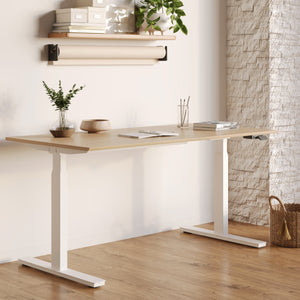
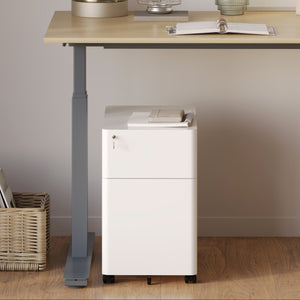






















Filing Cabinet Choices for Cleaner Workstation Planning
Cleaner workstation planning starts with filing storage that matches the desk, document volume, security needs, and daily workflow. Explore how cab...
Learn more

Visit quiz page to see how we makes it easy to create an inspiring workplace


When we look at a desk, we do not just see furniture and technology. We see the story the space tells about how someone works. Cables are a big part of that story. A clean surface with purposeful routing feels calm, considered, and professional. A tangle of cords hanging off every edge sends a very different message, both to the person who sits there and to anyone who visits.
Cord clutter usually creeps in gradually. A new monitor gets added, a printer appears, a charger is borrowed and never put away properly. Over time, the desk that once felt open and inviting becomes crowded with visible wires that catch the eye before any meaningful work does.
We pay a cognitive price every time our eyes land on something that looks messy or unresolved. Stray cables create lines that cut across the visual field, pull attention away from the task at hand, and make it harder to feel fully settled in the workspace.
When we design and furnish work environments, we treat visual noise as a real form of friction. It does not matter how premium the monitor is if it sits amid tangled cables that distract the brain before the content even loads. Cord organization is part of building a space where the mind can move straight to the work, instead of getting stuck on everything that feels unfinished around it.
Cable clutter is not only a visual problem. It also affects how people move and sit. Loose cords can catch feet, create unexpected tension on devices, or force people to adopt awkward postures just to avoid pulling on something.
Good cord organization supports the same priorities as good ergonomics: stable posture, clear movement paths, and predictable interactions between the body and the tools it uses. Alongside our own design standards, we respect established resources such as official ergonomic safety guidance, which reinforce just how closely comfort, safety, and workspace layout are connected.
Cables always follow the logic of the room. Outlet locations, floor paths, and desk shapes all influence how wires behave. A desk that sits directly against a wall with nearby outlets is easier to keep tidy than one that floats in an open plan with power coming from the floor. Furniture design matters just as much. Leg placement, depth, and built-in openings either help cords find a natural path or force them to spill out into view.
When we choose or design desks, we look for structures that naturally lend themselves to clean routing. Generous depth, discreet passthroughs, and solid under-structure give cables places to hide and rest, instead of leaving them to dangle in midair.
Tools alone do not solve cord clutter. The desk is the anchor that everything else relies on. Before we think about trays, clips, or spines, we start by understanding how the desk will be used and where technology will live on and around it.
For practical planning, we divide cord management into three zones:
The surface, where devices connect and disconnect throughout the day
The underside, where power supplies and hubs usually live
The floor, where cables travel toward outlets or shared power sources
Each zone has its own needs. The surface requires flexible, lightweight control that supports frequent interaction. The underside benefits from more permanent hardware that carries weight. The floor needs pathways that protect both cables and people moving through the space.
A well designed desk makes cord management easier even before a single accessory is installed. Features such as modesty panels, grommets, or concealed cable channels all help guide wiring toward more subtle routes. A contemporary office workstation with a clean structure and thoughtful cutouts, for example, gives cables a defined path that keeps them off the floor and away from the user’s direct line of sight.
When we match desks to workstyles, we always ask: where will the power come from, where will the cords go, and how much movement will the equipment require once everything is in place?
Most of the visual bulk in a setup comes from power bricks and multi-outlet devices, not from the cables themselves. We prefer to assign a dedicated space for these from the beginning. Whether that is a tray under the desk, a channel at the back, or a discrete mounting point, the goal is the same: get the heaviest, most disruptive pieces into a stable, hidden position that still allows easy access when needed.
Once we understand how the desk will be used, the next step is to move the cable mass out of direct view. Under desk tools are some of the most effective ways to change how a workspace feels without changing any of the devices themselves.
Securing power strips and adapters under the surface reduces clutter and protects connections from being bumped or kicked. A sturdy under desk cable organizer keeps multiple components in one controlled area, so that the only cords that reach the desktop are the ones that actually need to be there.
When these elements are gathered into a single tray or basket, cable routes become much clearer. It is easier to trace where a device plugs in, easier to reset a power strip, and far less likely that a single accidental tug will pull a component out of place.
Not every cable needs a heavy duty solution. Adhesive channels, clips, and small hooks are ideal for guiding lighter cords along the underside of the desk. They help keep the path predictable and stop cables from sagging or twisting around chair legs. We like to create one or two main routes, rather than many small, chaotic ones. That way, the desk feels organized underneath, not just hidden.
Different tools excel in different situations. A clear comparison helps match the solution to the setup.
| Tool Type | Best Use Case |
|---|---|
| Rigid trays | Multiple power bricks and strip-style outlets |
| Wire baskets | Mixed adapters that benefit from ventilation |
| Adhesive channels | Lightweight cords that need simple containment |
| Screw mounted clips | Permanent routing in high traffic environments |
By treating the underside of the desk as a deliberate design space, we create a foundation that keeps cords controlled before they ever reach the floor.
Height adjustable desks bring movement and health benefits, but they also add complexity to cord management. As the desktop travels, so do the devices attached to it. That motion needs to be supported by tools that are flexible, stable, and visually discreet.
On a fixed desk, excess cable can be coiled and tucked away. On a sit stand model, too much slack becomes messy, and too little creates tension when the height changes. This can strain ports, pull plugs loose, or even drag devices toward the edge. A height adjustable work desk is most effective when its wiring is planned to move with it smoothly, not fight against it.
We aim for cable paths that lengthen and shorten in a controlled way, with clear anchor points at both the desk and the floor.
A vertical cable spine solution brings structure to this movement. The spine gathers several cables together, guides them from the underside of the desk to the floor, and flexes as the desk rises or lowers. Instead of a loose bundle of cords hanging in midair, there is a defined, protective column that supports the motion.
This approach also simplifies maintenance. When all cables follow one vertical path, it is much easier to trace or replace a line without disturbing the others.
In open offices or shared rooms, cords that spill outward from a moving desk can become genuine hazards. Vertical management keeps them close to the desk footprint, which leaves walking paths clear and reduces the risk of accidental snags. It also gives the entire area a more professional, intentional look.
Not every workspace serves a single person at a single desk. Some rooms are compact home offices, others are shared studios or team clusters. Each context asks for a slightly different cable strategy.
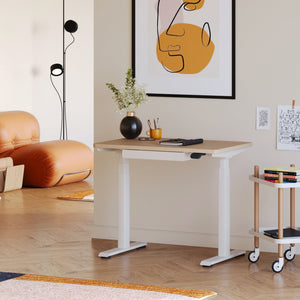
In smaller rooms, cord clutter stands out quickly. There is less room to hide loose wiring, and every inch of surface area matters. Choosing furniture that contributes to order is especially important in these environments. A compact standing desk setup can support healthier movement without dominating the room, and its cable paths can be planned to keep both the floor and the walls as clean as possible.
Here, we rely heavily on under desk containment, short cable runs, and careful placement of power sources to avoid visual overload.
Where two people share one desk structure, cable routes can easily overlap and become confusing. We prefer to give each person a clearly defined power zone and equipment path. A two person standing desk makes this separation easier, because its design anticipates dual setups and helps keep each side distinct.
The result is not only a cleaner appearance but also smoother collaboration, since either person can adjust or troubleshoot their side without disturbing the other.
In team pods or benching systems, the number of devices multiplies quickly. Without planning, that can turn into a visible maze of cables along the floor and under every surface. A four station workstation layout allows us to centralize power and data routes so that the group shares core infrastructure while still keeping individual spaces organized.
In these scenarios, we pay close attention to where trunk lines run, how they branch out to each seat, and how to keep both sightlines and walking paths as open as possible.
Not every cable can be hidden. Some need to be within reach because they are used multiple times a day. The goal on the surface is not to make cords disappear, but to keep them predictable and calm.
Laptop chargers, phone cables, and headphones tend to migrate unless they are given a stable home. Small anchors placed at the edge of the desk can hold these cords in a consistent position, so they remain easy to grab without falling behind the furniture or wrapping around other objects.
We design our setups so that the most used cables feel like part of the layout, not like temporary compromises.
Weighted cable holders keep plugs where they are expected, even when they are not in use. Combined with docks or stands for devices, they create zones where everything has a clear place to return to. Using cable lengths that match the actual distance between the device and its power source helps keep loops and knots to a minimum.
Central charging points reduce the need to stretch cables to far away outlets. When hubs are placed thoughtfully, particularly on or just under the desktop, they help simplify paths and reduce the number of cords that need to cross open areas.
A beautifully organized desk on day one will not stay that way without a simple system behind it. Technology changes, new tools arrive, and old ones retire. Our approach to cord organization has to be flexible enough to keep up.
We often divide cables into clear categories: power, display, networking, and peripherals. Routing each category along its own path makes it easier to follow and adjust later. Labels at either end of a cable save time when something needs to be unplugged or replaced. A quick diagram or photo of the initial setup can be surprisingly helpful when it is time to reconnect equipment after a move.
Over time, cables tend to drift. A clip loses adhesion, a new device is added without being fully integrated, or a temporary solution quietly becomes permanent. Short, occasional check-ins help catch these changes early. During these reviews, we look for cords that could be shortened, consolidated, or moved into existing trays and channels.
There are moments when a small adjustment is not enough and it makes sense to revisit the entire setup.
You might feel this when you add a second monitor, change computers, shift from sitting to standing more often, or introduce new team members at a shared station. Any of these changes can upset the balance of the original layout. Rather than layering quick fixes on top of an outdated structure, we prefer to step back, re-evaluate the overall cable map, and refine it so that the desk feels cohesive again.
For us, cord organization is not an afterthought. It is part of the design language of a workspace. The way cables move, disappear, or present themselves around a desk says a great deal about how that space supports the person who uses it.
We believe a calm, clean desk is both beautiful and practical. Tools such as trays, spines, and clips are not just behind the scenes hardware. They are the quiet structure that lets the furniture, lighting, and materials truly stand out. Our goal is always to pair pleasing lines and finishes with cable solutions that feel natural to live with every day.
Some people like to reconfigure their setup often. Others prefer a stable arrangement that rarely changes. Some work alone in compact rooms, while others collaborate at large shared stations. In every case, cord organization should match the rhythm of the work. That is why we focus on flexible, intuitive tools that can be rearranged as needs evolve, while still keeping clutter in check.
Desks are long term companions to our daily routines. The tools that support cord organization help those routines feel smoother and more sustainable. When cables are thoughtfully managed, the desk becomes a place where attention can stay on ideas, projects, and conversations, not on untangling the wires that power them.


You have unlocked free shipping!
You're saving $29 and unlocked free shipping!
Leave a comment