



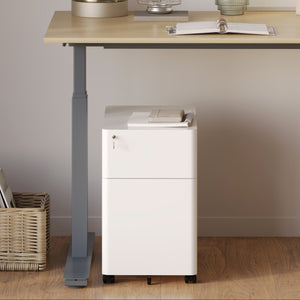






















Filing Cabinet Choices for Cleaner Workstation Planning
Cleaner workstation planning starts with filing storage that matches the desk, document volume, security needs, and daily workflow. Explore how cab...
Learn more
Visit quiz page to see how we makes it easy to create an inspiring workplace


A dual-monitor setup can transform the way work gets done, but it also exposes weaknesses that a basic desk can hide for months. A surface that feels acceptable with a laptop often becomes frustrating once two monitors, a monitor arm, daily typing pressure, and cable weight are added to the equation. The problem is not usually dramatic failure. It is the constant low-level movement that shows up while typing, adjusting the screens, or leaning into focused work.
That movement matters because a desk used for dual monitors is not just holding objects. It is supporting leverage, repeated motion, concentrated clamp pressure, and a workflow that depends on visual steadiness. When the desk flexes at the rear edge or shifts under normal use, the monitors can appear to shimmer or bounce even when the structure still looks solid at a glance. A good workstation should feel composed under real use, not merely pass a static weight test.
The most reliable solution starts with understanding why wobble happens, which desk features actually reduce it, and how the full system should work together. The desk, monitor arm, cable routing, and layout all contribute to whether the finished setup feels planted or irritating.
Many desk buyers focus only on how much weight a surface can technically hold. Dual monitors change the conversation because the force is often applied at the back edge through a clamp, not spread evenly across the top. Once the screens are mounted on arms, their weight is extended outward from the mounting point. That creates leverage, and leverage reveals weakness faster than a centered load.
A desk may feel stable with monitors sitting on their original stands because the weight is closer to the desktop and more broadly distributed. With monitor arms, the load becomes more concentrated and dynamic. Every adjustment to height, tilt, angle, or spacing transfers motion through a smaller section of the desk. That is why a surface that looks spacious can still perform poorly in practice.
The most common frustration is not that the desk cannot support the equipment at all. It is that the top flexes slightly, the frame sways a bit, or the rear edge transmits vibration into the monitor arms. Static capacity and day-to-day rigidity are not the same thing.
A desk can technically support two monitors and still feel unstable while typing. That difference matters because most people do not experience their desk as a lab measurement. They experience it through visual steadiness, hand pressure, and how quickly the structure settles after movement. A good dual-monitor desk resists motion and recovers quickly when disturbed.
Small movements become more noticeable in screen-heavy environments. Fast typing, resting forearms on the front edge, repositioning a mouse aggressively, and leaning forward during concentration all add force into the desk. Even cables can contribute. When charging cords, display cables, and power leads pull at the rear edge, the setup can feel less composed than it should.
This is where thoughtful accessory planning matters. A cleaner rear edge, supported by a built-in desk power module, can reduce cable drag and help preserve the mounting space monitor arms need.
The desktop itself does a surprising amount of stability work. Thin tops and weaker cores are more likely to compress, flex, or transmit vibration near the clamp zone. Since monitor arms rely on pressure at a single mounting point, the top needs enough substance to resist localized stress.
Dense materials and adequately substantial tops tend to perform better because they are less likely to bend under repeated pressure. This does not mean a desk has to be oversized or bulky. It means the mounting area should feel trustworthy and consistent under load.
Rear-edge integrity is often overlooked until installation day. The back edge needs enough support to handle clamp pressure without deforming or feeling springy. Unsupported overhangs, fragile edge profiles, or decorative shapes that reduce usable clamp area can all create problems.
The desk may still look refined and spacious, but if the area where the monitor arm attaches is not built to remain steady, the screens will reveal that weakness immediately. A reliable desk for dual monitors should treat the rear mounting zone as a working surface, not just a visual boundary.
The frame is what determines whether small pressure stays local or spreads through the entire workstation. A rigid base, balanced leg placement, and stable foot design all help reduce sway. Narrow stances and less planted frames can feel acceptable in light use but become less convincing once off-center forces are introduced.
This is one reason buyers often compare a broader collection of adjustable ergonomic office desks before deciding on a final setup. The right desk category is not only about appearance or size. It is about how the frame supports real work patterns.
Two monitors need enough width to sit comfortably side by side without squeezing the keyboard zone or pushing accessories into awkward positions. Width helps with organization, but depth often has the bigger impact on usability. A deeper surface improves viewing distance and gives the monitor arms more room to mount without forcing the screens too close to the user.
Shallow desks create chain reactions. The screens feel closer than they should, the arm may need to extend into a more stressful position, and cable clearance behind the monitors can become tight. This can make even a decent desk feel more active than it really is because the geometry of the setup is working against stability.
Monitor arm installation depends on more than thickness alone. Clamp clearance, rear-edge accessibility, and the absence of obstructions all matter. Some desks include back rails, shaped edges, or structural elements that interfere with mounting even if the overall desk looks ideal.
A desk that supports monitor arms well should allow secure contact between the clamp and the desktop without awkward workarounds. That means thinking ahead about the exact rear mounting area, not only the overall surface size.
A wide worktop does not automatically solve stability. If the heaviest load sits too far from the strongest part of the frame, or if the monitors are mounted off-center, movement can still become more visible. The best layouts place the visual load where the structure is strongest and keep the working zone balanced.
Different parts of the desk reveal different weaknesses. The front edge shows how the structure responds to forearm pressure and typing. The rear edge shows how the top reacts where monitor arms attach. The corners reveal whether the frame twists under asymmetrical use.
A desk intended for dual monitors should feel composed across all three zones. It should not feel stiff only in the middle while the corners and back edge remain lively.
A useful sign of rigidity is recovery. After you press, tap, or shift weight against the surface, does the movement stop quickly or linger? A desk that continues oscillating after a light disturbance can make monitor wobble feel worse throughout the day.
That does not mean every movement must disappear instantly. Real furniture moves slightly under use. The goal is for the motion to be controlled, minimal, and short-lived enough that it does not interfere with focus.
Desk specifications can be useful, but they do not tell the whole story. Numbers alone do not explain how the desk behaves under leverage, repeated adjustment, or off-center pressure. For a dual-monitor setup, practical steadiness matters more than an impressive figure on paper.
Some buyers assume a fixed desk must always feel more stable than a height-adjustable one. In practice, quality matters more than category. A poorly built fixed desk can wobble more than a thoughtfully engineered sit-stand model. What matters is how the frame manages movement, how the top is supported, and how well the desk maintains composure through normal use.
For users who want posture flexibility without giving up confidence in the structure, a standing desk with remarkable stability can be a strong fit when the frame and top are designed to work together.
Seated work often adds front-edge pressure from the forearms, while standing work changes where body weight and hand pressure land on the desk. A strong workstation should remain dependable in both postures. It should not feel composed in one mode and overly reactive in the other.
A desk that can adapt to changes in posture, equipment, and workflow tends to remain useful longer. Dual-monitor users often refine their layouts over time. The desk should support those adjustments rather than punish them.
A strong monitor arm does not solve a weak desk. If the surface below the clamp compresses, flexes, or vibrates, the arm will simply transfer that weakness to the screens. Overtightening also does not fix the problem. Excess pressure can damage the mounting zone without delivering the calm, steady feel users expect.
The farther the monitors extend from the pole, the more visible movement can become. Compact centered setups usually feel steadier than wide, fully extended configurations. That does not mean long reach is bad. It means the desk and arm need to be matched realistically.
Using an adjustable monitor arm accessory that supports positioning flexibility is most effective when the desk beneath it has the rigidity to keep those adjustments stable.
Whenever possible, positioning the monitors closer to the main support point can help reduce shake. This is especially helpful for users who do not need the screens pushed far outward all day. The less leverage placed on the rear mounting zone, the calmer the setup tends to feel.
Cable tension often gets dismissed as visual clutter, but it also affects how a setup behaves. Display cables, chargers, and power cords can tug lightly at the monitor arms or snag during adjustments. Those small pulls can make the whole station feel more active.
The cleaner the rear edge, the easier it is to mount monitor arms properly and keep movement under control. Built-in access points reduce the need to drag cords across the surface or let adapters collect around the clamp zone.
For desks where permanent built-in access is not the preferred route, a clamp-mounted desk power module can help keep charging and connectivity close at hand without crowding the main work area.
A tidy cable route is not only about appearance. It reduces accidental tugs, preserves useful monitor arm space, and supports a workstation that feels deliberate rather than improvised.
When two monitors are mounted side by side, balance matters. If the screens are pushed too far to one side or if other heavy accessories cluster away from the frame’s strongest area, the desk may twist slightly under use. Keeping the main setup centered helps the structure work more evenly.
Speakers, docking stations, task lighting, and desktop towers all influence the layout. They should support workflow without forcing the monitor arms into awkward positions or crowding the keyboard zone. The goal is not maximal density. It is a calm arrangement that preserves the desk’s strongest working areas.
In collaborative or benching environments, layout consistency matters even more. A two-person adjustable workstation makes the most sense when each user still has enough depth, screen clearance, and structural support for mounted displays without one side compromising the other.
| Desk Feature | Why It Helps | What Happens When It Is Weak |
|---|---|---|
| Adequately thick, dense top | Resists clamp pressure and localized flex | Rear edge can bounce or compress |
| Strong rear mounting zone | Supports monitor arm stability | Screens react more to small movements |
| Rigid frame with balanced stance | Controls sway and twisting | Typing and repositioning feel less composed |
| Sufficient desk depth | Improves viewing distance and clamp clearance | Arms extend into less stable positions |
| Clean cable and power layout | Reduces drag and accidental pulling | The setup feels cluttered and more active |
| Balanced monitor placement | Keeps force distributed more evenly | Off-center loads can exaggerate movement |
Developers, analysts, editors, and multitasking professionals spend long hours tracking small details across two screens. For them, even minor monitor shake can become fatiguing. A stable desk helps the displays disappear into the workflow so attention stays on the work itself.
A table that works for a laptop and notebook may become the wrong platform once clamp-mounted screens enter the picture. The shift from casual use to a more serious workstation usually reveals how important structure really is.
When a setup needs to look polished and perform well at the same time, the supporting furniture should be chosen with both function and cohesion in mind. Thoughtful modern ergonomic workspace solutions can help align the desk, accessories, and broader office environment around the way people actually work.
The easiest way to make a better decision is to evaluate the desk as a system, not as an isolated object.
1. Start with the number, size, and placement of the monitors.
2. Confirm the rear edge can accept the chosen monitor arm securely.
3. Check that the desktop has the substance to resist clamp pressure.
4. Make sure the frame feels planted under front-edge and corner pressure.
5. Choose a depth that supports comfortable viewing distance.
6. Plan cable and power access before the monitors are mounted.
7. Keep the finished layout balanced so the structure carries the load evenly.
A desk for dual monitors should not be selected only for the setup that exists today. Workstations change. Screens get upgraded, accessories get added, and workflows become more demanding. The right desk remains steady as those changes happen. It does not force compromises the moment the setup becomes more advanced.
The most satisfying dual-monitor desks are the ones that stop drawing attention to themselves. They allow the monitors to stay visually calm, give the monitor arms a reliable foundation, and support daily work without the low-grade annoyance of movement at every touch. When the structure is right, the desk feels less like a temporary platform and more like the backbone of a serious workstation.


You have unlocked free shipping!
You're saving $29 and unlocked free shipping!
Leave a comment