












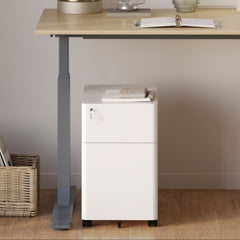




Filing Cabinet Choices for Cleaner Workstation Planning
Cleaner workstation planning starts with filing storage that matches the desk, document volume, security needs, and daily workflow. Explore how cab...
Learn more
Visit quiz page to see how we makes it easy to create an inspiring workplace


A messy desk rarely happens because someone is “bad at organizing.” It happens because cables are doing three jobs at once, and no single path tells them where to go.
Power cords want to live near outlets. Devices want to live where you work. When those two points are far apart, cords stretch across open air, drape down the front edge, or collect on the floor. The quickest cable improvements usually come from relocating where you plug in, not from buying more ties.
Even a tidy setup looks chaotic when extra cable length has no home. That extra length turns into loops behind the monitor, coils under the desk, or tangles near your feet. Clean cable management is mostly slack management.
Chairs roll. Feet nudge. Vacuuming and mopping pull cords. Standing desks travel up and down. Even turning a monitor can tug a cable run loose. A setup that stays clean is designed for movement, not just appearance.
If cables are visible from the front, fix routing. If the underside looks like a nest, fix slack containment. If things snag when you move, fix motion with a controlled drop path.
When we build office setups, the fastest wins come from a simple reset. It works because it forces a single path and removes the mystery of “which cable goes where.”
Start by shutting down and unplugging only what you are comfortable disconnecting. Leave anything sensitive or hardwired alone. The goal is not a full teardown, it is to sort what is already there.
Pick one primary route under the desk, usually along the rear edge. Every cable should travel toward that same route before it goes down to power or peripherals. If you bundle first, you lock in a messy path.
“USB-C” is not helpful when you have five USB-C cables. “Monitor power,” “Dock to laptop,” or “Speaker L” is helpful when you swap devices later.
1. Turn off devices, then unplug only what you can easily reconnect.
2. Separate cords into groups: power, display, data, audio, accessories.
3. Choose one under-desk route along the back edge as your main highway.
4. Route each group to the highway first, then decide where it drops down.
5. Remove visible front-edge drapes by re-entering the underside sooner.
6. Create a small service loop behind each device so you can reposition it.
7. Label both ends of cables that connect to a hub, dock, or monitor.
8. Keep daily-use plugs accessible and keep permanent plugs hidden.
9. Contain slack in one zone under the desk, not scattered everywhere.
10. Test movement: roll the chair, adjust the monitor, raise the desk if it moves.
The cleanest setups follow one principle: every cable gets a predictable path, and every path stays serviceable.
A practical baseline routing looks like this:
Device to nearest desk edge
Edge to underside highway (rear edge is usually best)
Highway to a single down path to power or floor
That route keeps the desktop visually calm while preserving access. If something fails, you can trace it without cutting ties everywhere.
Back-edge routing is usually best when the desk sits against a wall or divider. It hides cables naturally and keeps the front view clean. Side-edge routing can work when the desk floats in a room and you want cords to drop along the leg that faces away from you.
Use the rear edge as the highway, then drop cords near the outlet side. Avoid dropping cords directly behind your knees.
Choose the “least visible leg” as the drop point. That keeps cables from being seen from multiple angles.
Create the highway along the back, then drop into the corner itself. Corners hide volume better than open legs.
Leave enough slack to move a device without pulling on its connector, but not so much that it forms large loops. A small service loop behind a monitor or dock is usually the sweet spot. The rule we use is simple: you should be able to pull a laptop forward or rotate a monitor without any cable going taut.
If cables cross your knee space, they will get kicked, snagged, or pulled loose. Route the highway behind where your legs naturally move, then keep drops tight to a leg or a rear corner.
Even the best routing looks messy if the underside is full of power bricks, adapters, and random coils. The goal is not to eliminate bulk, it is to give bulk one controlled home.
Keep under the desk:
Power bricks and adapters
The “extra” length you do not need daily
Splitters and hubs that are set-and-forget
Keep accessible above the desk:
A single cable you unplug daily (laptop charging, camera, headset)
One spare port you actually use
Anything you need to see or press regularly
Power bricks are heavier than the cords that feed them. When bricks dangle or sit in a loose pile, they tug on plugs and slowly loosen connections. They also pull other cables into the mess.
Give bricks a stable surface, keep them separated so cords do not twist together, and avoid compressing them into a tight bundle. Good cable management should not trap heat or create stress points at connectors.
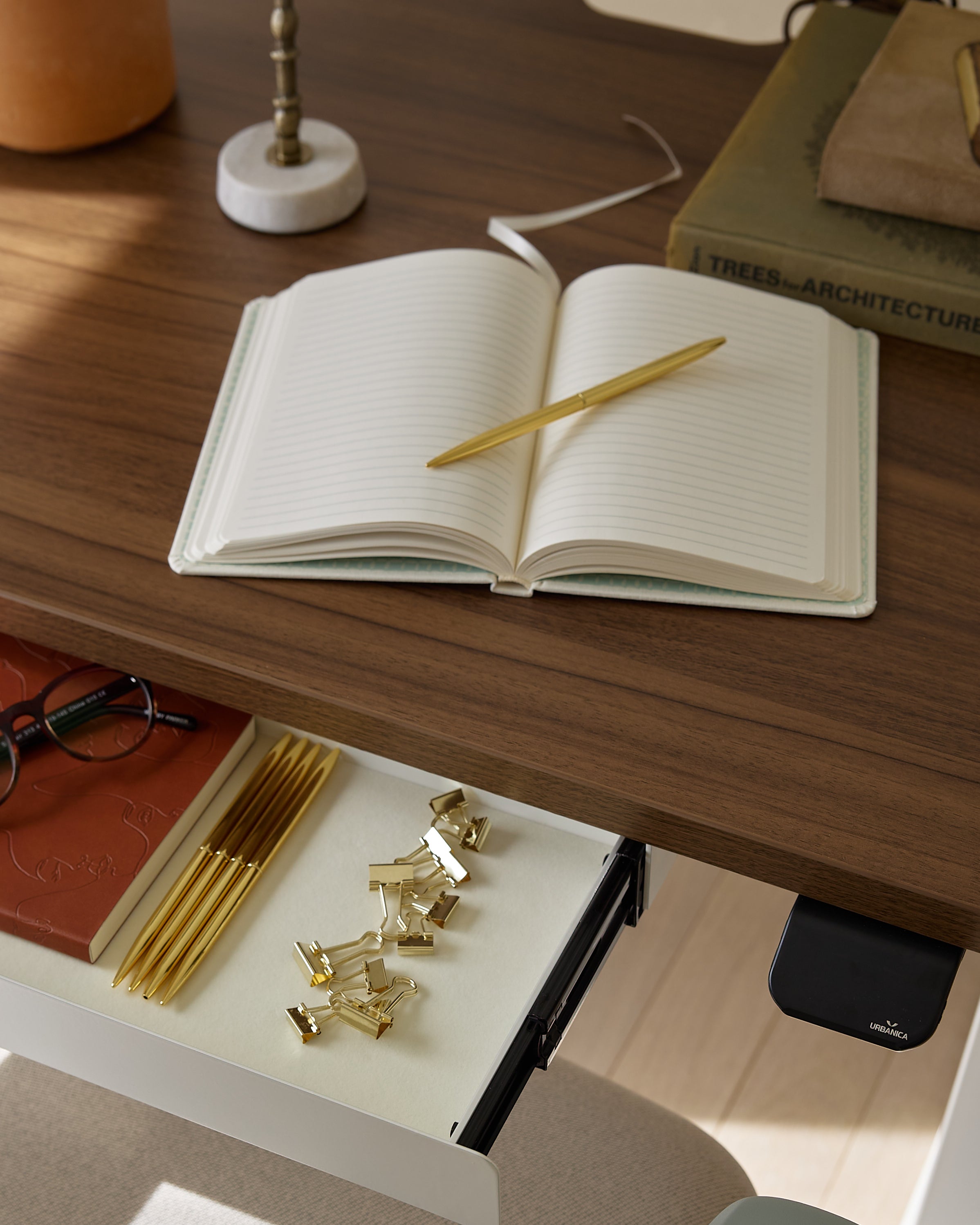
If your main problem is volume under the desk, an organizer can give you an instant containment zone. Our under-desk cable management organizer is designed to keep cords and excess length tucked beneath the desktop so the underside looks intentional instead of improvised.
This question comes up constantly because both options can work, but they solve different problems.
When power sits on the floor, cords naturally sprawl. Chair wheels and shoes become part of the routing plan, even if you do not want them to be. Cleaning becomes harder because the power zone is exactly where dust collects.
Mounting or positioning power under the desk typically reduces visible cables, protects cords from being kicked, and makes it easier to route everything along a single highway. It also helps you keep connectors away from the floor where they can loosen from motion.
If you frequently change plugs, keep your access point reachable, not buried.
If your setup is stable, hide and contain power under the desk for calmer visuals.
If pets, kids, or chair wheels interact with your cables, avoid floor sprawl whenever possible.
The fastest way to reduce visible cables is to bring power closer to where devices actually sit. There are two practical approaches: power integrated into the desktop, or power that attaches to the desk edge.
A built-in module shortens the distance between device and outlet. That often eliminates the “waterfall” of cords that drop off the front or side of the desk. Our in-desk power outlet module is made for that kind of clean access, with outlets and USB ports placed directly in the desktop.
Place them where you naturally plug in, but not in the primary writing or mouse zone. Many people prefer a rear corner or a rear-center position so cables can immediately disappear into the underside highway.
Think about where the module’s cords exit under the desk. If the exit faces the highway, cables stay controlled. If the exit forces cords across open space, you recreate clutter underneath.
Clamp-on power is a strong option when you want quick access without modifying the desktop surface. Our clamp-on desk power outlet attaches to a desk edge and provides convenient outlets and USB charging where you actually need it.
Shared workstations where the setup changes
Renters or anyone avoiding permanent desk modifications
Creators who plug and unplug gear throughout the day
Treat the clamp-on unit as a controlled “plug zone.” Then route its main cord immediately down the least visible leg or into the underside highway. The clamp-on unit should be the only visible access point, not the start of a new cable tangle.
If you want fewer visible cords on the surface, in-desk power usually wins because plugs start below your sightline. If you want flexible access and easy repositioning, clamp-on power usually wins because it adapts to how you work.
Standing desks are cable management’s stress test. The desk moves, so your cable system must move with it without pulling, snagging, or dragging.
When the desk rises, cables must lengthen. When it lowers, cables must shorten. A controlled loop gives cables room to move without yanking connectors. Without that loop, the first thing to fail is usually a tight power cord or a display cable under tension.
A standing desk stays cleaner when cables drop from one consistent point instead of multiple legs. It keeps the motion smooth and makes troubleshooting easier. When everything drops in different places, cables twist during travel and slowly pull each other out of alignment.
For many sit-stand setups, the cleanest vertical management tool is a spine that guides cords from desktop to floor. Our Spine cable organizer is designed to conceal and manage that vertical run so the moving desk stays tidy through its full range.
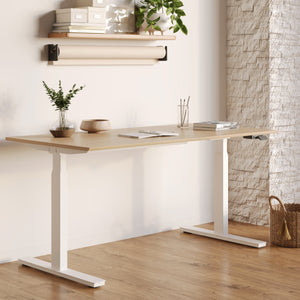
A desk that is stable, with thoughtful underside space, makes cable routing easier because your highway and containment zone stay consistent. Our adjustable standing desk is built for daily movement, and that kind of movement is exactly why we plan cable paths that flex without stress.
1. Raise the desk once to your highest working position and confirm nothing goes taut.
2. Lower the desk fully and confirm slack does not pool into a foot hazard.
Most tangles happen at the device cluster, behind monitors and around docks. The fix is not more ties, it is separating what changes from what stays.
Grouping by function keeps a future issue from turning into a full teardown.
Monitor power, dock power, and charging cords can share a route toward the underside containment zone.
USB and network connections should be routed so they are not stretched or kinked, especially near a dock.
Speaker or microphone cables often benefit from their own route, because they tend to cross toward one side of the desk.
High-change cables are unplugged daily, like laptop charging, camera gear, or a headset. Low-change cables rarely move, like monitor power or a dock’s upstream connection.
A clean setup keeps high-change cables accessible and simple, while low-change cables disappear into the highway and stay secured.
Place the dock close enough to the laptop that the main connection stays short, but not so close that the dock becomes desk clutter. Many people place it under the monitor line, then run the dock’s outgoing cables directly down into the highway. The goal is a short, tidy “device cluster” above the desk and a controlled system below it.
Some cable problems look similar, but they have different causes. This table maps the visible symptom to a practical, honest fix that keeps your desk serviceable.
| What you see at the desk | What is really causing it | The most reliable fix | What to avoid |
|---|---|---|---|
| Cables draping off the front edge | Outlets are too far from devices | Bring power access closer to the work zone, then route down the rear | Bundling visible cables and calling it done |
| A “nest” under the desk | Slack has no containment zone | Create one under-desk home for bricks and extra length | Spreading slack across multiple legs |
| Cords get kicked or rolled over | Routes cross knee space or floor paths | Move drops to a rear corner or a single leg | Leaving loose loops near chair wheels |
| Plugs loosen over time | Bricks are pulling on connectors | Support bricks on a stable surface and secure excess length | Letting adapters dangle midair |
| Standing desk snags during travel | No controlled loop and no single drop | Use a controlled loop and guide the vertical run | Tight cords that reach only at one height |
| Troubleshooting takes forever | Cables are not grouped or labeled | Label by endpoint and bundle by function | Labeling by cable type only |
Accessories help, but the desk itself sets your ceiling. Cable management becomes dramatically easier when the underside has room for a highway, the back edge provides clearance, and the surface supports sensible power access.
If the underside is cramped, any organizer becomes a compromise. If the rear edge sits flush to a wall with no clearance, cables get crushed or bent. A bit of space behind the desk lets cables run cleanly without pressure on connectors.
A cluttered surface usually creates cable clutter because devices end up scattered. A calm surface makes it easier to keep the “device cluster” tight and routing predictable. Our minimalist office desk is designed around a clean work surface and a practical workspace footprint, which helps cable routing stay consistent rather than improvised.
When you are coordinating desk, accessories, and power, you want clear guidance on delivery and support so setup planning feels straightforward. Our delivery and support details page is where we outline how we support customers ordering online, including practical help points and answers to common purchasing questions, without requiring an in-person showroom visit.
A cable system that only works for today will fail the moment you add a light, swap a monitor, or move outlets. The most durable approach is to design for change.
Spare capacity can be as simple as leaving a little room in your under-desk containment zone and keeping one accessible power option for a new device. Over-tightening everything can look perfect, but it makes upgrades frustrating and leads to people ripping out ties later.
When a new device enters the setup, route it into the existing highway, not across open air. If every new gadget creates a new path, the desk slowly returns to chaos. The highway and drop should stay constant, while devices connect into that system.
If you cannot trace a cable end-to-end in under a minute, regroup and label.
If you need to unplug something weekly, keep that cable accessible and simple.
If a cable is never touched, hide it and secure it so it stays out of the way.
The end goal is a desk that looks calm, stays safe, and remains easy to service, even when your work tools evolve.


You have unlocked free shipping!
You're saving $29 and unlocked free shipping!
Leave a comment