



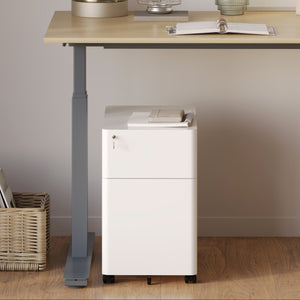






















Filing Cabinet Choices for Cleaner Workstation Planning
Cleaner workstation planning starts with filing storage that matches the desk, document volume, security needs, and daily workflow. Explore how cab...
Learn more
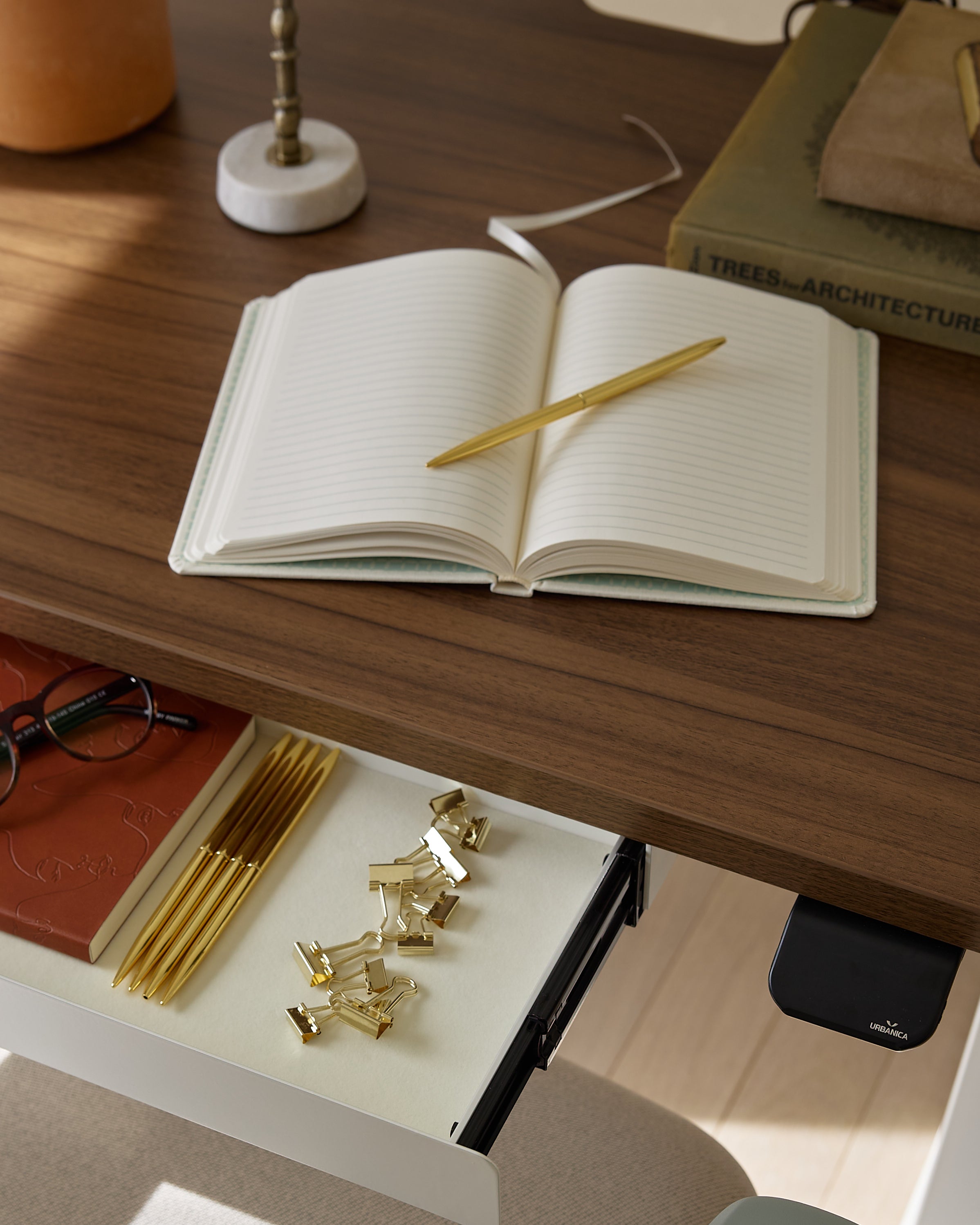
Visit quiz page to see how we makes it easy to create an inspiring workplace


Choosing between clamp-on desk power and built-in desk power is less about what looks cleaner in product photos and more about how your desk behaves day to day. Power access sits at the intersection of reach, workflow rhythm, and cable routing. When the outlet is easy to reach, plugging in becomes effortless and consistent. When it is awkward, cords creep across the surface, adapters hang, and the clean setup you wanted slowly turns into a work-around.
A desk power solution needs to solve two practical problems at the same time.
First is reach. Ports should be accessible without standing up, crawling under the desk, or stretching across a monitor arm. If power is hard to reach, you will leave things plugged in that should not stay plugged in, or you will keep a tangle of extensions on top of the desk.
Second is routing. Power is only clean when the cable path is planned. Without a clear route down the desk and into a containment zone, even the most minimal outlet style will still look messy because the cords have no place to go.
At Urbanica, we look at power as part of the workstation system. The desk frame, the desktop thickness, whether the surface is fixed or height-adjustable, and the way the desk sits in the room all influence what power style will feel natural.
A height-adjustable desk introduces movement and travel, which means cable slack and snag prevention become priorities. A fixed-height desk often allows tighter routing and more permanent placement. If your foundation is adjustable, start by considering how power will behave across the full height range of a height-adjustable standing desk.
Does the desk move regularly, or does it stay in one place for years
Is the desk used by one person or shared
Do you plug and unplug devices frequently
Do you want to keep the surface visually minimal, or do you prefer ports within arm’s reach
Are you comfortable modifying the desktop, or do you prefer a non-invasive change
Clamp-on power is the most flexible way to bring outlets and charging ports closer to where you work. It attaches to the edge of the desk and immediately changes your daily experience because power becomes part of your reach zone.
Clamp-on units mount to the desk edge using a clamping mechanism that grips the underside and the top surface. This approach avoids cutting into the desktop and it makes the power module removable if you change desks or reconfigure the room.
Clamp-on power works best when you want to place ports where your hands already are. Side-edge positioning can be ideal for frequent charging. Rear corner positioning can be ideal for keeping cables out of your work zone while still keeping ports accessible.
Clamp-on power tends to feel right for setups that change.
If you rotate between devices, or you bring in temporary equipment, clamp-on power puts ports where the action is. That might mean charging a phone and earbuds during a work block, powering a camera battery charger, plugging in a task light, or adding a small printer for occasional use. In these cases, it is valuable to be able to move the module to match the workflow.
Clamp-on can also be a strong fit for renters and multipurpose rooms where you want a clean setup but you also want reversibility. The ability to remove the module without leaving a permanent cutout keeps the desk adaptable.
A concrete example of this category is our clamp-on desk power module, which is designed to add convenient port access without committing to permanent installation.
Clamp-on power is not automatically better. It is simply better for certain behaviors.
A clamp-on module occupies edge space. If you rest your forearms on the desk edge, or if you write on the front third of the desktop, a front-edge mount can feel intrusive. This is why many people end up placing clamp-on power at a rear corner or along a side edge where it stays accessible but out of the primary comfort zone.
The cleanest clamp-on installs are the ones where the cable drops immediately into a planned route. If the cable exits toward the front and then loops back, the cord becomes a visual line across your workspace. Choosing placement that supports a straight drop is often more important than choosing the most convenient spot for plugging in.
Desk thickness, edge shape, and underside structure affect compatibility. A clamp mechanism needs a predictable underside to grip safely and consistently. If your desk has a thick edge profile, a beveled edge, or an apron that reduces clamp space, placement may be limited. Protecting the finish matters too. Soft pads and appropriate pressure keep surfaces looking good over time.
Built-in desk power is the cleanest style when the goal is an integrated look. Ports sit within a cutout in the desktop surface, often near the rear portion of the desk so cords can drop down behind equipment.
Built-in power tends to shift behavior. Because ports are integrated into the surface, many users stop leaving cords draped across the front of the desk. When placed well, built-in power encourages cables to live near the back of the desk where they are easier to route downward and hide.
Built-in power can also feel more stable in the sense that it becomes part of the desk. The module stays in the same spot and the cord path can be designed once and maintained with minor adjustments.
Built-in power usually fits best when the workstation is stable and the surface aesthetic matters.
A dedicated home office desk that will not be moved frequently is an ideal candidate. So is a space where the desk needs to look clean on video calls, or a room where a minimal surface supports focus.
Built-in power also shines in shared or guest spaces where you want a consistent place to plug in without relying on a loose power strip.
A reference example for this category is our in-desk power module, which is designed to sit flush in the desktop and support a clean port zone.
Built-in power works best when placement and routing are planned with care.
A built-in module requires a cutout. That means the desktop material, thickness, and structure should support installation without compromising stability. It also means the location becomes a lasting choice, so it is worth thinking through the reach zone, elbow space, and where equipment will sit.
A clean install still needs to remain usable. Cords should not be trapped in a way that makes unplugging difficult. A good plan accounts for access to the underside for cable changes and avoids routing that pinches cables against frame elements.
If you later rotate your desk, change monitor placement, or switch the side where you sit, the built-in module does not move with you. It stays where it was installed. That is fine for stable setups, but it can feel limiting for people whose workspace evolves frequently.
When we help customers think through desk power, the most accurate method is to choose based on behavior rather than preference. Clamp-on and built-in are both useful. The best fit depends on how your setup changes, how many devices you power, and how you want to access ports.
If your desk moves, clamp-on power usually matches that reality better. Moving can mean switching rooms, rotating the desk to face a different direction, or changing the layout around the desk. Even small shifts can make a fixed port location feel wrong.
If your desk stays in one place and your equipment layout is consistent, built-in power can feel like the most natural solution because it supports a set-and-maintain workflow.
Device density is about simultaneous demand. A simple laptop setup with one monitor often needs fewer touchpoints than a workstation with a docking station, speakers, a microphone, chargers, and a task light.
Higher device density can go either way. Clamp-on can keep frequently used ports within easy reach. Built-in can keep the surface clean by placing ports where cables can drop away behind equipment. The deciding factor becomes whether you frequently swap devices or whether the device set is stable.
Some people want ports at the edge because it feels easy and natural to plug in. Others want ports integrated into the back zone of the desktop because they prefer fewer objects on the edge and fewer cords crossing the working area.
1. Does the desk change position, orientation, or room often
2. Do you add and remove devices weekly, or is your device set stable
3. Is a clear desk surface a core preference, or is instant access to outlets more important
4. Are you willing to modify the desktop surface
5. Will the desk be shared, and does each person need equal reach to ports
A standing desk introduces a new problem that fixed-height desks do not have. The cable path must remain safe and functional while the desk moves through its height range. The outlet type matters, but the routing plan matters more.
When a desk rises, any cable that is too short will tug. Tugging creates strain at connection points and it can pull devices, adapters, or cable management components out of place. When a desk lowers, excess slack can bunch and catch on frame parts or nearby objects.
A good standing desk power plan starts with a predictable slack loop and a controlled downward route.
Clamp-on power can be a strong match for standing desks because it is easy to position ports in a comfortable reach zone at both seated and standing heights. The main requirement is that the cable exit and route support smooth movement.
Rear corners and rear side edges are typically safer than front-edge mounts. The goal is to let the power cord drop behind the equipment zone rather than drape across the work surface.
If the clamp-on module sits near the front edge, cables often hang in front of drawers, knees, or the chair path. The setup may still work, but it tends to look busier and it can snag when you shift positions.
Built-in power can look especially clean on a standing desk, but it still needs a controlled drop path. The cord leaving the module must travel down in a way that prevents pinching and reduces tangles.
A vertical guide that moves with the desk helps keep the cable path consistent. This is where a structured vertical route makes a difference, especially when you want to preserve a tidy look at all heights. A practical solution for this is a vertical cable spine organizer, which creates a guided channel between the desk and the floor.
Clamp-on versus built-in is often framed as convenience versus aesthetics, but the more accurate framing is cable routing discipline. A good cable plan makes either option feel premium. A weak cable plan makes either option feel chaotic.
The most reliable cable management concept is the single-drop principle. The idea is simple. Most cables should travel toward one controlled drop point, then route downward together.
When cables drop from multiple points around the desk, you get multiple loops, multiple snag risks, and multiple visual lines. When cables drop from one planned point, you get predictability and the ability to tidy the system without redoing everything.
Power bricks, adapters, and excess cord length need a home. If they dangle, they tug. If they stack loosely, they rattle, collect dust, and become hard to service.
A contained under-desk zone solves this by giving you a structured place to mount and store power components. An under-desk cable management accessory can create that zone, keeping power bricks and extra length off the floor and out of sight.
A workstation stays maintainable when cables are grouped by purpose.
Power cables often need thicker paths and more slack planning
Data cables benefit from gentle curves and reduced tension
Peripheral cables like webcams, microphones, and keyboards often need access for swapping
Separating these into lanes reduces tangles and makes it easier to troubleshoot when something changes.
Shared desks introduce a human factor that matters more than the outlet style. If one person has convenient access to power and the other does not, the setup becomes frustrating quickly. This is true in coworking zones, home offices shared by partners, and collaborative workstations.
Clamp-on modules can be placed on each side so each user has independent access. This approach can reduce cable crossover because each person’s charging and plugging can stay on their side of the desk.
Clamp-on also makes it easier to adjust port locations if seating positions change.
Built-in power can still work for shared stations, but placement becomes more strategic. A single built-in module may not serve both users equally depending on where they sit and how equipment is arranged. Some shared setups benefit from multiple built-in points, but that requires careful planning to keep the surface functional.
The goal is equal reach without clutter in the center. A clean shared station often uses side-oriented access for each user, with the center zone reserved for collaborative work materials.
A good way to picture this is a shared sit-stand layout such as a two-person standing desk, where each side benefits from its own access strategy and its own routing lane.
| Decision factor | Clamp-on desk power outlet | Built-in desk power outlet |
|---|---|---|
| Installation approach | Attaches to desk edge without modifying the surface | Requires a desktop cutout and planned placement |
| Reconfiguration flexibility | Easy to reposition or remove | Fixed location once installed |
| Best match for frequent layout changes | Strong fit due to portability | Can feel limiting if the desk rotates or the user position changes |
| Desktop surface clarity | Depends on placement and cable routing | Often supports a cleaner surface when placed near the rear zone |
| Cable concealment potential | High with a disciplined drop path | High with a disciplined drop path and strong placement planning |
| Standing desk considerations | Works well when slack and routing are managed | Works well when slack and routing are managed |
| Shared workstation dynamics | Easy to create per-user access points | Works well when placement serves both users equally |
| Upgrade or replacement ease | Simple to swap modules without changing the desk | Replacement may require accessing the underside and matching the cutout |
The most common reason desk power disappoints is poor placement. The fix is rarely new hardware. It is usually a better location and a better cable path.
Rear corners tend to be the safest default because they keep cables behind the work zone. Side edges can be excellent when you plug and unplug often, especially if the cable drop still routes behind the desk rather than down the front.
A good placement goal is to keep the module within a comfortable reach but outside the elbow and writing zones.
Built-in modules usually feel best when placed in the back third of the desk, often off-center. This keeps the work area clear and it reduces the chance that cords will cross your primary work surface.
Placement should also respect where your monitor, laptop stand, and desk accessories live. If built-in power sits directly under a monitor arm clamp or directly in the path of a keyboard cable, it can create a cramped zone that defeats the purpose.
Mounting clamp-on power at the front edge where cables hang into the leg space
Installing built-in power too close to where you write or rest your forearms
Routing cables without a single-drop path, which creates scattered loops
Allowing power bricks to hang rather than storing them in a contained under-desk zone
A desk power solution should feel stable, stay serviceable, and avoid cable stress. The safest setups are the ones that keep tension low and cable paths predictable.
Office workstations tend to accumulate chargers and adapters. The practical goal is not to run everything through one outlet cluster without thinking. It is to create a calm, maintainable system where power is distributed appropriately and cords do not heat up from being tightly bundled around bulky adapters.
If you use multiple adapters, give them space, avoid tight stacking, and keep them in a zone that has airflow rather than compressing everything into a tight pocket.
Strain relief is the simple practice of preventing cables from pulling directly on ports. This can be done by routing cables through guides, leaving a gentle slack loop, and avoiding sharp bends near connectors.
Clamp-on modules benefit from strain relief because the cord path can shift when the desk moves. Built-in modules benefit from strain relief because the underside cable path can become tight if the drop is not planned.
Under-desk organization should not create an environment where adapters are packed tightly together. Airflow matters because power bricks naturally produce warmth during use. A calm layout with separation and a stable mounting approach tends to be easier to maintain.
Labeling cables near the device end
Grouping power cables separately from data cables
Checking that sit-stand movement does not tug on connections
Leaving enough slack for devices that move, like laptop docks and adjustable monitor arms
The most reliable way to choose correctly is to measure and mock placement before committing.
For clamp-on power, focus on desk thickness, underside clearance for the clamp, and the edge zones where you do not rest your arms. For built-in power, focus on desktop space behind your primary work zone and the available routing area underneath.
Also consider the distance to your wall outlet and where the cable will travel. A clean setup is easier when the power path matches the room.
Painter’s tape can simulate where a module would sit. A piece of string can simulate cable drop. When you sit and stand, you can see immediately whether the placement will invade your comfort zone or whether the cable path will cross your work area.
Sometimes the best decision comes from seeing how a power module and cable solution fits into a real workstation layout. If you want support choosing components that match your desk type, room layout, and accessory needs, the workspace planning and product support page is a practical starting point for exploring options and fit guidance.
Different work styles create different definitions of success. The goal is to choose the power approach that continues to feel right even as devices change.
If you shift your desk, rotate your room, or change equipment regularly, clamp-on power tends to stay aligned with your behavior. It gives you the ability to move the port zone without committing to a permanent desktop location.
If you value a clean surface and your desk layout is stable, built-in power often supports that goal better. It can keep cords in the back zone, encourage a consistent cable path, and reduce the visual footprint of power on the surface.
With standing desks, the outlet type is secondary to the cable path. Choose the outlet style that fits your access preferences, then build the routing system that prevents tugging and snagging across height changes.
A vertical guide for the main drop, combined with a contained under-desk zone for adapters and slack, is often the difference between a setup that looks good on day one and a setup that stays clean months later.
For two-person stations, the best solution is the one that gives each user predictable access and keeps cables from crossing into the other person’s space. Clamp-on modules can be assigned per side. Built-in modules can work when placed strategically. In both cases, the system should be planned as two parallel lanes that meet the same standards for reach and routing.


You have unlocked free shipping!
You're saving $29 and unlocked free shipping!
Leave a comment