




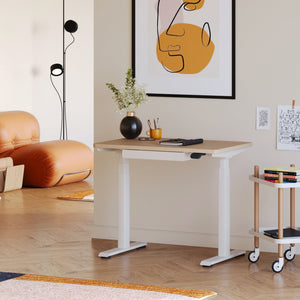
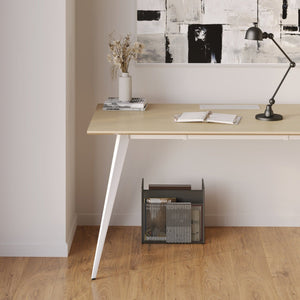
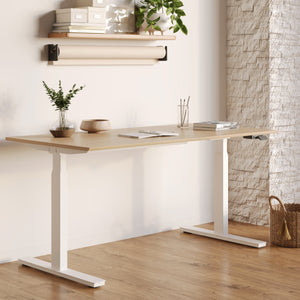
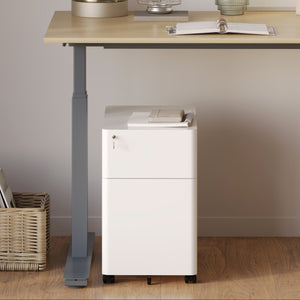






















Filing Cabinet Choices for Cleaner Workstation Planning
Cleaner workstation planning starts with filing storage that matches the desk, document volume, security needs, and daily workflow. Explore how cab...
Learn more
Visit quiz page to see how we makes it easy to create an inspiring workplace


A chair that sits too low relative to a desk changes the way the body reaches for the work surface. The desk becomes a vertical obstacle rather than a platform that supports the arms. At Urbanica, this shows up as the same pattern across many home offices: wrists bending back to “climb” onto the keyboard, elbows drifting away from the torso, and shoulders quietly lifting to compensate. The discomfort is real, but the cause is usually mechanical, which means the fix can be mechanical too.
A low seat lowers the pelvis and the ribcage. That shifts the elbow down, because the upper arm follows the ribcage. When elbows sit below the work surface, the hands have to travel upward to meet the keyboard and mouse. Most people do that by bending the wrist back, since it is the fastest way to gain height without moving the whole arm.
Wrist extension is not inherently “bad.” It becomes a problem when it is sustained and paired with force, such as typing with hands floating above the keys or resting the heel of the palm on a sharp desk edge. In a low-chair setup, those stressors tend to stack up. The wrists extend, the forearms tense to hold position, and the fingers overwork because the arm is not supported.
When the chair is low, the elbows often cannot sit at the same height as the keyboard. The body solves this in two common ways:
The elbows flare outward so the forearms can approach the keys at a steeper angle.
The shoulders round forward to shorten the reach, which then pulls elbows forward and away from the torso.
Either way, the mouse and keyboard start to feel “far,” even if they are not physically far. That perceived distance is a posture signal. It usually means the arms are not getting stable support at the right height.
A desk edge that contacts the forearm or the heel of the hand can turn a mild wrist angle into a significant irritant. In a low chair scenario, people often rest into the edge for leverage. That can compress soft tissue and encourage even more wrist extension, because the hand bends around the edge like a hinge.
If the desk edge feels like it is “cutting” into the forearm or palm, treat that as useful feedback. It is rarely solved by willpower. It is solved by changing height and distance so the arms can rest lightly without collapsing into the edge.
A wrist that is close to neutral looks like a long line from forearm through the back of the hand. It does not look like the knuckles are lifted high above the forearm. It also does not require pressing the wrist down flat. Pressing down can create a different problem by compressing the palm and limiting circulation. The goal is a relaxed hand position that does not force a hinge-like bend for extended periods.
Posture reminders often fail because the issue is not effort, it is geometry. A low chair makes the arms approach the desk from below. Even perfect “upright” posture will still leave the elbows low unless the seat and the work surface are brought into alignment. When geometry is wrong, the body will compensate to get the work done. The best strategy is to remove the need for compensation.
A comfortable workstation is not a statue pose. It is a range where the body can move while staying mechanically efficient. The clearest way to approach wrist and elbow alignment is to aim for targets that reduce strain, then make the setup easy enough to maintain without constant self-correction.
For most desk tasks, a wrist that stays close to neutral reduces forearm effort and keeps the fingers working with less tension. Neutral-ish means small natural variation is fine. What matters is avoiding a sustained, pronounced bend back at the wrist, especially while bearing weight against the desk edge.
A practical cue is to think “hands level with forearms.” If the back of the hand rises significantly above the forearm while typing, the keyboard is likely too high relative to the elbows or too far away.
Elbow angle changes depending on what you do. Typing, mousing, drawing, gaming, and reading each place the arms differently. Instead of chasing one number, aim for a range where the elbows can stay near the sides and the shoulders stay relaxed.
For many people, a comfortable typing position is a moderate bend at the elbow, with forearms approaching the keyboard without needing to lift the shoulders. If the shoulders float upward or the elbows drift forward to reach the keys, the setup is still asking your body to compensate.
Shoulders are the early warning system for desk mismatch. Watch for these cues:
Upper traps feel “on” even during light typing
Shoulders creep upward toward the ears over time
You catch yourself holding your arms up rather than letting them feel supported
When the chair is too low, shoulders often become the lift mechanism. Fixing the height mismatch reduces that lifting demand, which usually improves both wrist comfort and neck comfort.
Sit normally and bring your hands to the keyboard. If your forearms angle noticeably upward toward the desk, the chair is likely too low or the keyboard is too high. A flatter forearm approach makes neutral wrists easier. You do not need perfectly level forearms. You need an approach that does not force wrists to hinge backward.
One common mistake is lowering the chair to feel comfortable with the monitor, then paying for it at the wrists. Keyboard and mouse height should be matched to elbow comfort. Monitor height should be matched to eye comfort. These two goals often require different adjustments. If you raise the chair to fix elbows and wrists, raise the monitor separately rather than undoing the chair adjustment.
“Chair too low” can mean a few different things. The best fixes depend on which pattern you are living with, because each pattern points to a different constraint.
This is the classic mismatch. The feet feel grounded, but the elbows are clearly lower than the keyboard surface. Typing feels like reaching up and forward, and wrists tend to bend back to meet the keys. The solution typically starts with raising the seat to meet elbow needs, then addressing foot support only if it becomes necessary.
This happens when you correct elbow height by raising the seat, but the floor is now too far away. Without stable foot contact, the body often slides forward on the seat. Sliding forward removes back support and increases reach. That usually brings wrist extension back, even though the chair is technically higher.
This pattern is solved by keeping the seat height that supports the elbows, then restoring stable foot contact using a footrest or a firm surface that allows the feet to rest without pushing the body forward.
A desk can block a good chair adjustment. Thick desk tops, aprons, drawers, or crossbars reduce clearance. When you raise the chair to match elbow height, your thighs may contact the underside, which can feel like pressure or numbness over time.
If thigh contact is the limiter, the long-term solution is usually to lower the keyboard surface rather than forcing the seat low again. Sometimes the simplest change is to use a lower input surface so elbows align without raising the thighs into the desk.
Armrests can quietly create a low-chair problem even when seat height is adequate. If armrests hit the desk and prevent you from pulling close, the body reaches forward. Reach drives elbow flare and wrist extension. If armrests are too high, shoulders shrug. Both outcomes reduce alignment quality.
If you cannot get close enough to the desk with shoulders relaxed and elbows near your sides, armrests need adjustment or temporary removal from the equation.
Use these two checks:
Measurement check: compare elbow height to keyboard height while seated.
Sensation check: notice where tension first appears during light typing. Wrists, forearms, shoulders, or thighs.
The first point of tension is often the real constraint. Fix the constraint and the downstream discomfort usually reduces.
Random tweaks tend to cause new problems. A fix ladder creates compatibility, where each step supports the next. Start with the chair and the body, then move outward to the desk interface.
Seat height is the primary control for elbow height. Raise the seat until your hands can reach the keyboard without bending wrists back or lifting shoulders. Then check foot contact.
If feet remain flat and stable, you have a straightforward fix. If feet lose contact, do not lower the seat to chase the floor. Keep the seat height that supports your elbows and add stable foot support. That preserves wrist and elbow alignment while restoring lower-body stability.
When evaluating seating options for a tall desk, we focus first on whether a chair can realistically support this adjustment sequence. A task chair like the Ergonomic Novo Chair is designed around adjustability and support, which matters when the desk height forces you to work within a narrower range of positions.
A high desk often leads to reach. Reach is not only distance, it is the feeling that the keyboard is “out there.” The fix is usually to bring keyboard and mouse closer so the elbows can stay by the sides.
Practical adjustments:
Pull the keyboard closer until your elbows can stay near your torso while typing.
Place the mouse next to the keyboard, not forward or far to the side.
Avoid pushing the keyboard back toward the monitor to create “space.” That space often becomes a reach gap that wrists pay for.
If you use a wrist rest, treat it as a place to pause, not a place to bear weight while typing. Typing with wrists planted can encourage extension and pressure.
If you raise the chair and bring devices closer but wrists still bend back, the keyboard surface is still too high. In that case, reducing the input height is often the cleanest relief. Options include a keyboard tray, a lowered platform, or a desk that fits your body.
A tray can be especially useful in Pattern C, where desk clearance prevents raising the chair enough. The goal is to create a keyboard height that matches elbow height so wrists stop acting like a hinge.
Armrests should reduce effort, not force posture. The best armrest settings typically allow:
shoulders to remain relaxed
elbows to stay near the body
forearms to be lightly supported during pauses
the chair to pull close to the desk without armrests colliding
If armrests cannot do this, lower them temporarily or move them out of the way, then reintroduce support once the rest of the setup is correct.
Change one variable, test for a few minutes, then adjust again. The order matters because it prevents a common trap: raising the chair, feeling unstable, then sliding forward, then reaching, then blaming the wrists again. Stable feet and a supported pelvis are what allow wrist and elbow fixes to “stick.”
Use a fast reset routine:
1. Set seat height so elbows can meet the keyboard without shrugging.
2. Bring the keyboard and mouse close enough that elbows stay near the sides.
3. Set armrests so shoulders stay relaxed or move them out of the way if they block docking.
This routine keeps your setup consistent even when the desk cannot change.
Wrist and elbow alignment depends on where the torso sits. If the pelvis slides forward, the arms reach. If the pelvis is supported, the shoulders stack more naturally and elbows can stay closer to the body.
Foot support should create stable contact with the feet while allowing the thighs to rest comfortably on the seat. The footrest height should not force the knees upward excessively or push the body forward. If you notice yourself sliding toward the front edge of the seat after adding foot support, the footrest may be too high or too far forward.
A stable lower body is what allows the upper body to relax. Without it, wrists and shoulders often become stabilizers.
Seat depth affects whether you can sit back into support. If the seat is too deep, you may perch on the front edge so your knees can bend comfortably. Perching typically reduces back support, which increases reach. Increased reach usually means elbows drift forward and wrists bend back to find the keyboard.
If you cannot sit back without pressure behind the knees, seat depth is likely part of the problem. A chair that fits your body allows you to sit back and still keep feet stable and elbows aligned.
Slumping tends to roll the pelvis backward and round the upper back. That moves the shoulders forward. When shoulders move forward, elbows follow. When elbows follow, the hands reach. When the hands reach, wrists often extend.
Restoring pelvic support is not about forcing an upright posture. It is about creating a base that reduces reach demand. When the pelvis is supported, the keyboard can come closer without crowding, and the forearms can approach the keys without climbing.
Comfort can be misleading at first. Watch for these signs:
You sit forward on the seat most of the time.
Your lower back loses contact with the backrest quickly.
You feel a consistent need to lean forward to type.
Your shoulders round despite trying to relax them.
These are signals that the body is choosing stability at the edge rather than support at the back.
Even with a good setup, static posture increases fatigue. Micro-movements help:
Alternate between light forearm support and hands hovering for short bursts.
Shift the chair slightly closer or farther to change elbow angle during the day.
Change mouse grip and hand position occasionally if you do repetitive pointing tasks.
Movement keeps tissues from being loaded in the same way for hours.
Armrests are often treated like a comfort feature, but they are also a geometry feature. If armrests are misaligned, they can elevate shoulders, push elbows outward, and prevent proper docking at the desk.
Armrests help when they support the forearms lightly during pauses and reduce the effort of holding the arms up. They are especially useful when you read, think, or take short breaks between tasks. The key is that armrests should not force your shoulders upward or trap your arms in an awkward angle.
Armrests tend to harm alignment when:
they are too high, causing shoulder shrugging
they are too wide, pushing elbows away from the torso
they are too far forward, preventing you from getting close to the desk
they collide with the desk edge, forcing reach
This harm often shows up as forearm fatigue or wrist extension because the keyboard becomes harder to reach without bending at the wrist.
Height should allow shoulders to relax. Width should allow elbows to stay near the torso. Setback should allow the chair to pull close to the desk.
If your chair offers meaningful armrest control, it is easier to match the arm support to your desk height. If armrests do not adjust, treat them as optional. It is better to have no armrest support than to have support that forces compensation.
You should be able to sit close enough that your elbows can remain near your sides while your hands reach the keyboard. If armrests stop you from getting close, the desk wins and your arms reach. That reach usually shows up in the wrists.
If armrests are fixed and problematic, prioritize proximity and input height. Some setups work best with armrests lowered out of contact with the desk. Others work best with the chair slightly lower and a keyboard tray, which reduces the need for armrests during typing.
Desk height is only the visible part of the problem. Clearance, thickness, and edge shape can force you into low-chair posture, even when you want to raise the seat.
A desk that looks “standard” may still be mismatched due to a thick top or a low apron. If you cannot raise the chair without thigh pressure, you are not truly free to match elbow height. In that case, the desk is dictating posture.
When a desk underside is low, the chair height ceiling becomes the desk clearance. If the chair cannot rise enough before thighs contact the underside, wrists and shoulders will compensate. The cleanest approach is to lower the keyboard surface rather than forcing the chair low and accepting wrist extension.
Even small differences in height between keyboard and mouse surfaces can irritate elbows and wrists. If the mouse sits higher than the keyboard, the shoulder often lifts or the wrist deviates to control it. If the mouse sits farther away, the elbow drifts outward and forward.
A well-matched surface keeps both devices at similar height and distance, which reduces asymmetry and helps elbows stay closer to the body.
If clearance blocks seat height, solve the clearance problem rather than fighting it. A tray can lower the input height while preserving seat height. A different desk design can remove the clearance constraint entirely. The right choice depends on whether the desk is permanent or temporary.
Look for a surface that allows enough space to bring keyboard and mouse close, and enough clearance underneath to raise the chair when needed. Edge shape also matters. A softer edge profile reduces pressure if forearms contact the desk during pauses.
A chair does not “fix” a desk. It helps you adjust to it. The right chair for a high desk is the chair that gives you enough adjustability to create neutral wrists and supported elbows without creating lower-body instability.
If the chair cannot rise to meet the desk, the desk becomes a keyboard cliff. A chair that can reach the needed height gives you the option to align elbows with the work surface, then solve foot support separately. That is why seat height range matters so much for this specific problem.
For a high desk setup where adjustability is a priority, the Ergonomic Onyx Chair is the type of chair we consider when the goal is to create a stable working position that does not rely on wrist extension or shoulder lift.
Recline can reduce spinal load, but it changes reach. When you recline, the keyboard effectively moves farther away unless you bring it closer or use a tray. A chair with supportive back design makes it easier to maintain a relaxed shoulder position, but only if the keyboard and mouse are positioned to match the new torso angle.
If wrists and elbows are the main complaint, armrest adjustability can matter as much as seat height. The right armrest behavior supports the forearm without lifting the shoulder and without blocking desk docking. This is especially relevant for people who do long sessions of mousing, where the arm tends to hover.
Use this quick test when evaluating a chair at a desk-height surface:
Can you raise the seat enough that wrists stay close to neutral while typing?
Can you keep shoulders relaxed without armrests forcing a shrug?
Can you sit back into support without reaching forward to the keyboard?
Can you pull close to the desk without armrests colliding?
Chairs that pass this test tend to support better wrist and elbow alignment across a wider range of desk setups.
Sometimes the desk is the main limiter, especially when it is tall and fixed. In those situations, a desk change can remove several workarounds at once.
A chair can raise you, but it cannot lower a desk. If you have already raised the chair, restored foot support, and brought devices closer, yet you still type with wrists bent back, the desk surface is still too high. A desk that matches your elbow height makes neutral wrist positioning easier to maintain without constant adjustment.
For exploring surface styles and dimensions that can better support elbow-level input height, the office desk collection is a practical starting point because it lets you compare different desk profiles and setups that change how the body interacts with the work surface.
Height-adjustable desks offer flexibility across users and tasks, but a fixed desk can still work well if it is the right height and has good clearance. The deciding factor is whether you can set keyboard height where your elbows want it. If not, you will be forced into wrist extension or shoulder lift, regardless of chair quality.
Depth matters because shallow surfaces encourage the keyboard to sit too close to the monitor, which increases reach. Edge profile matters because a sharp edge encourages pressure points that can irritate the forearm or palm. A desk that allows comfortable proximity and a forgiving edge makes it easier to keep wrists relaxed.
Aim for enough space so the keyboard can sit close to you while leaving room for the mouse beside it at the same distance. This reduces reaching and keeps the right arm from drifting outward, which supports elbow alignment and wrist neutrality.
Different rooms create different constraints. The goal is not perfection. The goal is a workable combination that reduces wrist extension and keeps elbows from drifting.
This scenario often creates Pattern A and Pattern B back-to-back. The most reliable combination is:
Raise seat until elbows can meet keyboard height comfortably.
Add stable foot support if feet lose contact.
Pull keyboard and mouse close enough that elbows stay near the torso.
Raise monitor separately if needed.
This sequence typically reduces wrist extension quickly because it removes the need to climb onto the keys.
Dining tables are often taller than desk standards, and dining chairs are often lower and less supportive. The strategy is to treat the table as a tall fixed surface and bring the body up to it, then bring the floor up to the feet.
If the chair cannot raise enough, a lower input surface like a tray can help. If armrests block docking, prioritize proximity over armrest support. A close keyboard position often reduces wrist extension more than any other single change.
Laptop setups often force an uncomfortable tradeoff. If the laptop is low enough for elbows and wrists, the screen is too low for the neck. If the laptop is high enough for the neck, the keyboard is too high for wrists.
The mechanical solution is to separate the screen from the input devices. Use the screen at eye level and place the keyboard and mouse at elbow-friendly height. This reduces the urge to reach and helps wrists stay closer to neutral.
If the chair is too low, the highest-impact change is usually raising the seat to meet elbow needs, then adding stable foot support if required. This single change reduces the need for wrist extension and shoulder lift at the same time.
Buying furniture online should still feel grounded and practical. The safest approach is to validate fit with clear checkpoints rather than assuming any chair or desk will solve discomfort.
A product page should help you confirm whether a chair or desk can support your adjustment needs. Focus on fundamentals you can validate, such as adjustability, overall design intent, and whether the piece is meant for desk work.
If you are comparing seating styles and want to see how different chairs are positioned for office use, browsing an ergonomic office chair collection can help you narrow choices based on whether you need height adjustability, arm support, and a task-focused structure.
Use your own desk, because that is where the mismatch happens. Run this audit:
Set seat height so elbows can meet the keyboard without shrugging.
Confirm feet are stable. If not, add foot support.
Pull keyboard and mouse close so elbows stay near the body.
Adjust armrests so they do not block docking and do not lift shoulders.
Type for two minutes and notice whether wrists stay long and relaxed.
If wrists still bend back, the input height is still too high relative to your elbows. That points to a tray or desk adjustment rather than more chair tweaks.
Some workspaces have constraints that are hard to diagnose alone, such as clearance issues, shared desks, or unique room layouts. In those cases, guided help can prevent mismatches. For customers who want assistance coordinating a workspace order and understanding practical delivery details, Urbanica’s delivery and contact information for local workspace orders is the right place to start.
Use this decision tree:
If the chair cannot raise enough to meet elbow height, change the chair.
If the chair can raise enough but feet lose stability, change the interface with foot support.
If thighs hit the desk underside before elbows align, change the interface with a tray or change the desk.
If wrist extension remains even after seat height and proximity are correct, the keyboard surface is still too high, which points to a desk or tray solution.
A good setup reduces the effort it takes to maintain alignment. The goal is not to hold one exact position all day. The goal is to make the neutral option the easy option.
Before a long session, check three things:
Seat height supports elbows meeting the keyboard without shrugging.
Keyboard and mouse are close enough that elbows stay near the torso.
Armrests support relaxed shoulders or stay out of the way if they interfere.
These three checks prevent the slow drift back into reach and wrist extension.
Discomfort patterns often point to specific constraints:
Tingling or numbness in the hands can signal pressure at the wrist or prolonged extension.
Hot forearms can signal sustained muscular effort from hovering.
Elbow tenderness can signal reach, especially from the mouse being too far away or too high.
Treat these as signals to adjust height and distance, not as reasons to push through.
A stable progression is:
1. Solve seat height and foot stability.
2. Solve keyboard and mouse proximity and height.
3. Solve armrest behavior so it supports without forcing posture.
4. If the desk is the limiter, choose a desk solution that removes workarounds.
When the desk and chair match your body’s mechanics, wrists stop acting like a hinge, elbows stop searching for support, and shoulders stop lifting to do the job of furniture.
A chair can feel comfortable while still creating a wrist problem if it sits too low for the desk. Mechanical efficiency feels different. It feels like your hands land on the keyboard without climbing. It feels like your elbows can stay close without effort. It feels like your shoulders are quiet rather than actively holding your arms up.
That is the standard we use at Urbanica when we think about workspaces: not just comfort in a showroom moment, but a setup that supports wrist and elbow alignment in the real rhythm of a workday.


You have unlocked free shipping!
You're saving $29 and unlocked free shipping!
Leave a comment