


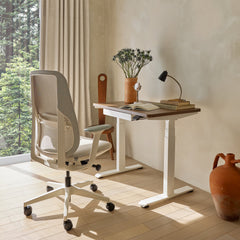
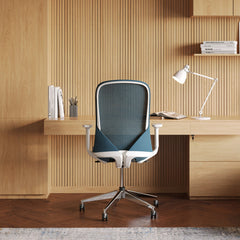

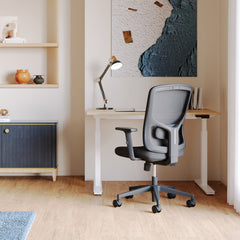
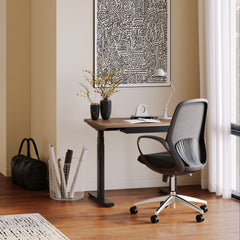






How to Choose an Executive Modern Office Desk Worth Building Your Whole Room Around - Urbanica Furniture's Statement Desk Guide
If you're choosing an executive modern office desk, chances are the rest of the room is going to take its cue from it. I think that's the right way round, because the desk is the first thing I look at when I walk into anyone's office. It's also the biggest choice you'll make in your own office. By the end of this guide, you'll know where your desk should stand, how big to go, and which finish suits your floor.
TLDR
A statement desk is the one you build a room around. I choose the chair, shelves, lamp, and rug to suit it, so I pick the desk with the room in mind before looking at a single product photo.
This guide explains how I choose an executive modern office desk for that job, and which of ours I'd put in each room.
So here's what's coming:
We start at your office door, with where the desk should stand, what a visitor sees first, and what the research says about both.
After that, the size. I'll share the rule I use to match a desk's width to the wall behind it, a quick calculation you can do on your phone, and how deep I'd go for the room.
I'll also go through the top and how its finish works with your floor and your light. The last part walks through our desks one at a time, including a desk two people share and the two round tables that also work as a desk.
By the end, you'll know where the desk goes, what size to order, which finish to pick, and which of ours to build the room around.
Who This Article Is For
- You're furnishing a home office from scratch, and you want the desk to be the piece the room is built around.
- Your desk is going to stand out in the room, in view of the door, rather than pushed up against a wall.
- You can't decide between Light Oak, Walnut, and White, and you want a real reason to pick one.
- You and a partner work from the same room, and you'd like one desk for both of you instead of two.
- You meet people at your desk, and you're wondering whether a round table could be the desk.

Ben P.
Brand Manager, Urbanica Furniture
Author's Note
I've worked from home for over eight years, and my desk is the one thing in my office I've never thought of as just furniture. It's the biggest thing in the room, it's where my whole working day happens, and it's what anyone who looks in from the door sees first.
So I give it more thought than a quick scroll through photos and picking my favorite color, which is how I've seen a lot of desks get chosen.
When a desk has to “carry” the room vibe, there are three things that matter the most:
- Where it stands and what its frame shows from the door
- How big it is next to the wall
- And how its top looks with your floor and your light.
So I will use my personal experience helping clients and deep research to actually try to help you, my dear readers. If you find any value in it, please share it with your friends, colleagues, and anyone choosing a desk to build their whole office around.
Disclaimer: I used AI to help me write and do the research, but I'm editing myself, verifying the facts, and writing my own conclusions and takes.
This article is part of our Build Your Home Office category, about building a room you actually want to work in, and it sits with our articles on statement desks. We have many related articles that go deeper into each piece of that room.
Check the full guide here: How to build a small home office you actually want to work from.
Ok, let's start!
An Executive Modern Office Desk Is Seen from the Doorway First, so Decide Where It Stands Before Anything Else
Your desk is the largest thing in the room, and it's getting most of the attention. That's why I settle where the desk stands before I think about its size or its finish. The spot decides which side of the desk you see, and how much of it.
So I found two studies that really shaped how I think about that first look at a room, and how the table sets the room's tone. One looks at what strangers can tell about you from your room, the other at where people like to sit in one. Here's what each one found and what I do with it.
Strangers Can Read a Lot About You from Your Office, Even When You Are Not in It
Samuel Gosling is a psychologist at the University of Texas at Austin. In a 2002 study he and his colleagues published, eight observers walked through 94 offices at five businesses, including a bank, an architecture firm, and an advertising agency.
The observers never saw the people who worked there. Even the photos and names in the rooms were covered up. The eight observers had to rate each person's personality based only on the office.
The observers' ratings agreed. According to the American Psychological Association, which publishes the journal where the study appeared, the observers were also remarkably accurate on two traits. One trait was how open each person was to new ideas, and the other was how careful and organized each person was.
To judge openness, the observers leaned on cues like distinctive decorating. To judge how organized someone was, they looked at how neat the office was.
Although the study wasn't about desks, think about where those cues sit in most offices. The neat surface, or the cluttered one, is usually the desk, and a distinctive desk is often the first piece of decorating anyone notices.
In my eyes, the biggest piece in the room carries most of that first impression. So when I choose a statement desk, I treat it as the first thing a visitor will judge you by.
Turn the Desk to Face the Door, so the Room Opens up in Front of You
Turning the desk to face the door gives you a clear view of the room, and research on indoor spaces supports wanting that view. Designers call the idea behind it prospect-refuge theory: people are drawn to spots with prospect, a clear view out over the space, and refuge, shelter at their back.
In 2016, Annemarie Dosen and Michael Ostwald synthesized studies that tested the idea. Both are architecture researchers at the University of Newcastle in Australia.
Taken together, they found the evidence mixed and inconsistent. For indoor and urban spaces, though, the studies backed prospect, the view out, and were more neutral about refuge. People tend to prefer places where they can see the space open up in front of them, while having a wall behind them mattered less clearly.
So that's how I place a statement desk: I bring it out from the wall and turn it to face the door. I'm looking across the room at whoever comes in, and a visitor in the doorway sees the front of the desk with me behind it.
A desk facing the door with you behind it is the picture most people have in mind when they say executive desk, and it comes as much from where the desk stands as from the desk itself.
In my guide to building a small home office, I wrote that what you look at while you work matters most, and that the view from the doorway matters less. For the hours you spend working, I still think that's true.
With a statement desk, facing the door means you don't have to choose between the two: you look out over the whole room while you work, and anyone who walks in sees the desk at its best.
Out in the Room, the Frame Is Half of What a Visitor Sees
A desk pushed against a wall hides one side, and its cables drop behind it, out of sight. Bring it out to face the door, and the frame is on show from the front and both sides, so the frame becomes part of the look as much as the top does.
The same goes for the cables. The ones that used to drop out of sight behind a desk against the wall now run in plain view, and our blog has a whole article on under-desk cable management that keeps them hidden.
Our desks offer three frame options.
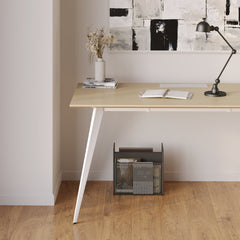
- The Office Desk stands on flared legs that open up the space under the top.
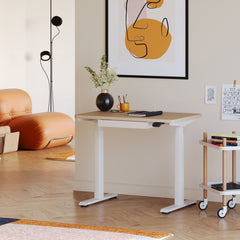
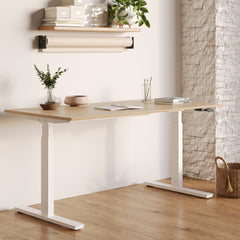
- The Standing Desk and the Mini Standing Desk rise on motorized legs, and our two round tables sit on a single central base.
The frame color determines how loud the desk is. A black frame draws a sharp outline against a pale wall, a white frame fades into a white room so the top looks like it floats, and on the Standing Desk, the Mini, and the Two-Person Standing Desk, a Dusty Blue frame turns the frame itself into the accent.
I bring a statement desk out from the wall and turn it to face the door, so the room opens up in front of me and the desk is the first thing anyone sees.
Size the Desk Against the Wall Behind It, and the Room Will Look Planned Around It
Once the desk faces the door, the wall behind your chair becomes its backdrop. Everyone who looks in sees the desk against that wall, so that wall is what I size the desk against, more than the floor or the room as a whole.
Get the proportion right, and the room looks as if it was planned around the desk. Go too small, and the desk looks like a side table that ended up in the middle of the room. Go too big, and the room seems to shrink around it.
My Rule of Thumb Is Half to Two-Thirds of the Wall's Width
Here's the rule I use, and it's my own rule of thumb rather than a published standard: a statement desk should be between half and two-thirds as wide as the wall behind it. Under half, the wall swallows the desk. Over two-thirds, the desk crowds the corners and you lose the space to walk around it.
To find your range, measure the wall width, then calculate half and two-thirds of it. Here's what that gives you for three common wall widths, against the desk widths we make.
| Wall behind the desk | Half | Two-thirds | Our desks that land in the range |
|---|---|---|---|
| 6 feet (72 inches) | 36 inches | 48 inches | Mini Standing Desk at 36 inches, or a 48-inch Office Desk or Standing Desk |
| 8 feet (96 inches) | 48 inches | 64 inches | Office Desk or Standing Desk at 48 or 60 inches |
| 10 feet (120 inches) | 60 inches | 80 inches | Office Desk or Standing Desk at 60 inches |
I count a desk as in range anywhere from exactly half to exactly two-thirds.
Against an 8-foot wall, both our 48-inch and 60-inch desks fit, but 48 sits right on the bottom edge while 60 sits comfortably inside the range, so I'd start with 60 there. For a 10-foot wall, 60 inches is our only width in range, right at half, and it still leaves room at both ends.
Past 10 feet, even our widest desks fall under half. On a wall that long, I'd pick the 60-inch width with its full 30 inches of depth and bring the desk further out into the room, so it reads as the centerpiece rather than as a desk lost along the wall.
Depth Is What Makes a Desk Look Substantial from the Front
From the door, width is how far the desk spreads across the wall behind it, and depth is how far the top reaches out toward you. Our Office Desk is 24 inches deep in the 48-inch size and 30 inches deep in the 60-inch size. Both sizes of our Standing Desk are 30 inches deep.
Going from 24 to 30 inches deep adds more than it sounds. At 48 inches wide, a 30-inch-deep top covers 10 square feet against 8 for a 24-inch-deep one, so six inches of depth gives you a quarter more desk, and from the door it reads as a desk with real weight to it.
Wherever the room allows it, I'd give a statement desk 30 inches of depth. Where the wall is only 6 feet wide, that points to our Standing Desk at 48 by 30, which keeps the full depth at the smaller width.
Twenty-four inches is the right call when the room itself is small, because a 30-inch top out in a small room takes the floor you need to walk around it. That's where our 36 by 24 Mini Standing Desk earns its place, and I come back to it further down.
Choose the Office Desk Top Against Your Floor First, and Then Against Your Light
With the spot and the size settled, the top is the last big decision. From the door, it's the largest patch of color in the room after the floor and the walls. Our desks come in Light Oak, Walnut, and White, and the Mini also comes in Black.
I choose between those finishes in two steps: the floor first, then the light. Before either step, it helps to know what a workplace safety agency says about how bright each office surface should be.
A Workplace Safety Agency Keeps the Ceiling Brightest and Puts the Desk and Floor in Overlapping Ranges
The Canadian Centre for Occupational Health and Safety (CCOHS) is Canada's federal agency for workplace health and safety, and its site includes a page on office lighting. On that page, CCOHS lists how much of the light hitting each surface should bounce back off it: ceilings 70 to 80 percent, walls 50 percent at most, furniture 25 to 45 percent, and floors 20 to 40 percent.
So the ceiling should be the brightest surface by a clear margin, and the walls are capped at half the light that hits them. The furniture and floor fall into two overlapping ranges. The same CCOHS page adds that work surfaces like a desk should be matte where possible to reduce glare.
Because those two ranges overlap, CCOHS doesn't settle how your desk should look against your floor. For that, I use a rule of my own, which comes next, and it's a looks choice: a White top, or the Mini's black one, sits brighter or darker than the 25 to 45 percent CCOHS suggests for furniture. If you want to stay inside that band, the mid-tone woods come closest. If glare is what worries you, our blog has a whole article on desk finishes that reduce glare and eye strain.
Pick a Top that Clearly Contrasts with Your Floor, Because a Near Match Looks Accidental
My rule for the floor is based on looks alone, not anything CCOHS says. Two woods that almost match look accidental, and two that clearly differ look chosen. So I'd go clearly lighter or clearly darker than your floor, never a shade off it.
On a pale oak floor or light tile, Walnut is the top that stands out, and on a 60-inch Standing Desk or Office Desk set out in the room, it's the finish I'd pick.
On a dark wood floor or a dark carpet, Light Oak or White gives you the contrast instead. On a mid-tone floor, either a light top or a dark one works, so let the light in the room decide.
Our blog compares all three finishes side by side in Office Desk Finishes Compared: Light Oak, Walnut, or White?, if you want to see each one up close.
Let the Light in the Room Settle the Last Choice
CCOHS makes a second point I keep coming back to: daylight is desirable at work, as long as it doesn't cause glare or make the work area too bright. How much of that daylight bounces back up at you from a desktop near a big window depends on the finish.
The light only decides when your floor leaves the choice open, as a mid-tone floor does. In that case, for a bright room with a big window, I lean toward Walnut, the darkest of the three tops on the Office Desk and the Standing Desk, because a darker top reflects less sun.
In a dim room, a north-facing one or a room with one small window, a White or Light Oak top earns its place, because a lighter top lifts the light around the desk and makes the room feel bigger.
That's the last of the three choices: the spot facing the door, the size against the wall, and the top against the floor and the light. Here's how they land on the desks we make.
Our Modern Office Desks, Each Matched to the Room It Can Carry on Its Own
Put those three choices together and, for one person, they point at one of three desks we make. Each one suits a different room, so I've organized them by the room they carry rather than by price, starting with the one I'd build most rooms around.
The 60-Inch Standing Desk Is the One I Would Build Most Rooms Around
When the whole room takes its cue from the desk, I start with the Standing Desk in the 60 by 30 size. It fits comfortably in the space against an 8-foot wall and takes up half the space of a 10-foot one; it's 30 inches deep and gives you both working heights on one top.
Its dual motors take the top from 22 to 44 inches, with four memory presets for the heights you use most. The top comes in any of our three finishes, and the frame in White, Dusty Blue, or Black. Next to the 60-inch Office Desk, it's the one that comes with a Dusty Blue frame, so the frame color can be part of the statement.
In the 60-inch size, the Standing Desk is $690, with the 48 by 30 version at $574 when the wall is 6 feet wide. Its frame and motor carry a 7-year warranty.
For a Fixed Height, the 60-Inch Office Desk Gives You the Cleanest Lines
If you work sitting down, the Office Desk in the 60 by 30 size is the statement desk I'd choose. It stands 30 inches high on flared legs and a powder-coated steel frame, so from the door you see the top over a light, open frame.
The top is scratch-resistant laminated MDF that wipes clean, finished in Light Oak, Walnut, or White, over a Black or White frame. Out in the open on a pale floor, I'd pick Walnut with a Black frame, which creates the strongest outline against a pale wall.
On a dark floor, I'd keep the Black frame and switch the top to Light Oak or White.
The 60 by 30 Office Desk is $479, and the 48 by 24 is $349, which suits a 6-foot wall in a small room. The frame comes with a 10-year warranty.
The Mini Standing Desk Makes the Statement in a Small Room
A small room can still be built around its desk, as long as the desk is in proportion. Half of a 6-foot wall is 36 inches, exactly the width of the Mini Standing Desk, our smallest standing desk, 36 by 24 inches.
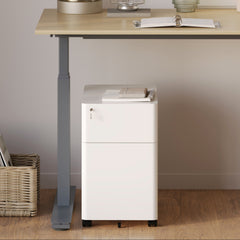
It's motorized, with two memory presets, and it has a built-in drawer that keeps the top clear, which matters on a small desk in plain view. It's also the one desk that adds a Black top to the usual three finishes, with a White, Dusty Blue, or Black frame underneath.
A black top on a black frame, in a white room, makes a small desk look deliberate. The Mini comes to $429 and includes a 10-year warranty on its frame and motor.
Each of the three desks in this section also comes in a bundle with one of our chairs, for less than the two bought separately:
- The Office Desk: the Executive Bundle or the Minimalist Bundle
- The Standing Desk: the Active Bundle
- The Mini: the Coastal Bundle
If you'd rather choose the chair on its own, I wrote about what a chair can and can't do for a lower back.
Two woods that almost match look accidental, and two that clearly differ look chosen.
Ben P., Urbanica
Two People Can Build One Room Around a Shared Desk When They Sit Face to Face
Everything so far assumes one person at the desk. When two of you work in the same room, the statement can be a single shared desk, and I like that better than two desks lined up along a wall, because the room still has one center.
We make two ways to do it. One lets each side move to its own height, while the other sets two of our fixed-height desks face to face.
The Two-Person Standing Desk Gives Each Side Its Own Height on One Frame
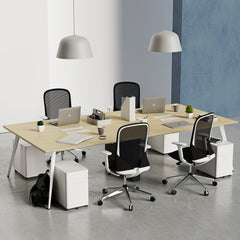
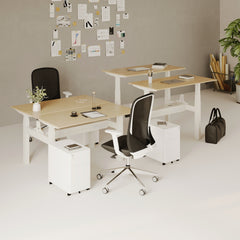
The Two-Person Standing Desk puts two tops face to face on one frame, with each side rising on its own motor. Our photos show it that way: two people facing each other, one side at sitting height and the other raised, and we built it with remote-working couples who share an office in mind.
The whole desk is about five feet across and four feet deep, with four memory presets, in the same three finishes and three frame colors as the Standing Desk. I'd set it with the door off to one side, so you both look across the room, and neither of you sits with your back to whoever comes in.
With a chair on each long side, it needs walking room on both sides, so it suits a room with a real middle. The Two-Person is $1,699 and carries a 7-year warranty.
Two Office Desks Pushed Face to Face Make a Shared Desk that Stays Put
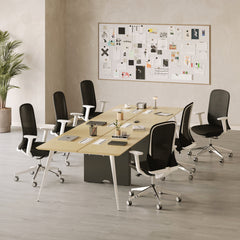
If you both work sitting down, two Office Desks placed face to face make one shared desk. We designed the Office Desk to be used that way. Two 60 by 30 desks give you a 5-foot square top, and two 48 by 24 desks make a 4-foot square.
A pair comes to $958 in the larger size or $698 in the smaller. Order both in the same finish and frame color so the pair reads as one desk from the door.
Between a pair of Office Desks and the Two-Person Standing Desk, then, the deciding question is height. If you both like to stand for part of the day, the Two-Person is worth the extra $741 over the larger pair. If you both sit, the larger pair gives you a bigger top: five feet square versus about five feet by four.
We cover more on rooms like this in our blog post, Dual Desk Setups for Shared Home Offices.
Round Tables Make the Statement Desk for a Room Where People Sit Down with You
A shared desk is built for two people who work at it every day. Some rooms are built for the people who visit (a client, a colleague, or a friend you're helping with something) and for those, I'd look at a round table as the desk.
From the door, a round top on one base in the middle reads as a table you're welcome to pull a chair up to. We make two round tables that make a different statement than a desk you sit behind.
The Round Meeting Table Is the Desk for Working Alongside the People You Meet
The Round Meeting Table has a 48-inch round top, a 30-inch pedestal base, and is designed with home offices, calls, and conversations in mind. Used as your desk, it gives a visitor a seat beside you rather than across from you, with the laptop or papers in front of both of you.
Because people sit all the way round it, it wants open floor on every side, so I'd put it in the middle of the room rather than near a wall. By my rule, its 48 inches suits a 6- to 8-foot wall behind it, but the space around it matters more than the wall.
It comes in our three finishes, on a White or Black base. The Round Meeting Table is $589 and comes with a 10-year warranty.
In a Smaller Room, the Bistro Table at Sitting Height Is the Round Desk
The Bistro Table is the smaller round, a 36-inch top standing on one pedestal column over a flat, round base.
Its top is a foot smaller across than the Round Meeting Table's, so it needs much less open floor around it. Its 36-inch top fits a small room or a corner of the living room, as long as you can pull a chair up on two sides, and at 30 inches high, it's a desk you can work at all day.
The sitting-height Bistro Table is $469 and offers the same top and base options as the Round Meeting Table.
It also comes at 42 inches for tall stools for $535, and I'd use that as a second spot to work in the kitchen rather than as the desk a room is built around.
FAQ
Should a Statement Desk Always Face the Door?
If the room lets you, yes. Facing the door gives you the view across the room that the research on prospect points to, and it gives anyone in the doorway the front of the desk with you behind it.
There are two cases where I turn the desk side-on to the door instead. One is a door that opens onto a busy hallway or the kitchen, where facing it means watching people walk past all day. The other is a desk two people share face to face, because if it faced the door, one of you would sit with your back to it.
In both cases, a side-on desk still lets you catch who comes in out of the corner of your eye.
How Big Should a Statement Desk Be for a Home Office?
Between half and two-thirds of the width of the wall behind it, by my rule of thumb. For a 10-foot wall, that's 60 to 80 inches, so the 60-inch Standing Desk or Office Desk fits.
Then go 30 inches deep wherever the room allows, which makes a desk look substantial from the door, and both of those 60-inch desks are 30 inches deep. In a small room, a 24-inch top like the Mini's keeps the floor open around it.
Which Frame Color Works Best on a Statement Desk?
It depends on how much you want the frame to show. Black draws the strongest outline, White disappears into a white room and lets the top float, and Dusty Blue, on our Standing Desk, Mini Standing Desk, and Two-Person Standing Desk, makes the frame the accent.
My own pick for a desk out in the room, on a pale floor, is a Walnut top on a Black frame. Against a pale wall, it reads clearly from the door.
Can a Round Table Work as Your Everyday Desk?
Yes, for laptop and paper days, especially if people sit down with you. Our Round Meeting Table measures 48 inches across and stands 30 inches high, the same height as our Office Desk, so it works as a desk with room for a second chair.
Give it open floor on every side, because a round table is meant to be walked around. If you work all day on two big screens, a rectangular desk will suit you better.
Send Us a Photo of Your Room from the Doorway, and We Will Pick the Desk to Build It Around
The photo from your doorway is where this whole guide starts, because the order matters most. Stand in the doorway before you choose; decide where the desk stands, measure it against the wall behind it, and pick the top based on your floor and light. The desk that's left at the end is the one to build the room around.
For the rest of the room, my guide to building a small home office you actually want to work from goes through it piece by piece. When you're ready to choose, every desk we make is on our desks page, with shipping free within the 48 contiguous states and 30 days to return it, as our shipping and returns terms set out.
And if you'd rather talk it through with a person, we do that every day. We're Urbanica Furniture, a family-owned business with three decades in furniture manufacturing, at 1705 NW 38th Ave, Lauderhill, FL 33311, at +1-(888)-350-9545.
Send us a photo of your room taken from the doorway, with the width of the wall behind where the desk will go. We'll tell you which desk we'd build the room around, and in which finish.
References
- American Psychological Association press release, March 2002, on the study by Samuel Gosling, Sei Jin Ko, Thomas Mannarelli and Margaret Morris, "A Room with a Cue: Personality Judgments Based on Offices and Bedrooms", Journal of Personality and Social Psychology, published by the American Psychological Association: 94 offices at five businesses (a bank, a real estate firm, a business school, an architecture firm and an advertising agency), eight observers, photos and names covered, raters agreed among themselves and were remarkably accurate at guessing openness and conscientiousness, using cues such as distinctive decorating and neatness. https://www.newswise.com/articles/a-persons-home-and-office-environment-can-reveal-certain-personality-traits
- Annemarie S. Dosen and Michael J. Ostwald, University of Newcastle, Australia, "Evidence for prospect-refuge theory: a meta-analysis of the findings of environmental preference research", City, Territory and Architecture, 2016: urban and interior studies supported the significance of prospect and were more neutral about refuge; the quantitative evidence overall remains inconsistent. https://link.springer.com/article/10.1186/s40410-016-0033-1
- Canadian Centre for Occupational Health and Safety, Lighting Ergonomics: Survey and Solutions: suggested reflectances in a typical office (ceiling 70 to 80 percent, walls 50 percent maximum, furniture 25 to 45 percent, floor 20 to 40 percent) and matte work surfaces to minimize glare. https://www.ccohs.ca/oshanswers/ergonomics/lighting/lighting_survey.html
- Canadian Centre for Occupational Health and Safety, Lighting Ergonomics: General: daylight is desirable in the workplace provided it does not cause glare or make the work area too bright. https://www.ccohs.ca/oshanswers/ergonomics/lighting/lighting_general.html

About the Author
Ben P. I'm the brand manager and marketing director at Urbanica. I've been working from home for over eight years, and I spent the years before that in offices.
I write here about Work-From-Home Lifestyle, home office gear & workstation pro-tips that make those hours better, and ergonomic solutions that help me work for hours without pain:
What helps a back that starts complaining by mid-afternoon, what makes a room worth walking into in the morning, which upgrades turn out to be worth the money, and how a growing team can furnish an office properly. Most of it comes from my own setup and from the questions our customers ask.


