



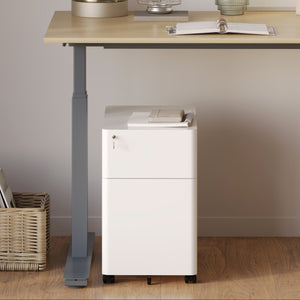






















Filing Cabinet Choices for Cleaner Workstation Planning
Cleaner workstation planning starts with filing storage that matches the desk, document volume, security needs, and daily workflow. Explore how cab...
Learn more
Visit quiz page to see how we makes it easy to create an inspiring workplace


Standing desks have become a core part of modern workspaces, but pairing them with dual monitor arms introduces a layer of complexity that is often underestimated. From our perspective as a furniture brand that designs and supports real office environments, the success of a dual monitor standing desk setup is less about trends and more about structure, physics, and long-term usability. A desk that performs well with a laptop alone can behave very differently once two cantilevered screens are mounted and adjusted dozens of times a day.
What follows is a technically grounded examination of what actually makes a standing desk compatible with dual monitor arms, based on how desks are built, how forces act on them, and how people genuinely work.
Dual monitor arms introduce forces that standard desk use does not. Instead of weight resting flat on the work surface, monitor arms shift mass outward and upward, creating leverage that acts on specific points of the desk.
When two monitors are mounted on arms, much of their combined weight is suspended beyond the rear edge of the desk. This creates rotational force that pulls downward at the mounting point rather than distributing load evenly across the surface. Even relatively lightweight displays can exert meaningful stress once extended or angled.
This effect increases as users reposition monitors throughout the day. Each adjustment slightly shifts the center of gravity, requiring the desk to absorb changing forces without flexing or drifting.
Height-adjustable desks experience motion that fixed desks never do. As the desk travels upward or downward, monitor arms move with it, and forces fluctuate across the frame. Any play in the legs, joints, or fasteners becomes more noticeable during movement.
Over time, desks not designed with repeated motion in mind may develop wobble, uneven lifting behavior, or fatigue at the rear edge where arms are mounted.
Many desks are rated for a certain amount of weight, but those figures usually assume evenly distributed loads. Dual monitor arms concentrate force in a small area and introduce torque rather than simple downward pressure. Understanding this distinction is critical when evaluating whether a standing desk can realistically support dual monitors over the long term.
A desk that works well with dual monitor arms is defined by its construction details. These are foundational elements that determine how the desk behaves under stress, not cosmetic features.
Desktop thickness plays a major role in resisting clamp pressure from monitor arms. Thin surfaces are more likely to compress or deform over time, especially near the rear edge.
Material density matters just as much. Solid wood and well-constructed engineered cores distribute clamp pressure more effectively than low-density composites. The goal is not absolute rigidity, but controlled, predictable performance under load.
Because most monitor arms mount near the back of the desk, rear-edge construction is one of the most important considerations. Reinforced edges or structurally consistent materials help prevent gradual sagging and surface fatigue where clamps apply constant force.
Without sufficient rear-edge strength, even a desk that feels stable initially can lose rigidity after months of regular use.
Grommet mounting can be a clean solution, but it requires careful placement and adequate material around the opening. On standing desks, poorly positioned grommets can weaken the desktop and concentrate stress in ways that reduce long-term durability during repeated height changes.
The frame is the structural backbone of a standing desk. Its geometry and connections determine whether the desk remains stable once dual monitor arms are introduced.
Two-leg frames are common and can perform well when engineered properly, but they are more sensitive to asymmetric loads. Dual monitor arms often create uneven forces from left to right, especially when displays are offset or angled.
Four-leg frames naturally distribute these forces more evenly and resist lateral movement more effectively, particularly in setups where monitor arms are frequently repositioned.
Crossbars reduce racking, which is the side-to-side movement that becomes more noticeable at standing height. Their placement matters. Crossbars positioned too low may not adequately counter torsional forces created by elevated monitor arms.
A stable frame maintains rigidity across the entire height range, not only at seated height.
On height-adjustable desks, lift columns must move in unison. Small inconsistencies can be amplified by the leverage of dual monitor arms. Balanced movement helps monitors stay level and reduces long-term strain on both the desk frame and the arm mechanisms.
Desk size directly affects both ergonomics and stability, not just surface capacity.
Desk depth determines how far monitors can be positioned from the user. Dual monitor arms require sufficient depth to allow proper viewing distance without excessive extension. Shallow desks often force arms into less stable positions, increasing leverage and stress.
Adequate depth also allows for cable routing and accessory placement without crowding the workspace.
Side-by-side monitor setups typically require more width than stacked arrangements. The desk must accommodate arm movement without pushing clamps too close to edges where structural support may be reduced.
Planning for future screen upgrades helps avoid situations where a desk becomes limiting over time.
Standing desks move while cables do not. Proper slack and routing ensure that cords can travel the full height range without pulling on monitors or arms, which could affect stability or alignment.
Different desk categories serve different work styles and spatial needs. Selecting the right type helps ensure long-term compatibility with monitor arms.
In evolving office environments, flexibility matters. Our office desk and table collections are designed to support varied configurations while maintaining structural consistency. This approach allows teams to plan for monitor arms without committing to rigid layouts.
Not every dual monitor setup requires height adjustment. For seated work environments, a standard office desk for computer work can provide a solid foundation for arm-mounted displays when paired with appropriate materials and frame support.
For users who alternate between sitting and standing, an adjustable standing desk workspace must handle both static and dynamic forces. Stability at full height is particularly important, as even minor movement becomes more noticeable once monitors are elevated.
Smaller rooms do not rule out dual monitors, but they require thoughtful planning. A compact sit-stand desk footprint can work effectively when paired with lighter displays and carefully positioned arms, prioritizing balance over maximum reach.
Shared workstations introduce additional variables that must be addressed intentionally.
When two people share a sit-stand workstation, movement on one side can affect the other. A shared standing desk for two users benefits from structural separation that helps isolate loads and preserve stability for both users.
In environments such as studios or operations centers, multiple displays may be mounted across a single structure. A multi-user workstation desk system focuses on distributing load across a broader frame to reduce localized stress and maintain consistent performance.
Even a well-designed desk can underperform if monitor arms are installed incorrectly.
Monitor arm clamps should be tightened enough to prevent movement without compressing the desktop material. Protective pads and manufacturer guidance help preserve surface integrity while maintaining security.
Standing desks require rear clearance, especially with arm-mounted displays. Allowing adequate space prevents collisions at standing height and gives arms room to articulate safely.
As desks move and arms are repositioned, tension settings may need periodic adjustment. Occasional checks help ensure the system remains balanced and responsive over time.
Ergonomics connects structure with daily comfort and productivity.
During transitions between sitting and standing, monitors should remain aligned with eye level. Proper arm adjustment allows displays to move with the desk without frequent manual repositioning.
Balanced angles reduce excessive head rotation and neck strain. Thoughtful spacing and articulation help maintain comfort during long work sessions.
Designing a desk setup for dual monitor arms benefits from hands-on evaluation rather than assumptions.
Testing furniture in person provides clarity that specifications alone cannot. Access to workspace planning support from a local showroom allows teams to assess stability, movement, and compatibility with monitor arms before finalizing decisions.
Dual monitor arms are rarely the final upgrade in a workspace. Displays evolve, workflows change, and expectations increase. A standing desk that performs well today should continue to do so as needs shift.
By focusing on structural integrity, realistic use cases, and honest evaluation of how desks behave under load, it becomes possible to create workstations that remain stable, intentional, and dependable over time. From our perspective, that reliability is what transforms a standing desk from a short-term solution into a lasting foundation for productive work.


You have unlocked free shipping!
You're saving $29 and unlocked free shipping!
Leave a comment