









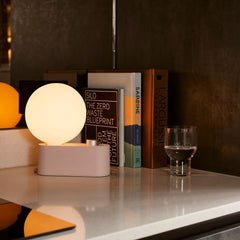
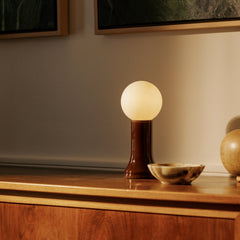


Table Lamp Buying Guide: What to Look For Beyond Just Style
Choosing a table lamp takes more than finding the right style. This buying guide explains how to evaluate lamp height, shade type, brightness...
Learn more
Visit quiz page to see how we makes it easy to create an inspiring workplace


Small desks do not leave room for careless decisions. A monitor that sits too low, a riser with a bulky footprint, or a lamp placed in the wrong corner can turn a compact workspace into a surface that feels cramped, tiring, and visually noisy. In a larger office, these issues may be inconvenient. In a tighter setup, they shape how comfortably the entire workspace functions every day.
The best monitor stand setups for small desks and compact workspaces are not defined by height alone. They succeed because they create useful space, support a healthier viewing position, preserve freedom of movement, and keep the desktop from feeling overloaded. A thoughtful setup makes the desk easier to work at, easier to maintain, and easier to live with, especially in apartments, bedrooms, shared rooms, or multi-purpose home offices where every square inch needs to earn its place.
Compact workstations make every object more consequential. On a wide or deep desk, an oversized monitor base may be a minor annoyance. On a small desk, that same base can steal the space needed for a keyboard, notebook, or comfortable forearm support. The issue is not only how much fits on the desk, but how well the desk still works once everything is placed.
Many people focus on desk width first, but the daily experience of a monitor setup is often determined by depth. A desk can appear wide enough while still forcing the screen too close to the eyes because the monitor base, stand, and accessories occupy the central working zone. This is where shallow desks often fail. The screen sits in the right general location, but the user loses the strip of space needed for writing, resting the wrists, or moving between tasks smoothly.
A successful compact setup protects this front edge of the desk. That is the active task area where most work actually happens. If a monitor stand uses too much of it, the workspace feels crowded even when the number of objects is low.
On a small desk, the monitor usually ends up closer than it would on a deeper desk. That makes vertical positioning more important. If the display sits too low, the user is more likely to angle the head downward for long periods, which can create tension through the neck and shoulders. A raised screen can help correct that, but the way it is raised matters. Some stands solve the viewing-height problem while creating a new space problem at the base.
For users who want more freedom in positioning, an adjustable monitor support arm can be a cleaner solution because it lifts the screen without occupying the center of the desktop in the same way a conventional riser often does.
A cluttered small desk is not always caused by owning too much. Often, it is the result of poor sequencing. When the monitor is placed first without considering lighting, cable path, chair height, or writing clearance, the desk gradually fills with compromises. The workspace may still look styled, but it will not feel easy to use. In smaller environments, practical order matters more than decorative layering.
The best monitor stand setup should be chosen in relation to the desk, not in isolation. The desk determines viewing distance, clamp clearance, edge access, and how much room remains for everything else the workday requires.
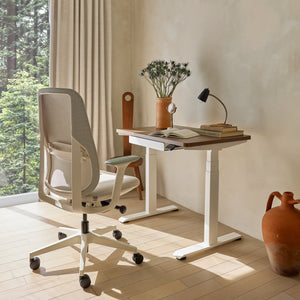
A narrow writing desk behaves differently from a broader office desk. A standing desk may allow more flexibility in posture, but it still needs enough surface area for stable monitor placement and task flow. A corner desk changes sight lines and may improve efficiency in some compact rooms, while a straight desk may offer simpler symmetry and cleaner cable control.
That is why monitor planning works better when considered alongside ergonomic office desks that support the actual shape and rhythm of the space rather than treating the screen as a separate decision.
A small desk does not automatically become efficient just because the screen has been elevated. Some risers are thick, wide, or supported by legs that consume the very area they are meant to free. Others create under-monitor storage that sounds useful in theory but becomes awkward in practice because the shelf is too low, too dark, or too difficult to access during the workday.
The right stand should not simply add height. It should leave the desk more usable than before. That means looking at base design, clearances, and how naturally the stand works with notebooks, keyboards, and lighting.
Compact setups fail quickly when practical details are ignored. A clamp-on arm needs suitable edge access. A desk placed too tightly against a wall may not allow a rear-mounted solution to move properly. A lamp base can interfere with monitor placement, and unmanaged cables can make a minimal surface look chaotic even when the furniture is well chosen.
These issues are not minor finishing touches. In small workspaces, they are core design decisions.
The most effective monitor arrangement depends on how the desk is used. A setup built for long screen-based work will differ from one that must also support writing, sketching, reading, or video calls.
A centered riser works well when the desk is used primarily for computer-based tasks. In this arrangement, the monitor sits in the middle of the desk, raised enough to improve the viewing angle while leaving some storage or open clearance beneath it. This can suit users who prefer a stable, straightforward setup with fewer moving parts.
This layout is often strongest when the monitor is the main object on the desk and when the user does not need to spread papers or tools widely in front of it. For remote work, admin tasks, communication-heavy roles, and everyday digital work, a centered riser can provide order and visual balance.
The desk is used mostly for screen-focused tasks
The user prefers a fixed layout
Under-monitor space is useful for slim essentials
The desktop does not need to support large analog materials
A fixed riser can become restrictive on a very shallow desk because the screen still occupies the center line and cannot move freely. It may also limit flexibility for people who switch often between digital and handwritten work.
When the desk is small and every inch matters, lifting the monitor off the surface entirely is often the most efficient approach. A monitor arm creates a floating effect that clears the central zone and gives the desk a lighter, more open feel. This can make a compact workspace easier to clean, easier to reconfigure, and more comfortable for varied tasks throughout the day.
For users building a tighter workstation, a coordinated monitor and desk accessory collection can help create a more cohesive arrangement instead of mixing pieces that compete for space and visual attention.
The key advantage is recovered depth. Without a bulky monitor base sitting in the middle of the desk, the user gains more room for a keyboard, notebook, or simply a clearer field of movement. This is often the difference between a desk that looks compact and a desk that actually functions well.
A floating-screen setup is not automatically right for every room. The desk edge needs to support the mounting method, rear clearance matters, and the monitor itself must be compatible with the mounting approach. The strongest results come from planning the desk, wall distance, and cable route together.
Many compact workstations need to support more than one mode of work. One moment the desk is used for concentrated computer tasks, and the next it needs to hold a planner, notebook, sketchpad, or printed documents. In this situation, the ideal setup is one that protects a clear working strip at the front of the desk.
The monitor should sit high enough to support a comfortable eye line but not in a way that blocks forward movement or claims unnecessary horizontal space. This is where slim risers, well-proportioned arms, and careful peripheral placement matter. The desk should still welcome hand movement and quick transitions between tools.
Some compact rooms do not have the luxury of a wide uninterrupted wall. Bedroom offices, alcoves, and apartment corners often demand a setup that works with architectural limitations rather than against them. In these environments, an angled monitor arrangement can improve both comfort and space use.
A corner setup can reduce the visual dominance of the screen, create a more tucked-in workstation, and make better use of otherwise underused floor area. The stand or arm in this setup should support the angle cleanly without creating a tangled cable path or pushing the screen into an awkward viewing position.
A monitor stand cannot fix a workstation that is fundamentally mismatched to the body using it. The screen, seat, keyboard, and reach zones have to work together.
A raised monitor only helps when the seated position below it supports the same goal. If the chair is too low, the user may still angle the head upward or forward in an uncomfortable way. If the chair is too high relative to the desk, the shoulders may tense and the arms may lose natural support.
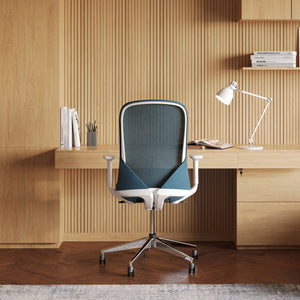
That is why the most effective compact workstations often pair the monitor setup with ergonomic office chairs that help maintain a steadier seated posture and better alignment with the desk surface.
The most frequently used items should remain easy to access without stretching around the monitor. Keyboard, mouse, notebook, pen tray, and daily-use tools belong in the primary zone. Objects used less often can move outward or below the monitor if that space is genuinely usable.
A small desk becomes inefficient when the monitor dominates the center and forces everyday movements into awkward side reaches. The better layout is usually the quieter one, where nothing feels like it has been squeezed in as an afterthought.
Small workspaces often sit inside larger living environments. That changes the role of the desk. It is not only a tool for work but also part of the room’s atmosphere. A monitor stand setup that appears too bulky, over-layered, or mechanically busy can make the whole room feel narrower and less settled.
For many compact spaces, the strongest solution is one that performs well while keeping a lighter visual profile.
Lighting decisions shape both comfort and spatial balance. On small desks, a poorly placed lamp can consume the same valuable area the monitor setup was supposed to save.
A task light should support the work zone, not fight for space with the display. Front-facing lamp placement often creates glare, especially in compact layouts where the distance between objects is limited. Side lighting is usually more effective because it brightens the desk surface while reducing direct reflections on the monitor.
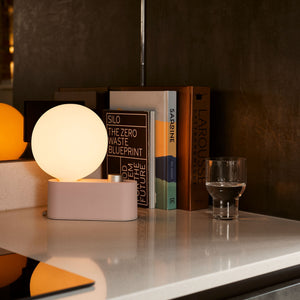
A flexible multi-use LED table and wall light can be especially useful in smaller settings where placement options are limited and lighting needs may shift throughout the day.
Brightness is only part of the story. The visual weight and footprint of a lamp also affect whether the desk feels balanced. A large opaque base can make one side of the workspace feel crowded, even if the monitor arrangement itself is efficient. A lighter-profile fixture can preserve openness while still supporting practical lighting needs.
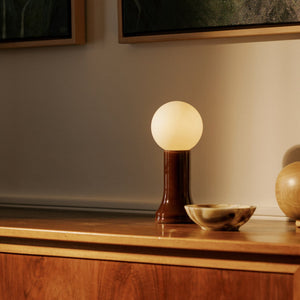
A recycled glass table lamp can suit smaller workspaces where the goal is to introduce light without making the desktop feel overly dense or visually heavy.
The strongest compact setups treat the monitor and the lamp as parts of the same composition. The monitor defines the main sight line. The light supports the adjacent task zone. When both are scaled and positioned thoughtfully, the desk feels calmer and easier to use. When they compete for the same corner, base area, or visual center, the space quickly loses efficiency.
Even well-intentioned monitor upgrades can backfire when the setup is approached as a single-product fix.
Some risers raise the screen but place a long shelf or thick platform directly where the user needs open space. The result is a desk that looks organized from a distance but feels less functional during actual work. Height without space recovery is only a partial improvement.
A monitor, lamp, laptop stand, notebook tray, decorative object, and charging dock may all seem reasonable individually. On a compact desk, however, they can create visual and physical congestion if the layout is not prioritized. A productive setup is usually selective rather than crowded.
The most successful compact desks feel coherent because each piece supports the same purpose. That is also why some users prefer to explore broader modern workspace furniture solutions when shaping a small office, rather than assembling the room from unrelated items that may not fit together spatially or visually.
When deciding between a riser, arm, or hybrid arrangement, it helps to evaluate the desk through a few practical questions.
| Workspace condition | Best general direction | Why it works |
|---|---|---|
| Very shallow desk with limited front-edge space | Monitor arm setup | Frees the center zone and improves flexibility |
| Single-screen desk used mostly for digital work | Slim riser setup | Creates order with minimal complexity |
| Desk used for writing and computer work equally | Hybrid or arm-based setup | Preserves usable task space in front |
| Compact room with awkward angles or corner placement | Corner-optimized support setup | Uses room geometry more efficiently |
| Small desk that also needs a calmer visual profile | Low-bulk stand or arm setup | Reduces perceived clutter and keeps the room balanced |
The best choice is rarely the most elaborate. It is the one that makes the desk easier to use every day, supports a healthier line of sight, and leaves enough room for the work that actually happens there.
The strongest compact workstations do not chase height for its own sake. They create a better relationship between screen position, body posture, lighting, and working space. They leave room for movement. They reduce visual strain. They make the desk feel more intentional and less burdened.
In small workspaces, success comes from restraint, proportion, and thoughtful coordination. A monitor stand should not simply hold a screen higher. It should help the desk perform better as a whole. When the setup respects depth, reach, posture, and balance, even a compact surface can become a workspace that feels composed, comfortable, and genuinely useful.


You have unlocked free shipping!
You're saving $29 and unlocked free shipping!
Leave a comment