



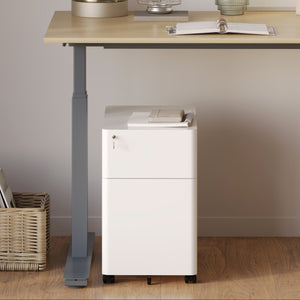






















Filing Cabinet Choices for Cleaner Workstation Planning
Cleaner workstation planning starts with filing storage that matches the desk, document volume, security needs, and daily workflow. Explore how cab...
Learn more
Visit quiz page to see how we makes it easy to create an inspiring workplace


A sore back from an office chair rarely comes from one “bad” chair. At home, it is usually a chain reaction between how you sit, how your chair fits, and what your desk and screen force your body to do. The fastest way to narrow the cause is to notice where the discomfort starts and what position changes calm it down.
A dull ache across the beltline often points to lumbar fatigue. It usually happens when your pelvis rolls backward (a tucked or slouched position), flattening your natural curve. Your low back ends up doing extra stabilizing work while you type, scroll, or lean forward.
A sharper pinch can appear when you sit deep into a chair that does not match your lumbar shape, or when you sit on the edge with your spine unsupported. It can also show up when you repeatedly twist to reach a mouse, a notebook, or a second monitor off to the side.
A burning feeling between the shoulder blades often begins as “just posture,” then turns into back soreness when your upper spine rounds and your ribcage collapses forward. Laptop-only setups often trigger this because the screen pulls your head forward, and your upper back rounds to keep your eyes on the display.
This usually relates to seat shape and pelvic position. If the seat pan is too deep, you slide forward and slump, increasing tailbone pressure. If the front edge is too firm or the height is off, circulation behind the thighs can suffer.
If one side of your low back or mid-back consistently hurts more, look for asymmetry: crossing the same leg, leaning on one armrest, reaching to the mouse on one side, sitting on a wallet, or rotating your torso toward a side screen.
At Urbanica, we think of comfort as support plus freedom to move. A chair that feels plush for five minutes can still create back soreness after an hour if it encourages the wrong mechanics.
Your pelvis is the foundation. When it tilts backward, your lumbar curve flattens. That changes how load is distributed through discs, ligaments, and muscles. The more you lean forward from that slouched base, the more your low back tissues work as a substitute for missing support.
“Perfect posture” held rigidly becomes tiring. When you recline slightly and keep contact with the backrest, the chair shares more of your upper-body load. The goal is not to lock yourself into one position. The goal is to make the supported position the easy default.
No seated position is healthy if it is held without movement. If your setup is correct but you still get sore, the missing ingredient is usually micro-movement. Tiny shifts, brief reclines, and regular standing resets keep tissues from being stressed in the same way for too long.
Most “sore back office chair” complaints trace to one of these fit issues. Each has a quick test and a practical adjustment.
If your seat is too high, your feet lose solid contact and your pelvis tends to tuck under. If it is too low, your knees rise and your hips flex more, which can also encourage tucking.
Fast test: sit back, place both feet flat, and notice whether your knees are roughly level with your hips. If your pelvis feels like it wants to roll backward, height is a prime suspect.
What usually helps: prioritize stable foot contact first. If the desk is high and lowering the chair causes your arms to float upward, use a foot support so your pelvis can stay neutral without raising your shoulders.
Seat depth is often overlooked at home. If the seat pan is too long for your thighs, it presses behind your knees or forces you to slide forward. Sliding forward breaks backrest contact, and your low back starts doing the support job.
Fast test: sit back with your hips fully against the backrest. Check the space behind your knees. You want a small gap so the seat does not press into the knee crease.
What usually helps: if you cannot adjust depth, sit fully back and add support behind your lumbar or mid-back, not behind your hips. Supporting the lumbar area helps you keep contact without pushing you forward.
A backrest can feel soft but still fail to meet your lower back. When that happens, you subconsciously search for comfort by rounding or leaning forward.
Fast test: can you keep gentle lumbar contact while typing with relaxed shoulders? If contact disappears the moment you start working, the backrest is not functionally supporting you in your working posture.
What usually helps: adjust recline tension and angle so the backrest meets you without you having to “pose.” If the chair lacks lumbar shaping, use a small towel roll placed at the natural curve, not at the beltline.
Armrests that are too high cause shoulder shrugging. Armrests that are too far forward pull your shoulders and ribcage forward, and your back compensates.
Fast test: rest your forearms lightly and see whether your shoulders rise or roll forward. Your elbows should feel supported without changing your shoulder position.
What usually helps: lower or widen the armrests. If the armrests cannot be positioned well, it is often better to ignore them and bring the keyboard and mouse closer so your arms can rest on the desk surface without reaching.
A well-built chair cannot fix a desk setup that forces you to reach, hunch, or perch. Chair soreness often improves quickly when desk geometry is corrected.
When a desk is too high, you shrug. When it is too low, you round and reach down. Both patterns can turn into back pain.
If you are refining the foundation of your workspace, our desks and work surfaces collection is a practical reference point for understanding how different desk formats fit different rooms and working styles.
If your shoulders feel “up” while typing, the desk is likely too high relative to your seated position. If your shoulders collapse forward to reach the keyboard, the desk may be too deep, or your chair is positioned too far away.
Your eyes drive your posture. If the screen is low or far, you lean forward, your head follows, and your upper back rounds. That rounded upper back often gets blamed on the chair when the real driver is screen position.
A laptop encourages downward gaze. Consider raising the laptop for screen height and using an external keyboard and mouse when possible. If that is not available, shorten your work blocks and add more posture variation.
When the mouse is far away, you slide forward to reach it. Sliding forward breaks lumbar contact, and your low back gets loaded. Bringing the mouse closer can sometimes fix “chair pain” in one move.
A good setup follows an order. If you start with armrests or lumbar first, you often chase symptoms instead of fixing the foundation.
Feet flat, weight evenly distributed. Knees comfortable and not forced upward. Pelvis neutral, not tucked under.
Lumbar support should feel like contact, not a shove. If you feel forced into an exaggerated arch, back off the support or change the recline so contact is softer.
A slight recline with appropriate tension helps the chair share the load. Your goal is to type without your torso constantly fighting gravity.
Armrests should support forearms without lifting shoulders. If you cannot achieve that, lower them and rest more on the desk surface.
Take a slow breath. If your chest feels cramped, your posture is likely rigid or slouched. The supported position should allow easy breathing.
1. Sit all the way back so hips contact the backrest.
2. Place both feet flat; add foot support if feet cannot plant comfortably.
3. Adjust seat height until knees feel easy and stable.
4. Set recline so you can lean back slightly without losing control.
5. Adjust tension so the backrest follows you, not fights you.
6. Set lumbar contact to “gentle support,” not “hard pressure.”
7. Bring your chair close enough that elbows are near your sides when typing.
8. Position armrests so forearms are supported without shrugging.
9. Center the monitor so you do not twist your torso.
10. Do one minute of small movement: micro recline, reset to neutral, repeat.
Not everyone has an adjustable task chair at home. You can still improve back comfort by solving the core mechanics.
A small rolled towel can help if it is placed at the natural curve of the low back. If it is too large or too low, it can push your pelvis forward and increase discomfort.
Aim for contact at the curve above the beltline. You should feel supported while typing, not only while leaning back.
When the desk is high, many people raise the chair to match. That can leave feet dangling or lightly touching the floor, which destabilizes the pelvis. A stable foot support can restore a neutral pelvis without changing your desk.
If the seat is long, do not perch at the edge. Instead, sit back and add lumbar support so your back stays in contact. If you must sit forward for certain tasks, rotate that posture with a supported reclined posture, not one fixed position.
If you raise a monitor or laptop, make the stack stable and wide. Avoid tall, narrow stacks that wobble. The goal is a safer viewing angle that reduces forward head posture.
Home offices often rely on whatever seating is available. Each option can work, but each needs guardrails.
Dining chairs often lack lumbar shaping and recline. They can be fine for shorter blocks, but long focus sessions can lead to slouching and lumbar fatigue.
Add gentle lumbar support.
Ensure feet are stable.
Bring the keyboard closer to reduce forward reach.
Stand and reset more frequently.
Soft seating encourages posterior pelvic tilt. That can feel relaxing while it is happening, then show up later as low-back soreness. If you must use a sofa, sit upright with support behind the lumbar area and keep work blocks shorter.
Variety is valuable, especially when the chair cannot be fully tuned. A compact surface can make it easier to do short standing tasks, quick calls, or reading sessions.
If you like the idea of a smaller alternate zone, the Bistro Table height options show a simple way to think about table height as a tool for posture variation, especially when you want a separate spot for short standing work blocks.
At Urbanica, we focus on features that support the way people actually work at home: typing, video calls, brief reclines, and frequent reach patterns. Features only matter if they help you maintain support while doing the task, not only in a showroom pose.
The best back support is the support you can keep while your hands are on the keyboard. When lumbar shaping and recline mechanics work together, it is easier to stay supported without bracing.
For an example of a chair built around multi-point adjustability, see the Novo Chair nine-point adjustment design, which highlights extensive adjustment points and 4D armrest control.
A chair can be ergonomic in theory and still fail in a real home office if the adjustment range does not match your desk height, your torso length, or how you sit during focused tasks.
If you want a reference for a chair positioned around adjustability and form, the Muse Chair six-point adjustment system is a useful example of a design that emphasizes multiple adjustment controls.
A solid ergonomic baseline usually includes breathable support, functional lumbar contact, and armrests that can be positioned to reduce shoulder strain. That baseline helps many people, but it still needs correct setup and movement.
For a straightforward reference point, the Onyx Chair BIFMA certification details highlight standards and core ergonomic features like lumbar support and adjustable armrests.
Breathable materials can reduce heat buildup and encourage small posture shifts instead of locking into one position. Pressure distribution matters too, since discomfort often triggers slouching as your body searches for relief.
If you are comparing breathable options, the Seashell Chair breathable mesh features provide a clear example of a mesh-forward design with lumbar support.
Choosing a chair is easier when you start with the trigger pattern rather than the label “ergonomic.”
Prioritize seat depth fit, a backrest that supports you while typing, and a recline that makes supported posture feel natural.
Perching is often a desk reach problem. Solve mouse and keyboard distance first, then ensure the chair height allows stable foot contact.
Look for recline and tension that encourage movement. A chair that supports gentle motion often reduces the feeling that you must hold yourself up all day.
Check seat height, seat depth, and pelvic tuck. Tailbone pressure often improves when you sit back with lumbar contact and stable feet.
A simple way to see options side by side is to browse an organized selection and filter by the chair type that matches your needs. Our Urbanica office chair collection can help you compare chair formats and decide what level of adjustability makes sense for your home setup.
Even the best setup needs movement. The goal is not to “exercise at your desk.” The goal is to change load patterns before your back complains.
Small recline cycles: lean back a little, hold for a breath, return to neutral.
Shoulder reset: drop shoulders, gently squeeze shoulder blades, release.
Hip reset: plant both feet, lightly press through heels, relax.
If you are on a call, do a gentle recline and return every few minutes. Keep feet planted. Keep your gaze steady. Most people never notice, but your back will.
Stand up, place hands on the desk lightly, step one foot back, and gently straighten that hip. Switch sides. This counters prolonged hip flexion from sitting.
Sit tall, clasp hands behind your head, and gently lift your chest without flaring ribs aggressively. The goal is a small extension through the upper back.
| Symptom that shows up at home | Most common setup cause | Fastest realistic fix | Why it helps |
|---|---|---|---|
| Low-back ache after typing | Pelvic tuck, lost lumbar contact | Foot stability plus gentle lumbar contact | Restores a neutral base so the backrest can share load |
| Mid-back burn near shoulder blades | Screen too low, forward head posture | Raise screen, shorten reach to keyboard | Reduces thoracic rounding and ribcage collapse |
| Tailbone pressure | Sliding forward, seat too deep | Sit fully back with lumbar support | Shifts pressure off tailbone by improving pelvic position |
| One-sided soreness | Asymmetrical reach or twist | Center the monitor, bring mouse closer | Reduces repetitive rotation and side-bending load |
| Shoulder tension that turns into back pain | Armrests too high or too far forward | Lower armrests, support forearms without shrugging | Stops shoulders from dragging the spine forward |
Ergonomic changes should feel directionally better. If symptoms are intense, unusual, or worsening, it is worth getting clinical input.
Pain with numbness, tingling, or weakness into an arm or leg
Symptoms that radiate below the knee or into the hand consistently
New bladder or bowel changes
Fever, unexplained weight loss, or night pain that does not change with position
Pain after a fall or injury
Bring a simple timeline of what triggers pain, what relieves it, and what your typical day looks like. Note whether the pain changes with standing, walking, or lying down. Mention your desk height, monitor position, and whether you work on a laptop.
Home workdays rarely look the same from morning to evening. A resilient setup supports different work modes so you do not end up stuck in one posture for everything.
Deep work mode: your most supportive chair position with the monitor centered and the keyboard close.
Call mode: a slightly more reclined, supported posture with relaxed shoulders.
Quick task mode: a short standing block for reading, planning, or light admin work.
Back comfort improves most reliably when three pieces work together:
1. Chair fit that supports your pelvis and back during real typing posture.
2. Desk geometry that prevents reaching and hunching.
3. Movement cadence that changes load patterns throughout the day.
Start by correcting what you already have: chair distance, foot stability, screen height, and reach. If you decide to upgrade furniture later, choose pieces that make the supportive posture easier to maintain, not pieces that promise to “fix” your back. The best home office is the one that supports how you work today and still makes it easy to move tomorrow.


You have unlocked free shipping!
You're saving $29 and unlocked free shipping!
Leave a comment