























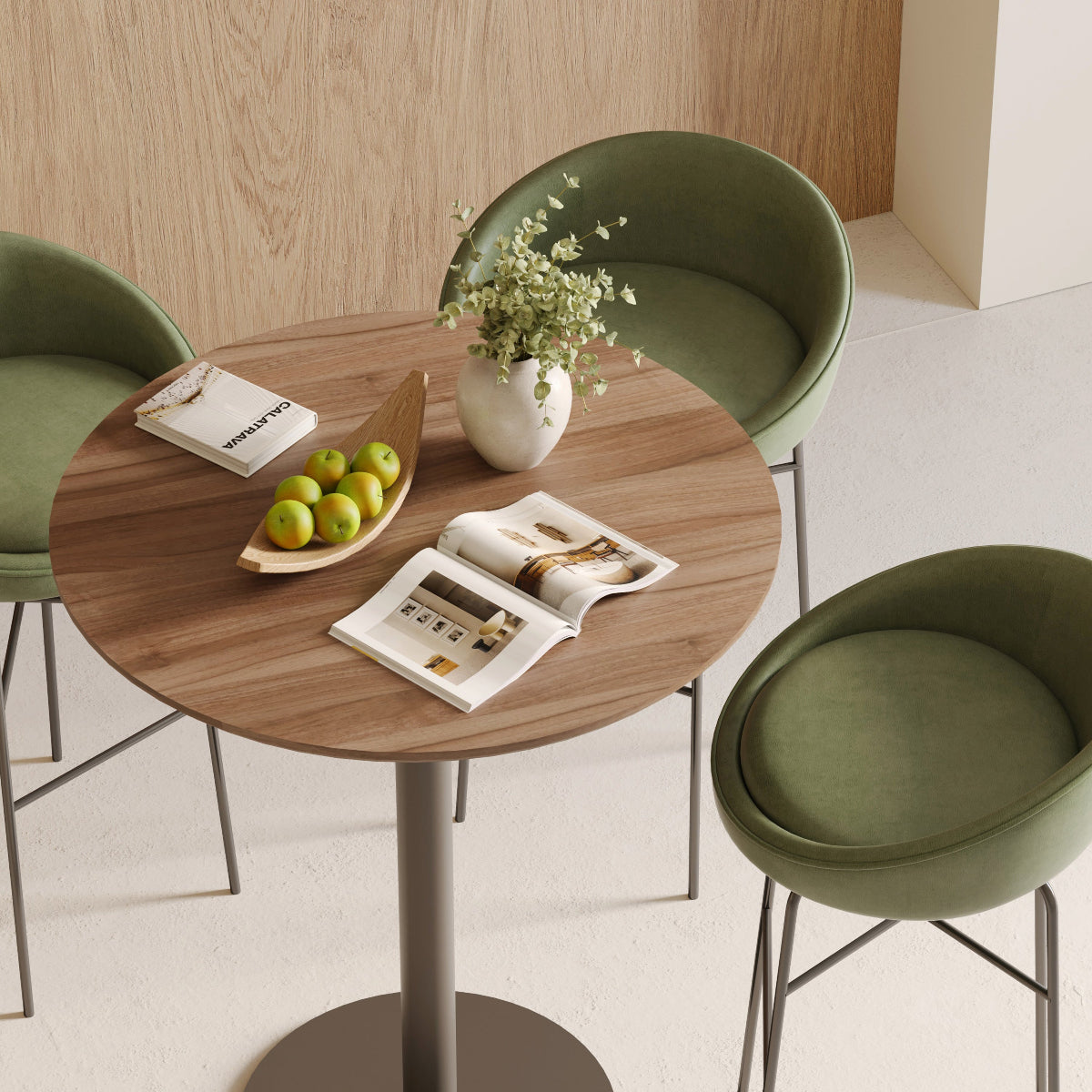
Make Small Shared Spaces Work Better With a Bistro Table

Small shared spaces often struggle because one room is expected to perform several jobs. A compact office corner may need to support coffee breaks, laptop work, quick conversations, informal meetings, and occasional meals. An apartment nook may shift between dining, remote work, hobbies, and social time within the same day.
Adding more furniture rarely solves the problem. It usually reduces circulation and makes each activity harder. A better approach is to choose one adaptable surface, place it carefully, and support it with seating and accessories that can be reset quickly.
A round bistro table with seated and standing height options can provide that flexible center. A round top supports face-to-face interaction, while the choice of table height lets the surrounding space lean toward seated comfort or brief standing collaboration. The result depends on more than the table itself. Scale, clearance, seating, storage, acoustics, and shared-use expectations all determine whether the area feels useful or crowded. A Bistro Table Helps One Small Space Support Several Activities
Compact shared rooms rarely have a single purpose. Even when a space is labeled as a break room, meeting corner, kitchen nook, or touchdown area, people usually use it in several ways.
A bistro table can accommodate these overlapping activities because it creates a defined surface without imposing the visual or physical weight of a large conference table. It gives people a recognizable place to gather while preserving more of the surrounding floor.
Multipurpose Rooms Need Adaptable Furniture
Specialized furniture works well when a room has one predictable function. A formal meeting table belongs in a dedicated conference room. A full workstation belongs in an assigned work area. Small shared spaces are different because their function may change from one hour to the next.
A bistro table might support:
-
Morning coffee and casual conversation
-
A short laptop session between meetings
-
A one-on-one employee check-in
-
Lunch for one or two people
-
A quick review of printed materials
-
A brief standing discussion
-
A temporary place to sort supplies
These uses do not require the same seating arrangement, equipment, or level of privacy. The table therefore needs to remain easy to approach, use, and clear.
A Round Top Improves Flow in Tight Layouts
Rectangular tables can create useful linear work surfaces, but their corners may project into walkways or make a narrow room feel more confined. A round tabletop creates a softer circulation pattern because people can move around its curved edge without navigating sharp corners.
The shape also supports balanced interaction. There is no visually dominant head position, so a conversation between two or three people tends to feel more direct and informal. Everyone has similar access to the center of the surface, which is useful for shared notes, samples, drinks, or a single laptop.
Round does not automatically mean space-saving, however. The table still needs enough surrounding clearance for chairs, people, and normal movement. Its advantage comes from smoother circulation and a more compact social footprint, not from eliminating the need to measure.
Flexibility Depends on How Quickly the Table Can Be Reset
A shared table is only flexible when it can change functions without a complicated setup. If users must move monitors, untangle cables, relocate personal belongings, or search for missing chairs, the table has effectively become a permanent workstation.
A practical bistro area should be reset in a few simple actions. Personal items leave with the user. Shared accessories return to nearby storage. Chairs move back into position. The surface remains ready for the next activity.
Measure the Bistro Table’s Full Operational Footprint
Product dimensions describe the table, not the entire area needed to use it. The true footprint includes the tabletop, base, seating, occupied chair depth, and surrounding circulation.
A table can fit neatly into an empty corner and still become an obstruction once people sit down. Accurate planning begins with movement, not furniture placement alone.
Account for Seating and Passage Space
A tucked-in chair creates an incomplete picture. When occupied, the chair moves away from the table and the person’s body extends farther into the room. Another user may also need to pass behind the seated person.
Test Chair Pullback in Real Conditions
Place an existing chair where the proposed seating will go, then sit in it naturally. Avoid holding the chair unusually close to the table just to make the layout appear workable.
Check whether another person can pass without asking the seated user to move. In a very small room, occasional negotiation may be acceptable. Constant conflict usually means the furniture is too large, there are too many chairs, or the table needs a different orientation.
Include Doors, Drawers, and Equipment Access
Clearance conflicts often come from nearby objects rather than the table itself. Refrigerator doors, filing drawers, cabinets, trash bins, printers, supply closets, and room doors all need usable approach space.
A bistro table should not require repeated furniture movement whenever someone wants to reach storage or use an appliance. That friction makes the shared room feel smaller than it is.
Use a Floor-Tape Test Before Finalizing the Layout
A simple physical mockup can reveal problems that are difficult to see on a floor plan.
1. Measure the narrowest and widest parts of the proposed area.
2. Mark the tabletop diameter on the floor with painter’s tape.
3. Position chairs, stools, or boxes where the seating will sit.
4. Move the seating outward to represent occupied positions.
5. Open every nearby door, drawer, and cabinet.
6. Walk each normal route through the room.
7. Test the setup with the number of people expected to use it regularly.
Plan for everyday occupancy rather than the largest group that might appear occasionally. Two well-positioned chairs are often more useful than four chairs that continually block circulation. Additional lightweight seating can remain nearby for infrequent overflow.
Table Height Determines How the Shared Area Feels and Functions
Bistro tables are commonly associated with casual settings, but table height changes the character of the space significantly. A seated table invites people to settle in. A standing-height surface encourages shorter, more active interaction.
The right choice comes from identifying the room’s dominant behavior.
Seated Height Supports Longer and More Varied Use
A standard-height bistro table is generally more suitable when people will eat, write, work on a laptop, review documents, or remain in conversation for an extended period. It provides a familiar relationship between the tabletop and conventional seating.
Seated height also gives the space broader functional range. The same surface can serve as a dining table in the morning, a shared work area in the afternoon, and a conversation spot later in the day.
Accessible Use Should Be Considered Early
A standing table should not be the only shared surface when the room needs to accommodate people with different mobility needs. Seated access, comfortable approach space, and appropriate chair placement should be part of the initial layout rather than treated as later additions.
Accessibility is not only about meeting a minimum dimension. It is also about making the shared area intuitive and dignified to use.
Standing Height Encourages Brief, Focused Interaction
A taller bistro table works well for quick check-ins, coffee stops, spontaneous brainstorming, and transitional areas. People can gather without pulling out chairs, which may reduce clutter and make the zone easier to enter and leave.
Standing configurations are especially useful when the table is intended as an alternative to holding a conversation beside someone’s desk. The group can move to a neutral surface, address the immediate topic, and return to focused work.
Stools should be added selectively. Surrounding a standing table with permanent seating can consume as much floor space as a seated arrangement while making the area less accessible.
Seating and Accessories Must Protect the Table’s Compact Footprint
A small table can be overwhelmed by the wrong supporting pieces. Wide armchairs, deep rolling chairs, oversized stools, and permanent equipment may turn a compact surface into a crowded furniture cluster.
Every item around the table should support the intended activity without making other activities more difficult.
Choose Chairs by Total Size, Not Visual Lightness
A chair may appear slim in a photograph while still requiring substantial floor space. Armrests, angled legs, swivel movement, casters, and seat depth all influence how the chair behaves in the room.
For short coffee breaks, lightweight seating may be sufficient. When the area regularly supports longer conversations or presentations, a conference chair designed for collaborative rooms may provide a more appropriate level of support. The linked seating is presented for meeting rooms and collaborative spaces, so it belongs in layouts where sitting comfort matters more than extreme compactness.
Proportion remains essential. A supportive chair that cannot move comfortably around the table is not the right chair for that particular room.
Turn the Table Into a Temporary Touchdown Workspace
A bistro table can support laptop work, but it should remain a shared surface rather than becoming one person’s permanent desk. This type of short-duration work area is often called a touchdown space because users arrive, complete a defined task, and move on.
A compact accessory can improve the setup without occupying the table indefinitely. An anodized aluminum laptop stand raises the computer from the surface and can be stored when the table returns to dining, conversation, or meeting use. The linked stand is made from anodized aluminum and is designed to improve laptop positioning for comfort and focus.
Keep Technology Removable
Permanent monitors, docking stations, and tangled charging cables reduce flexibility. Shared power accessories should be easy to store, and cords should never cross a normal walking route.
A laptop stand can improve screen position, but it does not make a compact shared table equivalent to a dedicated ergonomic workstation. Longer computer sessions may still require an appropriate desk, adjustable seating, and separate input devices.
Establish a Clear-Surface Standard
A simple shared-space rule prevents gradual clutter:
-
Personal items leave with the user.
-
Shared tools return to assigned storage.
-
Food and drink are cleared after use.
-
Chairs are returned to their intended positions.
-
The tabletop is not used as long-term storage.
These expectations protect the table’s multipurpose role without requiring complicated scheduling.
Choose Between a Bistro Table and a Round Meeting Table by Use Case
A bistro table and a meeting table can look similar in a product image, especially when both have round tops. Their spatial roles are different.
A bistro table prioritizes flexibility and lighter use. A meeting table provides more surface area for scheduled collaboration, shared documents, and predictable seating.
| Planning factor | Bistro table | Round meeting table |
|---|---|---|
| Primary activity | Coffee, short work sessions, informal conversation | Recurring meetings and collaborative work |
| Typical room role | Multipurpose shared zone | Defined meeting area |
| Surface capacity | Personal items and limited shared materials | Multiple devices, documents, and group materials |
| Seating approach | Flexible and often minimal | More consistent seating arrangement |
| Circulation priority | Preserve movement around a compact area | Provide enough room for longer seated use |
| Best fit | Break areas, office edges, small nooks | Huddle rooms and dedicated discussion areas |
Use a Bistro Table When Adaptability Comes First
A bistro table is usually the stronger choice when no single activity should control the room. It can occupy an office kitchen corner, reception edge, multipurpose nook, or informal collaboration zone without making the area feel like a formal conference room.
Its smaller surface also encourages users to bring only what they need. That limitation can be useful for brief meetings because it keeps the interaction focused and reduces the tendency to spread materials across the room.
Move Up to a Meeting Table When Group Work Is the Main Purpose
When several people regularly need space for notebooks, laptops, samples, or printed documents, a larger surface may be justified. A 48-inch round meeting table provides a clearer meeting-room function than a smaller bistro configuration. The linked table is listed with a 48-inch round surface at standard seated height.
The larger option should earn its footprint through regular use. Choosing it for a rare group gathering may leave the room burdened by excess furniture every other day.
Position the Bistro Table as a Satellite to Primary Work Areas
In an office, the bistro table should complement assigned desks rather than compete with them. Its role is to absorb informal activity that would otherwise interrupt focused work.
Placement determines whether the table reduces disruption or simply moves the disruption closer to other employees.
Separate Quick Conversations From Concentration Zones
Avoid placing the table directly behind seated workers or beside monitors containing sensitive information. Conversations feel louder when they occur within a person’s immediate working radius, even when the speakers are using normal voices.
A useful collaboration satellite sits close enough to reach easily but far enough away to signal a change of activity. Employees can leave their desks for a brief discussion, use the table as a neutral gathering point, and return without booking a formal room.
This arrangement works particularly well near a six-person workstation configured for larger teams. The linked workstation is designed as a shared desk system for six users and can serve as the primary focus area, while the bistro table handles shorter exchanges nearby.
Control Noise Before Adding More Furniture
Distance and orientation should be the first acoustic tools. Face the gathering area away from focused employees, avoid directing conversation into enclosed corners, and keep the table out of narrow passages where sound and traffic collect.
Where additional definition is useful, modular panels for defining work zones can help create separation without constructing a permanent wall. The linked collection presents panels as tools for supporting focus, reducing noise, and organizing work areas while maintaining openness.
Keep Boundaries Light and Legible
Panels should guide sightlines and soften distraction, not surround the bistro table on every side. An enclosed arrangement can make a small area feel cramped and may discourage spontaneous use.
A pendant light, area rug, wall color, or change in furniture orientation can also define the zone. These visual signals help people understand where conversation is welcome without adding more floor-consuming objects.
Three Bistro Table Layouts for Small Shared Spaces
The same table can behave differently depending on its location. A successful layout responds to the room’s traffic pattern, primary activity, and expected duration of use.
Office Kitchen and Break-Area Corner
Keep Seating Outside the Preparation Path
Place the table beyond the active route between the refrigerator, sink, coffee station, cabinets, and waste bin. Someone seated at the table should not prevent another person from preparing food or cleaning up.
A seated configuration usually works best when meals and longer breaks are common. Limit the number of everyday chairs to normal demand, and select seating that can tuck close to the table when unused.
Nearby wall-mounted storage can hold napkins, supplies, and small appliances without occupying the tabletop or requiring another floor cabinet.
Open-Office Collaboration Edge
Encourage Short Discussions Without Blocking Desks
A standing-height bistro table can create an effective huddle point at the perimeter of an open office. Keep it visible and easy to approach, but avoid placing it inside the main workstation aisle.
The table should support quick decisions, project updates, and spontaneous problem-solving. It should not become an overflow desk covered with unattended laptops and documents.
Where conversations may run longer, provide access to nearby seated space rather than surrounding the standing table with numerous stools.
Apartment or Studio Multipurpose Nook
Make the Table Easy to Transition Between Roles
A seated bistro table can move between breakfast, remote work, creative projects, and evening conversation. The key is giving work equipment a separate home.
Store chargers, notebooks, headphones, and computer accessories in a portable container or nearby cabinet. When work ends, the container leaves the table and the room changes function without a major reset.
Lighting can support the transition. Focused light helps during work or hobbies, while softer ambient lighting allows the same furniture arrangement to feel more social.
Visual Coordination Makes the Bistro Area Feel Deliberate
Furniture does not need identical colors or finishes to feel cohesive. A small shared space often looks more considered when pieces relate through scale, visual weight, material tone, and shape.
A delicate table paired with oversized chairs may feel unbalanced. A compact table beside very heavy storage may appear temporary or misplaced. Coordination helps the bistro zone read as part of the room rather than furniture placed in leftover space.
Match Proportions Before Matching Finishes
Begin with physical relationships. Table height should suit the chairs. Chair width should suit the tabletop. The base should allow comfortable leg placement. Nearby furniture should leave the table visually accessible.
Then consider finishes. Repeating one or two elements, such as a light wood tone, black frame, white surface, or softened edge profile, can connect the table to the larger setting without creating a rigid matched set.
A broader collection of modern ergonomic office furniture can help maintain that relationship across desks, chairs, accessories, and shared surfaces. The linked page presents coordinated workplace furniture for creative, professional, and flexible office environments without limiting the selection to a single product category.
Let Real Behavior Refine the Layout
Even careful planning cannot predict every movement. After the table is in use, observe how people approach it, where chairs drift, whether conversations disturb nearby work, and which activities occur most often.
Small adjustments may solve problems more effectively than adding furniture. Rotating the table, removing one chair, relocating shared supplies, or changing the direction people face can improve circulation and comfort.
A bistro table works best when the surrounding space remains responsive rather than fixed.
A Thoughtfully Planned Bistro Table Becomes a Flexible Shared-Space Center
The most useful small rooms are not the ones containing the most furniture. They are the ones where each piece supports several realistic needs without obstructing movement or confusing the room’s purpose.
A well-placed bistro table can create a natural center for conversation, breaks, temporary work, and informal collaboration. Its success comes from choosing the right height, allowing enough clearance, pairing it with proportionate seating, controlling clutter, and positioning it in relation to surrounding activity.
When those decisions work together, the table does more than fill an empty corner. It gives the shared space a clear, adaptable role throughout the day.
Related Articles
-
 This Is How To Build A Small Home Office You Actually Want To Work From, And How To Pick Desks For Small Spaces - Urbanica Furniture's Full Guide
-
 Filing Cabinets for Small Spaces That Still Look Clean Now
-
 Minimalist Office Table Ideas That Work Like a Bistro Table
-
 Best Filing Cabinet Layout Ideas for Small Home Offices and Shared Rooms
-
 What Size Filing Cabinet Makes Sense for Small Workspaces?
-
 Best Laptop Stand Ideas for Flexible Workspaces and Multi-Use Rooms


