















Skip to content
For Teams
We sell direct. You save big. Premium Ergonomic Office Furniture| Free Shipping on Orders $65+
FAQ
need to know

Useful articles

Standing Desks That Work with Dual Monitor Arms: What to Measure First

Standing Desks That Work with Dual Monitor Arms: What to Measure First

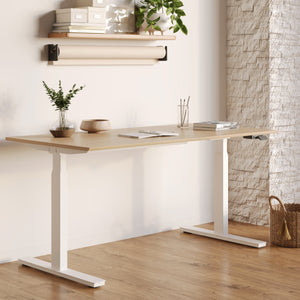
Adjustable height standing desk with stable frame

A dual-monitor setup can either make a standing desk feel precise and productive or turn it into a daily compromise. The difference usually comes down to measurement. Screen size matters, but it is rarely the first thing that determines whether the setup will feel stable, comfortable, and easy to use. What matters more is how the monitors, the arm, the desk edge, the work surface, and the user’s posture all interact once the desk begins moving up and down.

That interaction becomes more important with dual monitor arms because the load is no longer resting evenly across the desktop. It is being held at one or two concentrated mounting points, often near the back edge, while the desk itself changes height throughout the day. A height-adjustable desk needs to support not only the weight of the displays, but also the extra leverage and motion created by the arm system. That is why the desk should be treated as part of the monitor-mounting system, not just the surface beneath it. Height-adjustable standing desk options are built around movement, but the setup still depends on measuring the full workstation correctly before anything is mounted. 

Why dual monitor arms change the way a standing desk should be chosen

A standing desk and a dual arm need to be planned as one system

A dual-monitor arm changes the buying criteria immediately. With standard monitor stands, most of the load sits directly on the desktop, and adjustments are relatively limited. With a mounted arm, the desk edge, top thickness, rear clearance, and frame stability all become critical. If one of those pieces is overlooked, the workstation can feel crowded, shaky, or awkward to adjust even when every individual component looks good on its own.

This is where many setups go wrong. Buyers often compare screen sizes, desktop widths, and visual style first, then think about mounting later. In practice, the order should be reversed. The first question is whether the desk can physically and ergonomically support the arm system you want to use.

Movement reveals problems that a static setup can hide

A seated desk that feels acceptable can behave very differently when raised. A small amount of flex in the worksurface or slight vibration in the frame can become more noticeable once monitors are elevated and suspended on arms. That does not mean every dual-monitor setup needs an oversized desk. It means the right measurement sequence helps avoid guessing and prevents a setup that technically fits but never feels truly settled.

Measure the full monitor layout before choosing desktop width and depth

Screen size is not the same as real working span

The first number to measure is not the listed size of each display. It is the full width of both monitors at your actual working angle. Two 27-inch displays can take up very different amounts of horizontal space depending on bezels, curve, stand-off distance from the arm joint, and how sharply the panels are angled inward.

For a realistic number, place both monitors in the position you actually prefer and measure from the far left edge of one screen to the far right edge of the other. That measurement tells you how much horizontal zone the monitors will occupy above the desk. It also helps you decide whether you want a symmetrical layout or a primary-and-secondary layout with one screen centered and the other angled beside it.

Viewing depth affects comfort more than buyers expect

Depth is often underestimated because the arm mount sits behind the screen, not under it. Once the monitors are mounted, the display plane may move closer or farther from you than expected depending on the arm’s reach and the desk’s back-edge placement. That changes how much room is left for the keyboard, mouse, notebook, and wrist support.

A shallow desk can force the screens too close to your eyes or push the keyboard too close to the front edge. A desk with better depth gives you more room to balance viewing comfort with working posture. When comparing adjustable desk collections, it helps to think beyond whether the monitors will physically fit and instead focus on whether the working distance will still feel natural once the arm is installed. 

Reserve space for everything that shares the surface

Dual monitors rarely sit alone. Most workstations also need room for a keyboard, mouse, charging area, notebook, task light, speakers, webcam accessories, or a docked laptop. These tools may not need much room individually, but together they determine whether the desk feels clean or overpacked.

A useful rule is to measure three horizontal zones:

1. The monitor footprint above the desk

2. The active work zone in front of the screens

3. The accessory zone to the left, right, or rear

When those zones are defined early, it becomes easier to choose desk dimensions that support real work instead of just display placement.

Rear-edge compatibility is often the first hard stop

Clamp clearance decides whether the arm can be installed at all

One of the most common oversights is rear-edge access. A monitor arm clamp needs unobstructed space not only on top of the desk, but also beneath the rear edge. Walls, cable channels, privacy panels, back rails, or decorative edge shapes can interfere with installation even when the desktop itself looks wide enough.

This is especially important in smaller offices where the desk sits close to a wall. Even a good monitor arm can become difficult to mount or adjust if there is not enough room for the clamp body, the arm column, and hand access during installation. Measure the open area behind the desk and check the underside as carefully as the top.

Desktop thickness and edge shape affect clamp stability

The clamp has to match the actual thickness of the worksurface at the mounting point. Flat edges are usually the simplest to work with, but beveled or rounded undersides can reduce how much secure contact the clamp has with the desk. A clamp that technically attaches may still feel less stable if the contact point is narrow or uneven.

That matters more on a sit-stand desk because the monitors are moving through a range of positions throughout the day. A secure fit on a static desk may not feel equally secure once the surface rises and the screens are elevated.

Power accessories can compete with monitor mounts for the same space

Rear-edge real estate disappears quickly once accessories are added. A monitor arm clamp, cable routing path, and desktop power solution often want the same corner or center section of the desk. That is why power planning should happen during the measurement stage, not after the monitors are already mounted.

A clamp-mounted desk power outlet can be useful for accessible charging and device power, but it also occupies the exact edge area that some monitor arms need. If the desk will carry dual monitors, the mounting zone should be mapped first so power access supports the setup rather than interfering with it. 

Cut-in accessories can free the edge for mounting

If edge space is limited, integrated power can be a cleaner approach because it avoids adding another clamp to the desktop perimeter. An in-desk power module is positioned within the surface rather than attached over the edge, which can help preserve the rear mounting area for the monitor arm and keep the top cleaner around the primary work zone.

Weight and leverage matter as much as raw dimensions

Static weight is only part of the story

Many people ask whether the desk can hold two monitors, but that question is incomplete. What matters is the combined load of the monitors, the arm, and any attached accessories, along with how far those items extend from the mount. A long arm holding two screens forward creates more leverage than the same weight sitting close to the mounting point.

That leverage affects the desk surface and the frame differently than a simple object resting flat on top. It can amplify minor flex and make vibration easier to notice during typing or height adjustment.

Concentrated load changes how the desk behaves

Monitor arms focus force at a small clamp or grommet area. That concentrated pressure is one reason rear-edge quality matters so much. A desk may look strong in general use but feel different once a dual arm introduces localized downward pressure and forward pull.

When evaluating the setup, think in terms of pressure zones rather than total desk capacity. Where will the clamp sit? Is that part of the desktop well supported? Does the arm extension place the monitors farther forward than expected? These are practical questions that reveal more than broad product categories alone.

Stability should be judged at standing height, not just seated height

The higher the desk goes, the more visible tiny movements can become. Screen shake that seems minor while seated may be distracting when standing because your eye line is closer to the display plane and the monitors are farther from the worksurface. For dual monitors, this often becomes the difference between a setup that feels premium and one that feels merely acceptable.

Height range should support posture first and monitor position second

The desk has to fit the person before it fits the screens

A common mistake is trying to solve a poor desk-height match through monitor-arm adjustment alone. The desk height should first support relaxed shoulders, neutral wrists, and a keyboard position that does not force reaching or shrugging. Once that is right, the monitors can be aligned to the eyes.

For seated work, elbow height and keyboard posture are the priority. For standing work, the same principle applies. If the desk does not move into a comfortable working range for the body, the monitor arm cannot fully correct the setup.

The monitor arm needs enough vertical travel to match desk movement

Once the desk is in the right seated and standing positions, the displays should still land near eye level without constant re-adjustment. That is where an ergonomic monitor arm becomes especially relevant. The page presents it as an adjustable support accessory, which aligns with the role a monitor arm should play in maintaining useful screen positioning across a changing desk height. 

Primary and secondary screen placement should reduce neck rotation

With two monitors, perfect symmetry is not always the best ergonomic answer. Many users work more efficiently when the primary monitor is centered and the second sits slightly angled to the side. Others need equal access to both screens and prefer a balanced arrangement. The right decision depends on the task, but the measurement principle stays the same: center the body on the display you use most, then position the second screen to minimize repeated twisting.

Cable routing needs to be measured early, not improvised later

A sit-stand desk needs cable slack by design

Cables on a standing desk have to move through the desk’s full range of motion without pulling tight, dragging, or tangling beneath the surface. That means cable routing is not just an aesthetic detail. It is part of the workstation’s functionality. If there is too little slack, the cables strain. If there is too much unmanaged slack, the underside becomes messy and more likely to snag.

The best cable zone is usually planned around the monitor arm zone

Monitor cables, power leads, charging accessories, and laptop connections all converge near the back of the desk. That same area also needs room for the arm mount and any power access points. When the desk is measured with cable flow in mind, it becomes much easier to preserve a clean rear-third layout where movement, access, and support do not interfere with one another.

Room layout can change what works on paper

Wall distance affects real arm movement

A desk may fit within the room dimensions and still have poor adjustability if it is placed too close to the wall. Some monitor arms need rear movement space for articulation, cable routing, or hand access. If the setup is tight against the wall, the arm may lose useful range or become harder to install cleanly.

Shared environments need broader planning than solo stations

When the workstation is part of a team layout, a benching setup, or a collaborative office, spacing decisions become more important. Monitor arms need enough separation to avoid collision, and cable routing should stay organized across multiple positions. In these cases, a two-person standing office desk becomes relevant because the workstation has to support more than one user zone while still keeping movement and monitor placement controlled. 

In-person comparison can reveal details that dimensions do not

Finish quality, rear-edge accessibility, edge profile, and perceived stability are easier to judge when viewed in context. A local modern ergonomic office furniture selection page can support this part of the decision because broader workspace planning often benefits from seeing desks and accessories as part of a full office environment rather than as isolated items. The most useful measurement sequence before you buy

Start with the monitor layout

Measure the full width of both displays at your real working angle. Then define whether one screen or both will sit on your centerline. This tells you how much desk width and arm reach you truly need.

Measure depth from the eyes back to the mount

Identify the viewing distance that feels comfortable, then work backward to the rear edge of the desk where the arm will attach. This reveals whether the desk depth supports the way you actually use the screens.

Check the rear edge and underside

Measure wall clearance, underside access, top thickness, and edge profile. This step determines whether the arm can be mounted securely and whether any other accessories will interfere.

Map power and cable positions

Decide where charging, monitor cables, and device power should live before selecting accessories. This keeps the rear mounting zone functional and avoids stacking too many items in the same area.

Evaluate stability at full working height

Think about the desk at the height where you will stand and type, not just where you will sit. That is the position where movement, leverage, and visual vibration are most noticeable.

Measurement checklist for a dual-monitor standing desk setup

Measurement area What to record Why it matters
Monitor span Full width of both displays at working angle Prevents crowding and overhang
Viewing distance Eye line to screen plane Supports visual comfort
Desk depth Front edge to rear mount zone Preserves keyboard and mouse space
Rear clearance Space behind and below the back edge Confirms clamp compatibility
Top thickness Actual thickness at the mount point Helps secure the arm properly
Edge profile Flat, beveled, rounded, or obstructed Affects clamp contact
Mounted load Monitors, arm, and accessories together Reduces flex and instability
Height fit Comfortable seated and standing work height Protects posture
Cable path Slack and routing through full movement Prevents strain and clutter
Room clearance Wall gap and user circulation Protects adjustability


Better dual-monitor setups begin with measurement discipline

The strongest standing desk setups are rarely the ones built around the biggest screens or the most accessories. They are the ones measured carefully enough to keep the body aligned, the screens stable, and the work surface usable throughout the day. When the desk, arm, monitors, and cable path are planned together, the result feels intentional instead of improvised.

For dual monitor arms, the smartest first step is simple. Measure the workstation as a moving system. Once width, depth, rear clearance, thickness, posture, and cable flow are all accounted for, choosing the desk becomes much more precise and much less uncertain.

Previous article How to Light a Compact Desk Setup with One Well-Placed Desk Lamp

Leave a comment

* Required fields

Get 10% off your first order

Find the office furniture that’s designed to match your style, comfort, and needs perfectly. Subscribe

My Office

You have unlocked free shipping!

You're saving $29 and unlocked free shipping!


Your cart is empty.
Start Shopping

Contact Us